



 Chat with AI
Exam 13: Relevant Costs for Decision Making

Exam 1: Managerial Accounting and the Business Environment25 Questions
Exam 2: Managerial Accounting and Cost Concepts148 Questions
Exam 3: Systems Design: Job-Order Costing163 Questions
Exam 4: Systems Design: Process Costing106 Questions
Exam 5: Cost Behavior Analysis and Use119 Questions
Exam 6: Cost-Volume-Profit Relationship213 Questions
Exam 7: Variable Costing: a Tool for Management136 Questions
Exam 8: Activity Based Costing: a Tool to Aid Decision-Making77 Questions
Exam 9: Profit Planning144 Questions
Exam 10: Flexible Budgets and Performance Analysis294 Questions
Exam 11: Standard Costs and Operating Performance Measures163 Questions
Exam 12: Segment Reporting, Decentralization, and the Balanced Scorecard99 Questions
Exam 13: Relevant Costs for Decision Making131 Questions
Exam 14: Capital Budgeting Decisions138 Questions
Exam 15: How Well Am I Doing Statement of Cash Flows103 Questions
Exam 16: How Well Am I Doing Financial Statement Analysis207 Questions
Exam 17: Pricing Products and Services61 Questions
Exam 18: Profitability Analysis72 Questions
Exam 19: Further Classification of Labor Costs18 Questions
Exam 20: Cost of Quality24 Questions
Exam 21: the Predetermined Overhead Rate and Capacity25 Questions
Exam 22: Fifo Method72 Questions
Exam 23: Service Department Allocations51 Questions
Exam 24: Least-Squares Regression Computations14 Questions
Exam 25: Abc Action Analysis14 Questions
Exam 26: Using a Modified Form of Activity-Based Costing to17 Questions
Exam 27: Predetermined Overhead Rates and Overhead Analysis88 Questions
Exam 28: Journal Entries to Record Variances46 Questions
Exam 29: Transfer Pricing20 Questions
Exam 30: Service Department Charges34 Questions
Exam 31: The Concept of Present Value14 Questions
Exam 32: Income Taxes in Capital Budgeting Decisions33 Questions
Exam 33: The Direct Method of Determining the Net Cash Provided by42 Questions
Select questions type


Elgot Company produces a single product. The cost of producing and selling a single unit of this product at the company's normal activity level of 30,000 units per month is as follows:  The normal selling price of the product is $51.10 per unit.
An order has been received from an overseas customer for 3,000 units to be delivered this month at a special discounted price. This order would have no effect on the company's normal sales and would not change the total amount of the company's fixed costs. The variable selling and administrative expense would be $0.50 less per unit on this order than on normal sales.
Direct labor is a variable cost in this company.
-Suppose the company is already operating at capacity when the special order is received from the overseas customer. What would be the opportunity cost of each unit delivered to the overseas customer?
The normal selling price of the product is $51.10 per unit.
An order has been received from an overseas customer for 3,000 units to be delivered this month at a special discounted price. This order would have no effect on the company's normal sales and would not change the total amount of the company's fixed costs. The variable selling and administrative expense would be $0.50 less per unit on this order than on normal sales.
Direct labor is a variable cost in this company.
-Suppose the company is already operating at capacity when the special order is received from the overseas customer. What would be the opportunity cost of each unit delivered to the overseas customer? (Multiple Choice)
4.8/5  (88)
(88) Policastro Corporation produces two intermediate products, A and B, from a common input. Intermediate product A can be further processed into end product X. Intermediate product B can be further processed into end product Y. The common input is purchased in batches that cost $71 each and the cost of processing a batch to produce intermediate products A and B is $10. Intermediate product A can be sold as is for $29 or processed further for $14 to make end product X that is sold for $39. Intermediate product B can be sold as is for $45 or processed further for $29 to make end product Y that is sold for $91.
Required:
a. Assuming that no other costs are involved in processing potatoes or in selling products, how much money does the company make from processing one batch of the common input into the end products X and Y? Show your work!
b. Should each of the intermediate products, A and B, be sold as is or processed further into an end product? Explain.
(Essay)
4.8/5 (89)
(89) Oran Refiners, Inc., processes sugar cane that it purchases from farmers. Sugar cane is processed in batches. A batch of sugar cane costs $76 to buy from farmers and $18 to crush in the company's plant. Two intermediate products, cane fiber and cane juice, emerge from the crushing process. The cane fiber can be sold as is for $21 or processed further for $12 to make the end product industrial fiber that is sold for $43. The cane juice can be sold as is for $47 or processed further for $21 to make the end product molasses that is sold for $88.
-How much profit (loss) does the company make by processing one batch of sugar cane into the end products industrial fiber and molasses?
(Multiple Choice)
4.9/5 (95)
(95) Kleffman Corporation is presently making part X31 that is used in one of its products. A total of 2,000 units of this part are produced and used every year. The company's Accounting Department reports the following costs of producing the part at this level of activity:  An outside supplier has offered to produce and sell the part to the company for $23.40 each. If this offer is accepted, the supervisor's salary and all of the variable costs, including direct labor, can be avoided. The special equipment used to make the part was purchased many years ago and has no salvage value or other use. The allocated general overhead represents fixed costs of the entire company. If the outside supplier's offer were accepted, only $1,000 of these allocated general overhead costs would be avoided.
-If management decides to buy part X31 from the outside supplier rather than to continue making the part, what would be the annual impact on the company's overall net operating income?
An outside supplier has offered to produce and sell the part to the company for $23.40 each. If this offer is accepted, the supervisor's salary and all of the variable costs, including direct labor, can be avoided. The special equipment used to make the part was purchased many years ago and has no salvage value or other use. The allocated general overhead represents fixed costs of the entire company. If the outside supplier's offer were accepted, only $1,000 of these allocated general overhead costs would be avoided.
-If management decides to buy part X31 from the outside supplier rather than to continue making the part, what would be the annual impact on the company's overall net operating income? (Multiple Choice)
4.9/5 (76)
(76) Rowena Corporation manufactures laser printers. Rowena currently manufactures the 32,000 imaging drums that it uses in its printers. The annual costs to manufacture these 32,000 drums are as follows:  Hardware Solutions, Inc. has offered to provide Rowena with all of its imaging drum needs for $72 per drum. If Rowena accepts this offer, 70% of the fixed manufacturing cost above could be totally eliminated. Also, Rowena will be able to use the freed up space to generate $240,000 of income each year in the production of alternative products.
-Based on the information presented, would Rowena be better off to make the drums or buy the drums and by how much?
Hardware Solutions, Inc. has offered to provide Rowena with all of its imaging drum needs for $72 per drum. If Rowena accepts this offer, 70% of the fixed manufacturing cost above could be totally eliminated. Also, Rowena will be able to use the freed up space to generate $240,000 of income each year in the production of alternative products.
-Based on the information presented, would Rowena be better off to make the drums or buy the drums and by how much? (Multiple Choice)
5.0/5 (78)
(78) Manning Co. manufactures and sells trophies for winners of athletic and other events. Its manufacturing plant has the capacity to produce 18,000 trophies each month; current monthly production is 15,300 trophies. The company normally charges $141 per trophy. Cost data for the current level of production are shown below: 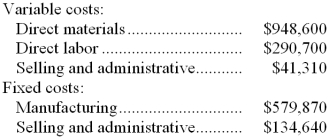 The company has just received a special one-time order for 900 trophies at $73 each. For this particular order, no variable selling and administrative costs would be incurred. This order would also have no effect on fixed costs.
Required:
Should the company accept this special order? Why?
The company has just received a special one-time order for 900 trophies at $73 each. For this particular order, no variable selling and administrative costs would be incurred. This order would also have no effect on fixed costs.
Required:
Should the company accept this special order? Why? (Essay)
4.7/5 (70)
(70) Part N19 is used by Malouf Corporation to make one of its products. A total of 7,000 units of this part are produced and used every year. The company's Accounting Department reports the following costs of producing the part at this level of activity:  An outside supplier has offered to make the part and sell it to the company for $24.50 each. If this offer is accepted, the supervisor's salary and all of the variable costs, including the direct labor, can be avoided. The special equipment used to make the part was purchased many years ago and has no salvage value or other use. The allocated general overhead represents fixed costs of the entire company, none of which would be avoided if the part were purchased instead of produced internally. In addition, the space used to make part N19 could be used to make more of one of the company's other products, generating an additional segment margin of $25,000 per year for that product. What would be the impact on the company's overall net operating income of buying part N19 from the outside supplier?
 (Multiple Choice)
5.0/5 (69)
(69) Tingstrom Inc. makes a range of products. The company's predetermined overhead rate is $20 per direct labor-hour, which was calculated using the following budgeted data:  Component B6 is used in one of the company's products. The unit cost of the component according to the company's cost accounting system is determined as follows:
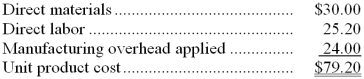 An outside supplier has offered to supply component B6 for $76 each. The outside supplier is known for quality and reliability. Assume that direct labor is a variable cost, variable manufacturing overhead is really driven by direct labor-hours, and total fixed manufacturing overhead would not be affected by this decision. Tingstrom chronically has idle capacity.
Required:
Is the offer from the outside supplier financially attractive? Why?
Component B6 is used in one of the company's products. The unit cost of the component according to the company's cost accounting system is determined as follows:
An outside supplier has offered to supply component B6 for $76 each. The outside supplier is known for quality and reliability. Assume that direct labor is a variable cost, variable manufacturing overhead is really driven by direct labor-hours, and total fixed manufacturing overhead would not be affected by this decision. Tingstrom chronically has idle capacity.
Required:
Is the offer from the outside supplier financially attractive? Why? (Essay)
5.0/5 (81)
(81) Elgot Company produces a single product. The cost of producing and selling a single unit of this product at the company's normal activity level of 30,000 units per month is as follows: The normal selling price of the product is $51.10 per unit.
An order has been received from an overseas customer for 3,000 units to be delivered this month at a special discounted price. This order would have no effect on the company's normal sales and would not change the total amount of the company's fixed costs. The variable selling and administrative expense would be $0.50 less per unit on this order than on normal sales.
Direct labor is a variable cost in this company.
-Suppose there is not enough idle capacity to produce all of the units for the overseas customer and accepting the special order would require cutting back on production of 1,200 units for regular customers. The minimum acceptable price per unit for the special order is closest to:
The normal selling price of the product is $51.10 per unit.
An order has been received from an overseas customer for 3,000 units to be delivered this month at a special discounted price. This order would have no effect on the company's normal sales and would not change the total amount of the company's fixed costs. The variable selling and administrative expense would be $0.50 less per unit on this order than on normal sales.
Direct labor is a variable cost in this company.
-Suppose there is not enough idle capacity to produce all of the units for the overseas customer and accepting the special order would require cutting back on production of 1,200 units for regular customers. The minimum acceptable price per unit for the special order is closest to: (Multiple Choice)
4.8/5 (71)
(71) Degner Inc. has some material that originally cost $19,500. The material has a scrap value of $13,300 as is, but if reworked at a cost of $2,100, it could be sold for $14,000. What would be the incremental effect on the company's overall profit of reworking and selling the material rather than selling it as is as scrap?
(Multiple Choice)
4.9/5 (77)
(77) Hobbins Corporation makes three products that use compound W, the current constrained resource. Data concerning those products appear below:  Rank the products in order of their current profitability from most profitable to least profitable. In other words, rank the products in the order in which they should be emphasized.
 (Multiple Choice)
4.9/5 (86)
(86) The following are the Wyeth Company's unit costs of making and selling an item at a volume of 10,000 units per month (which represents the company's capacity): 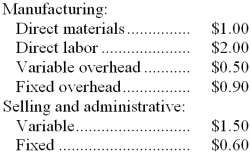 Present sales amount to 9,000 units per month. An order has been received from a customer in a foreign market for 1,000 units. The order would not affect current sales. Fixed costs, both manufacturing and selling and administrative, are constant within the relevant range between 8,000 and 10,000 units per month. The variable selling and administrative costs would have to be incurred for this special order as well as all other sales. Assume direct labor is a variable cost.
-Assume the company has 50 units left over from last year which have small defects and which will have to be sold at a reduced price as scrap. This would have no effect on the company's other sales. What cost is relevant as a guide for setting a minimum price on these defective units?
Present sales amount to 9,000 units per month. An order has been received from a customer in a foreign market for 1,000 units. The order would not affect current sales. Fixed costs, both manufacturing and selling and administrative, are constant within the relevant range between 8,000 and 10,000 units per month. The variable selling and administrative costs would have to be incurred for this special order as well as all other sales. Assume direct labor is a variable cost.
-Assume the company has 50 units left over from last year which have small defects and which will have to be sold at a reduced price as scrap. This would have no effect on the company's other sales. What cost is relevant as a guide for setting a minimum price on these defective units? (Multiple Choice)
4.9/5 (70)
(70) Veron Corporation purchases potatoes from farmers. The potatoes are then peeled, producing two intermediate products-peels and depeeled spuds. The peels can then be processed further to make a cocktail of organic nutrients. And the depeeled spuds can be processed further to make frozen french fries. A batch of potatoes costs $35 to buy from farmers and $19 to peel in the company's plant. The peels produced from a batch can be sold as is for animal feed for $24 or processed further for $14 to make the cocktail of nutrients that are sold for $48. The depeeled spuds can be sold as is for $34 or processed further for $29 to make frozen french fries that are sold for $55.
Required:
a. Assuming that no other costs are involved in processing potatoes or in selling products, how much money does the company make from processing one batch of potatoes into the cocktail of organic nutrients and frozen french fries? Show your work!
b. Should each of the intermediate products, peels and depeeled spuds, be sold as is or processed further into an end product? Explain.
(Essay)
4.9/5 (72)
(72) Rackett Corporation is considering two alternatives that are code-named M and N. Costs associated with the alternatives are listed below: 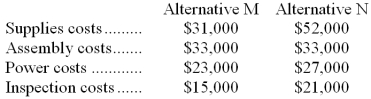 Required:
a. Which costs are relevant and which are not relevant in the choice between these two alternatives?
b. What is the differential cost between the two alternatives?
Required:
a. Which costs are relevant and which are not relevant in the choice between these two alternatives?
b. What is the differential cost between the two alternatives? (Essay)
4.8/5 (69)
(69) Julison Company produces a single product. The cost of producing and selling a single unit of this product at the company's normal activity level of 60,000 units per month is as follows: 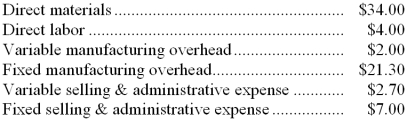 The normal selling price of the product is $79.80 per unit.
An order has been received from an overseas customer for 2,000 units to be delivered this month at a special discounted price. This order would have no effect on the company's normal sales and would not change the total amount of the company's fixed costs. The variable selling and administrative expense would be $0.30 less per unit on this order than on normal sales.
Direct labor is a variable cost in this company.
Required:
a. Suppose there is ample idle capacity to produce the units required by the overseas customer and the special discounted price on the special order is $71.60 per unit. By how much would this special order increase (decrease) the company's net operating income for the month?
b. Suppose the company is already operating at capacity when the special order is received from the overseas customer. What would be the opportunity cost of each unit delivered to the overseas customer?
c. Suppose there is not enough idle capacity to produce all of the units for the overseas customer and accepting the special order would require cutting back on production of 700 units for regular customers. What would be the minimum acceptable price per unit for the special order?
The normal selling price of the product is $79.80 per unit.
An order has been received from an overseas customer for 2,000 units to be delivered this month at a special discounted price. This order would have no effect on the company's normal sales and would not change the total amount of the company's fixed costs. The variable selling and administrative expense would be $0.30 less per unit on this order than on normal sales.
Direct labor is a variable cost in this company.
Required:
a. Suppose there is ample idle capacity to produce the units required by the overseas customer and the special discounted price on the special order is $71.60 per unit. By how much would this special order increase (decrease) the company's net operating income for the month?
b. Suppose the company is already operating at capacity when the special order is received from the overseas customer. What would be the opportunity cost of each unit delivered to the overseas customer?
c. Suppose there is not enough idle capacity to produce all of the units for the overseas customer and accepting the special order would require cutting back on production of 700 units for regular customers. What would be the minimum acceptable price per unit for the special order? (Essay)
4.9/5 (74)
(74) Tjelmeland Corporation is considering dropping product S85U. Data from the company's accounting system appear below:  All fixed expenses of the company are fully allocated to products in the company's accounting system. Further investigation has revealed that $55,000 of the fixed manufacturing expenses and $71,000 of the fixed selling and administrative expenses are avoidable if product S85U is discontinued.
Required:
a. According to the company's accounting system, what is the net operating income earned by product S85U? Show your work!
b. What would be the effect on the company's overall net operating income of dropping product S85U? Should the product be dropped? Show your work!
All fixed expenses of the company are fully allocated to products in the company's accounting system. Further investigation has revealed that $55,000 of the fixed manufacturing expenses and $71,000 of the fixed selling and administrative expenses are avoidable if product S85U is discontinued.
Required:
a. According to the company's accounting system, what is the net operating income earned by product S85U? Show your work!
b. What would be the effect on the company's overall net operating income of dropping product S85U? Should the product be dropped? Show your work! (Essay)
4.7/5 (85)
(85) The Clemson Company reported the following results last year for the manufacture and sale of one of its products known as a Tam.  Clemson Company is trying to determine whether or not to discontinue the manufacture and sale of Tams. The operating results reported above for last year are expected to continue in the foreseeable future if the product is not dropped. The fixed manufacturing overhead represents the costs of production facilities and equipment that the Tam product shares with other products produced by Clemson. If the Tax product were dropped, there would be no change in the fixed manufacturing costs of the company.
-Assume that discontinuing the Tam product would result in a $120,000 increase in the contribution margin of other product lines. How many Tams would have to be sold next year for the company to be as well off as if it just dropped the line and enjoyed the increase in contribution margin from other products?
Clemson Company is trying to determine whether or not to discontinue the manufacture and sale of Tams. The operating results reported above for last year are expected to continue in the foreseeable future if the product is not dropped. The fixed manufacturing overhead represents the costs of production facilities and equipment that the Tam product shares with other products produced by Clemson. If the Tax product were dropped, there would be no change in the fixed manufacturing costs of the company.
-Assume that discontinuing the Tam product would result in a $120,000 increase in the contribution margin of other product lines. How many Tams would have to be sold next year for the company to be as well off as if it just dropped the line and enjoyed the increase in contribution margin from other products? (Multiple Choice)
4.9/5 (70)
(70) Creelman Company makes four products in a single facility. Data concerning these products appear below:  The milling machines are potentially the constraint in the production facility. A total of 13,000 minutes are available per month on these machines.
-Which product makes the MOST profitable use of the milling machines?
The milling machines are potentially the constraint in the production facility. A total of 13,000 minutes are available per month on these machines.
-Which product makes the MOST profitable use of the milling machines? (Multiple Choice)
4.8/5 (81)
(81) Chrisjohn Beet Processors, Inc., processes sugar beets in batches. A batch of sugar beets costs $51 to buy from farmers and $16 to crush in the company's plant. Two intermediate products, beet fiber and beet juice, emerge from the crushing process. The beet fiber can be sold as is for $23 or processed further for $18 to make the end product industrial fiber that is sold for $47. The beet juice can be sold as is for $46 or processed further for $20 to make the end product refined sugar that is sold for $59. How much profit (loss) does the company make by processing the intermediate product beet juice into refined sugar rather than selling it as is?
(Multiple Choice)
4.9/5 (89)
(89) 
Filters
- Essay(0)
- Multiple Choice(0)
- Short Answer(0)
- True False(0)
- Matching(0)