



 Chat with AI
Exam 26: Capital Budgeting

Exam 1: Accounting: Information for Decision Making116 Questions
Exam 2: Basic Financial Statements115 Questions
Exam 3: The Accounting Cycle: Capturing Economic Events126 Questions
Exam 4: The Accounting Cycle: Accruals and Deferrals117 Questions
Exam 5: The Accounting Cycle: Reporting Financial Results111 Questions
Exam 6: Merchandising Activities122 Questions
Exam 7: Financial Assets182 Questions
Exam 8: Inventories and the Cost of Goods Sold120 Questions
Exam 9: Plant and Intangible Assets141 Questions
Exam 10: Liabilities143 Questions
Exam 11: Stockholders Equity: Paid-In Capital120 Questions
Exam 12: Income and Changes in Retained Earnings125 Questions
Exam 13: Statement of Cash Flows130 Questions
Exam 14: Financial Statement Analysis114 Questions
Exam 15: Global Business and Accounting78 Questions
Exam 16: Management Accounting: a Business Partner104 Questions
Exam 17: Job Order Cost Systems and Overhead Allocations94 Questions
Exam 18: Process Costing65 Questions
Exam 19: Costing and the Value Chain62 Questions
Exam 20: Cost-Volume-Profit Analysis88 Questions
Exam 21: Incremental Analysis70 Questions
Exam 22: Responsibility Accounting and Transfer Pricing72 Questions
Exam 23: Operational Budgeting79 Questions
Exam 24: Standard Cost Systems91 Questions
Exam 25: Rewarding Business Performance53 Questions
Exam 26: Capital Budgeting74 Questions
Exam 27: Forms of Business Organization52 Questions
Exam 28: The Time Value of Money: Future Amounts and Present Values50 Questions
Select questions type


The minimum rate of return used by an investor to bring future cash flows to their present value is called:
(Multiple Choice)
4.9/5  (85)
(85) Kenny Company is considering the possibility of investing $1,500,000 in a special project.This venture will return $375,000 per year for 12 years in after tax cash flows.Depreciation on the project will be $187,500 per year using straight-line depreciation.The payback period for the project is:
(Multiple Choice)
4.9/5 (69)
(69) Capital budget audit
Briefly discuss the reasons that a company's management would conduct a regular capital budget audit.
(Essay)
4.8/5 (78)
(78) Jericho Corporation is considering the purchase of new equipment costing initially $96,000.The equipment has an estimated life of 6 years with no salvage value.Straight-line depreciation is to be used.Net annual after tax cash flow is estimated to be $31,200 for 6 years.The payback period is:
(Multiple Choice)
4.8/5 (82)
(82) Capital budgeting
Zhang Corporation is considering investing $190,000 in equipment to produce a new product.Useful service life of the equipment is estimated to be 5 years,with zero salvage value.Straight-line depreciation is used.The company estimates that production and sale of the new product will increase net income by $65,000 a year.(Round your years and percentage answers to one decimal place.)
(a)The payback period will be __________ years.
(b)The expected rate of return on average investment will be __________.
(Short Answer)
4.8/5 (75)
(75) The return on average investment computation ignores the timing of an investment's future cash flows.
(True/False)
4.9/5 (75)
(75) The management of Trylon Farms is considering the purchase of equipment costing $320,000.The equipment has a useful life of eight years,with $20,000 residual value.The use of this equipment will produce positive annual cash flow of $60,000 for eight years,as well as $20,000 from sale of the equipment at the end of the eighth year.Compute the net present value of this investment,discounted at an annual rate of 10%.(Present value of $1 due in eight years,discounted at 10%,is 0.467; present value of $1 received annually for eight years,discounted at 10%,is 5.335.)
(Multiple Choice)
4.8/5 (81)
(81) The shortcomings of the payback method
What are the major shortcomings of relying too heavily upon the payback period in evaluating capital investment decisions?
(Essay)
4.8/5 (84)
(84) The payback period analysis fails to consider the cash flows over the entire life of the investment.
(True/False)
4.7/5 (79)
(79) Capital budgeting
Mason Co.is evaluating two alternative investment proposals.Below are data for each proposal: 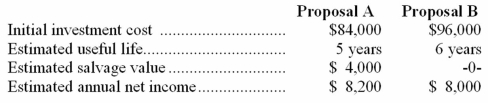 The following information was taken from present value tables:
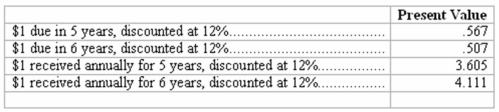 All revenue and expenses other than depreciation will be received and paid in cash.The company uses a discount rate of 12% in evaluating all capital investments.
Compute the following for each proposal (round payback period to the nearest tenth of a year and round return on average investment to the nearest tenth of a percent):
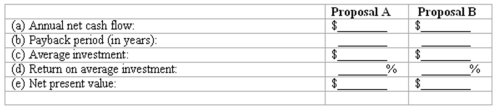 (f)Based on your analysis,which proposal appears to be the best investment?
The following information was taken from present value tables: All revenue and expenses other than depreciation will be received and paid in cash.The company uses a discount rate of 12% in evaluating all capital investments.
Compute the following for each proposal (round payback period to the nearest tenth of a year and round return on average investment to the nearest tenth of a percent): (f)Based on your analysis,which proposal appears to be the best investment? (Essay)
4.8/5 (68)
(68) An investment cost $80,000 with no salvage value,a 5 year useful life,and had an expected annual increase in net income of $7,000.Straight line depreciation is used.What is the expected return on average investment?
(Multiple Choice)
4.9/5 (77)
(77) If an investment costs $140,000 with no residual value,an expected increase in net income of $35,000 and a 5 year useful life,the payback period would be:
(Multiple Choice)
4.9/5 (83)
(83) Discounting cash flows
Determine the present value of the following cash flows discounted at an annual rate of 10%:
(a)$96,000 to be received five years from today (the present value of $1 at a 10% compound interest rate for five years is 0.621): $__________
(b)$37,000 to be received annually for five years (the present value of $1 at 10% received annually for five years is 3.791): $__________
(c)$58,000 to be received annually for six years,with an additional $16,000 salvage value to be received at the end of the sixth year (the present value of $1 at 10% received annually for six years is 4.355,and the present value of $1 due six years hence at 10% is 0.564): $__________
(Short Answer)
4.9/5 (86)
(86) 
Filters
- Essay(0)
- Multiple Choice(0)
- Short Answer(0)
- True False(0)
- Matching(0)