



 Chat with AI
Exam 25: Rewarding Business Performance

Exam 1: Accounting: Information for Decision Making116 Questions
Exam 2: Basic Financial Statements115 Questions
Exam 3: The Accounting Cycle: Capturing Economic Events126 Questions
Exam 4: The Accounting Cycle: Accruals and Deferrals117 Questions
Exam 5: The Accounting Cycle: Reporting Financial Results111 Questions
Exam 6: Merchandising Activities122 Questions
Exam 7: Financial Assets182 Questions
Exam 8: Inventories and the Cost of Goods Sold120 Questions
Exam 9: Plant and Intangible Assets141 Questions
Exam 10: Liabilities143 Questions
Exam 11: Stockholders Equity: Paid-In Capital120 Questions
Exam 12: Income and Changes in Retained Earnings125 Questions
Exam 13: Statement of Cash Flows130 Questions
Exam 14: Financial Statement Analysis114 Questions
Exam 15: Global Business and Accounting78 Questions
Exam 16: Management Accounting: a Business Partner104 Questions
Exam 17: Job Order Cost Systems and Overhead Allocations94 Questions
Exam 18: Process Costing65 Questions
Exam 19: Costing and the Value Chain62 Questions
Exam 20: Cost-Volume-Profit Analysis88 Questions
Exam 21: Incremental Analysis70 Questions
Exam 22: Responsibility Accounting and Transfer Pricing72 Questions
Exam 23: Operational Budgeting79 Questions
Exam 24: Standard Cost Systems91 Questions
Exam 25: Rewarding Business Performance53 Questions
Exam 26: Capital Budgeting74 Questions
Exam 27: Forms of Business Organization52 Questions
Exam 28: The Time Value of Money: Future Amounts and Present Values50 Questions
Select questions type


Most organizations try to achieve their goals by providing incentives to employees who use resources wisely.

Free
(True/False)
4.8/5  (79)
(79) Correct Answer: Verified
True
Identify and explain the components of management compensation and the tradeoffs that compensation designers make.
Free
(Essay)
4.7/5 (84)
(84) Correct Answer:Verified
VerifiedIn creating management compensation plans,designers consider multiple characteristics such as fixed salary versus bonuses and the type of bonuses (cash,stock or stock options,for example).In addition,numerous design trade-offs are available such as choices related to the time horizon over which compensation is available,choosing to emphasize local versus global performance,or choosing a cooperative or a competitive incentive scheme.
Listed below are eight accounting terms introduced or emphasized in this chapter:  Each of the following statements may (or may not)describe one of these technical terms.In the space provided,indicate the accounting term described,or answer "none" if the statement does not correctly describe any of the terms.
(a)_______ is the amount by which operating earnings exceeds a minimum acceptable return on the average invested capital.The minimum rate of return represents the opportunity cost of using the invested capital.
(b)______ is the operating income divided by the average invested capital associated with the generation of that income.
(c)_______ is computed by dividing the operating income by the total sales for a particular business segment or product line.It tells managers the amount of earnings generated from a dollar of sales.
(d)_______ give an employee the right to purchase a pre-specified number of shares at a pre-specified price within a certain future time period.They provide incentives for managers to increase stock prices.
(e)_______ is the set of activities necessary to create and distribute a desirable product or service to a customer.
(f)_______ is a specific type of residual income.It is computed by multiplying weighted average cost of capital by total assets minus current liabilities,and subtracting that product from the after-tax operating income.
(g)_______ is a measure created by dividing sales by the average invested capital to generate those sales.It tells managers the amount of sales generated by a dollar of invested capital.
(h)_______ is a system for performance measurement that links a company's strategy to specific goals,assesses progress towards those goals,and measures specific initiatives to achieve those goals.It is a systematic attempt to create a business performance measurement process that integrates objectives across four business lenses to achieve the organization's strategic goals.
Each of the following statements may (or may not)describe one of these technical terms.In the space provided,indicate the accounting term described,or answer "none" if the statement does not correctly describe any of the terms.
(a)_______ is the amount by which operating earnings exceeds a minimum acceptable return on the average invested capital.The minimum rate of return represents the opportunity cost of using the invested capital.
(b)______ is the operating income divided by the average invested capital associated with the generation of that income.
(c)_______ is computed by dividing the operating income by the total sales for a particular business segment or product line.It tells managers the amount of earnings generated from a dollar of sales.
(d)_______ give an employee the right to purchase a pre-specified number of shares at a pre-specified price within a certain future time period.They provide incentives for managers to increase stock prices.
(e)_______ is the set of activities necessary to create and distribute a desirable product or service to a customer.
(f)_______ is a specific type of residual income.It is computed by multiplying weighted average cost of capital by total assets minus current liabilities,and subtracting that product from the after-tax operating income.
(g)_______ is a measure created by dividing sales by the average invested capital to generate those sales.It tells managers the amount of sales generated by a dollar of invested capital.
(h)_______ is a system for performance measurement that links a company's strategy to specific goals,assesses progress towards those goals,and measures specific initiatives to achieve those goals.It is a systematic attempt to create a business performance measurement process that integrates objectives across four business lenses to achieve the organization's strategic goals.Free
(Essay)
4.8/5 (77)
(77) Correct Answer:Verified
Verified(a)Residual income (b)Return on investment (c)Return on sales (d)Stock options (e)Value chain (f)Economic value added (g)Capital turnover (h)Balanced scorecard
Residual income is calculated by subtracting the minimum acceptable return on the average invested capital from the operating income.
(True/False)
5.0/5 (81)
(81) Capital turnover can be improved by reducing invested capital while keeping sales constant.
(True/False)
4.8/5 (81)
(81) The following information is available for the Hancock Company. 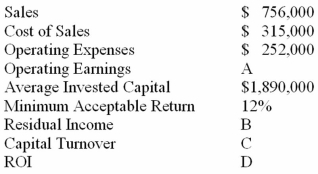 Compute the answers for items A-D.
 (Short Answer)
4.7/5 (84)
(84) The value chain usually starts with the _________ and ends with the ____________.
(Multiple Choice)
4.9/5 (65)
(65) Which of the following is not one of the strategies of the financial perspective lens of the balanced scorecard?
(Multiple Choice)
4.8/5 (77)
(77) Which of the following is not one of the balanced scorecard lenses?
(Multiple Choice)
4.9/5 (81)
(81) The balanced scorecard approach attempts to measure whether an organization is meeting its strategic goals.
(True/False)
4.8/5 (81)
(81) Operating earnings rather than net income is used to compute return on sales.
(True/False)
4.9/5 (80)
(80) Explain the importance of incentive systems for motivating performance.
(Essay)
4.9/5 (74)
(74) Stock based performance evaluation of managers is considered more risky than accounting based performance evaluation.
(True/False)
5.0/5 (78)
(78) The Lastrom Company provided the following information regarding its operations: 2014 Total assets $750,000
2015 Total assets $800,000
2014 Net operating income $1,875,000
2015 Net operating income $1,925,000
2014 Net sales $4,525,000
2015 Net sales $5,100,000
What is Lastrom's ROI for the year ending 2015?
(Multiple Choice)
4.8/5 (87)
(87) Capital turnover is equal to sales divided by average invested capital.
(True/False)
4.8/5 (85)
(85) Which of the following is not a measure used by the financial perspective lens of the balanced scorecard?
(Multiple Choice)
4.9/5 (74)
(74) Which ratio tells managers about how the invested capital is generating sales dollars?
(Multiple Choice)
4.8/5 (85)
(85) 
Filters
- Essay(0)
- Multiple Choice(0)
- Short Answer(0)
- True False(0)
- Matching(0)