



 Chat with AI
Exam 26: Capital Budgeting

Exam 1: Accounting: Information for Decision Making116 Questions
Exam 2: Basic Financial Statements115 Questions
Exam 3: The Accounting Cycle: Capturing Economic Events126 Questions
Exam 4: The Accounting Cycle: Accruals and Deferrals117 Questions
Exam 5: The Accounting Cycle: Reporting Financial Results111 Questions
Exam 6: Merchandising Activities122 Questions
Exam 7: Financial Assets182 Questions
Exam 8: Inventories and the Cost of Goods Sold120 Questions
Exam 9: Plant and Intangible Assets141 Questions
Exam 10: Liabilities143 Questions
Exam 11: Stockholders Equity: Paid-In Capital120 Questions
Exam 12: Income and Changes in Retained Earnings125 Questions
Exam 13: Statement of Cash Flows130 Questions
Exam 14: Financial Statement Analysis114 Questions
Exam 15: Global Business and Accounting78 Questions
Exam 16: Management Accounting: a Business Partner104 Questions
Exam 17: Job Order Cost Systems and Overhead Allocations94 Questions
Exam 18: Process Costing65 Questions
Exam 19: Costing and the Value Chain62 Questions
Exam 20: Cost-Volume-Profit Analysis88 Questions
Exam 21: Incremental Analysis70 Questions
Exam 22: Responsibility Accounting and Transfer Pricing72 Questions
Exam 23: Operational Budgeting79 Questions
Exam 24: Standard Cost Systems91 Questions
Exam 25: Rewarding Business Performance53 Questions
Exam 26: Capital Budgeting74 Questions
Exam 27: Forms of Business Organization52 Questions
Exam 28: The Time Value of Money: Future Amounts and Present Values50 Questions
Select questions type


A cost that has been incurred irrevocably by past actions is a (an):
(Multiple Choice)
4.7/5  (75)
(75) Which of the following is not considered a capital investment?
(Multiple Choice)
4.9/5 (70)
(70) Carter & Co.is trying to decide which of two investments they should consider.The following information is available: 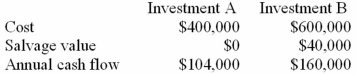 Each investment is expected to have a useful life of 5 years.(Rounded)
(a)What is the rate of return on average investment of each investment?
(b)What is the payback period of each investment?
Each investment is expected to have a useful life of 5 years.(Rounded)
(a)What is the rate of return on average investment of each investment?
(b)What is the payback period of each investment? (Essay)
4.8/5 (90)
(90) Capital investment proposals may not be evaluated by using:
(Multiple Choice)
4.7/5 (88)
(88) Capital budgeting
Carry-Along is debating whether or not to invest in new equipment to manufacture a line of high-quality luggage.The new equipment would cost $850,000,with an estimated four-year life and no salvage value.The estimated annual operating results with the new equipment are as follows:  All revenue from the new luggage line and all expenses (except depreciation)will be received or paid in cash in the same period as recognized for accounting purposes.You are to compute the following for the investment in the new equipment to produce the new luggage line: (rounded)
(a)Annual cash flow: $__________
(b)Payback period: __________
(c)Return on average investment: __________%
(d)Total present value of the expected future annual cash flows,discounted at an annual rate of 12% (an annuity table shows that the present value of $1 received annually for four years discounted at 12% is 3.037): $__________
(e)Net present value of the proposed investment: $__________
All revenue from the new luggage line and all expenses (except depreciation)will be received or paid in cash in the same period as recognized for accounting purposes.You are to compute the following for the investment in the new equipment to produce the new luggage line: (rounded)
(a)Annual cash flow: $__________
(b)Payback period: __________
(c)Return on average investment: __________%
(d)Total present value of the expected future annual cash flows,discounted at an annual rate of 12% (an annuity table shows that the present value of $1 received annually for four years discounted at 12% is 3.037): $__________
(e)Net present value of the proposed investment: $__________ (Essay)
4.9/5 (69)
(69) In considering investment in new plant assets,the payback period is computed without regard to the total useful life of the investment.
(True/False)
4.7/5 (81)
(81) When management considers an investment,they look for the payback period to be:
(Multiple Choice)
4.9/5 (75)
(75) The residual value of an asset should be subtracted from the cost of the asset when determining the average amount invested.
(True/False)
4.9/5 (82)
(82) Which of the following is generally not considered a capital budgeting technique?
(Multiple Choice)
4.9/5 (84)
(84) When the net present value is greater than zero,the investment's rate of return is less than the discount rate.
(True/False)
4.9/5 (76)
(76) The discount rate used in discounting cash flows from proposed investments is usually the rate of return required by the investor.
(True/False)
4.9/5 (84)
(84) Most capital budgeting techniques involve analysis of net operating profits.
(True/False)
4.9/5 (83)
(83) The difference between the present value and future value depends on the rate of interest and the length of time that interest accumulates.
(True/False)
4.9/5 (71)
(71) Which method of project selection gives consideration to the time value of money in a capital budgeting decision?
(Multiple Choice)
4.9/5 (84)
(84) In computing the return on average investment of a particular asset,the asset's annual depreciation expense may be viewed as:
(Multiple Choice)
4.9/5 (76)
(76) The payback period considers total profitability over the life of an investment and takes into consideration the timing of an investment's future cash flows.
(True/False)
4.7/5 (77)
(77) The impact of a capital budgeting decision upon the environment is an example of a nonfinancial consideration.
(True/False)
4.8/5 (71)
(71) Capital budgeting computations
A project costing $80,000 has an estimated life of 3 years and no salvage value.The estimated net income and net after tax cash flows from the project are as follows: 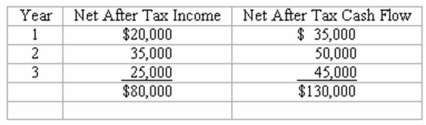 The company's minimum desired rate of return for discounted cash flow analysis is 10%.The present value of $1 at compound interest of 10% at 1,2,and 3 years is 0.909,0.826,and 0.751 respectively.The present value of a $1 annuity for three years at 10% is 2.487.The company uses straight-line depreciation.
Compute
(a)Net present value of the project _________________________.
(b)The rate of return on average investment __________________.(rounded)
Calculations
The company's minimum desired rate of return for discounted cash flow analysis is 10%.The present value of $1 at compound interest of 10% at 1,2,and 3 years is 0.909,0.826,and 0.751 respectively.The present value of a $1 annuity for three years at 10% is 2.487.The company uses straight-line depreciation.
Compute
(a)Net present value of the project _________________________.
(b)The rate of return on average investment __________________.(rounded)
Calculations (Short Answer)
4.9/5 (81)
(81) To compute a future amount from a present value,we need to know:
(Multiple Choice)
4.9/5 (81)
(81) 
Filters
- Essay(0)
- Multiple Choice(0)
- Short Answer(0)
- True False(0)
- Matching(0)