



 Chat with AI
Exam 2: Derivatives

Exam 1: Functions and Limits117 Questions
Exam 2: Derivatives151 Questions
Exam 3: Applications of Differentiation153 Questions
Exam 4: Integrals95 Questions
Exam 5: Applications of Integration120 Questions
Exam 6: Inverse Functions127 Questions
Exam 7: Techniques of Integration124 Questions
Exam 8: Further Applications of Integration86 Questions
Exam 9: Differential Equations67 Questions
Exam 10: Parametric Equations and Polar Coordinates72 Questions
Exam 11: Infinite Sequences and Series158 Questions
Exam 12: Vectors and the Geometry of Space60 Questions
Exam 13: Vector Functions93 Questions
Exam 14: Partial Derivatives132 Questions
Exam 15: Multiple Integrals124 Questions
Exam 16: Vector Calculus137 Questions
Exam 17: Second-Order Differential Equations63 Questions
Exam 18: Final Exam44 Questions
Select questions type


Find the differential of the function at the indicated number. 
(Multiple Choice)
4.9/5  (77)
(77) Find equations of the tangent lines to the curve  that are parallel to the line
 .
that are parallel to the line . (Multiple Choice)
4.8/5 (83)
(83) The sides of a square baseball diamond are 90 ft long. When a player who is between the second and third base is 30 ft from second base and heading toward third base at a speed of 24 ft/sec, how fast is the distance between the player and home plate changing? Round to two decimal places. 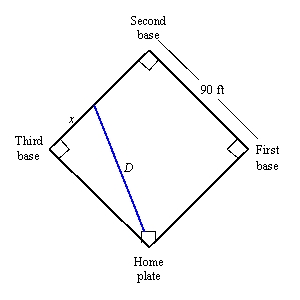
(Short Answer)
4.9/5 (92)
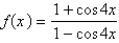
(92) 
The altitude of a triangle is increasing at a rate of  while the area of the triangle is increasing at a rate of
 . At what rate is the base of the triangle changing when the altitude is 10 cm and the area is
 .
while the area of the triangle is increasing at a rate of . At what rate is the base of the triangle changing when the altitude is 10 cm and the area is . (Essay)
4.9/5 (83)
(83)  by implicit differentiation.
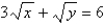
In this exercise we estimate the rate at which the total personal income is rising in the Richmond- Petersburg, Virginia, metropolitan area. In 1999, the population of this area was 961,600, and the population was increasing at roughly 9,400 people per year. The average annual income was $30,591 per capita, and this average was increasing at about $1,300 per year (a little above the national average of about $1,225 yearly). Use the Product Rule and these figures to estimate the rate at which total personal income was rising in the Richmond-Petersburg area in 1999.
(Short Answer)
4.8/5 (77)
(77) Find the derivative of the function and evaluate  at the given value of x.

at the given value of x. (Short Answer)
4.9/5 (75)
(75) Use implicit differentiation to find an equation of the tangent line to the curve at the indicated point. y = sin xy7; 
(Multiple Choice)
4.8/5 (74)
(74) Two sides of a triangle are  m and
 m in length and the angle between them is increasing at a rate of
 rad/s. Find the rate at which the area of the triangle is increasing when the angle between the sides of fixed length is /3 .
m and m in length and the angle between them is increasing at a rate of rad/s. Find the rate at which the area of the triangle is increasing when the angle between the sides of fixed length is /3 . (Multiple Choice)
4.8/5 (79)
(79) 
Identify the "inside function" u = f (x) and the "outside function" y = g (u). Then find dy/dx using the Chain Rule. 
(Essay)
4.9/5 (69)
(69)  Find

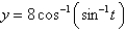
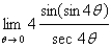
The position function of a body moving along a coordinate line is
s(t) = 3 sin t + 4 cos t
where t is measured in seconds and s(t) in feet. Find the position, velocity, speed, and acceleration of the body when t =  .
. (Essay)
4.9/5 (88)
(88) 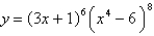
Use the table to estimate the value of  , where
 and
 .
 10
10.1
10.2
10.3
10.4
10.5
10.6
 4.5
 5.6
4.3
2.5
9.9
7.8
 6.5
5.9
4.7
4.2
5.4
 6.3
, where and . 10
10.1
10.2
10.3
10.4
10.5
10.6 4.5 5.6
4.3
2.5
9.9
7.8 6.5
5.9
4.7
4.2
5.4 6.3 (Essay)
4.8/5 (91)
(91) Two curves are said to be orthogonal if their tangent lines are perpendicular at each point of intersection of the curves. Show that the curves of the given equations are orthogonal.
y -  x =
 x =
 cos y
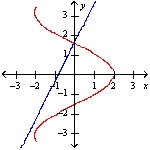
x = x = cos y (Essay)
4.9/5 (90)
(90) 
Filters
- Essay(0)
- Multiple Choice(0)
- Short Answer(0)
- True False(0)
- Matching(0)