



 Chat with AI
Exam 14: Partial Derivatives

Exam 1: Functions and Limits117 Questions
Exam 2: Derivatives151 Questions
Exam 3: Applications of Differentiation153 Questions
Exam 4: Integrals95 Questions
Exam 5: Applications of Integration120 Questions
Exam 6: Inverse Functions127 Questions
Exam 7: Techniques of Integration124 Questions
Exam 8: Further Applications of Integration86 Questions
Exam 9: Differential Equations67 Questions
Exam 10: Parametric Equations and Polar Coordinates72 Questions
Exam 11: Infinite Sequences and Series158 Questions
Exam 12: Vectors and the Geometry of Space60 Questions
Exam 13: Vector Functions93 Questions
Exam 14: Partial Derivatives132 Questions
Exam 15: Multiple Integrals124 Questions
Exam 16: Vector Calculus137 Questions
Exam 17: Second-Order Differential Equations63 Questions
Exam 18: Final Exam44 Questions
Select questions type


 where
 .



Find the gradient of the function 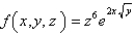 .
.
Free
(Multiple Choice)
4.8/5  (89)
(89) Correct Answer: Verified
D
A boundary stripe 2 in. wide is painted around a rectangle whose dimensions are 100 ft by 240 ft. Use differentials to approximate the number of square feet of paint in the stripe.
Free
(Multiple Choice)
4.9/5 (86)
(86) Correct Answer:Verified
VerifiedB
Suppose (1, 1) is a critical point of a function f with continuous second derivatives. In the case of  ,
 ,
 what can you say about f ?
, , what can you say about f ? (Multiple Choice)
5.0/5 (81)
(81) The wind-chill index I is the perceived temperature when the actual temperature is T and the wind speed is v so we can write  . The following table of values is an excerpt from a table compiled by the National Atmospheric and Oceanic Administration. Use the table to find a linear approximation
 to the wind chill index function when T is near
 and v is near 30 kmh.
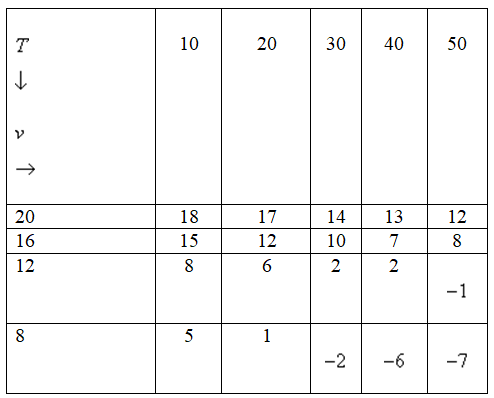
. The following table of values is an excerpt from a table compiled by the National Atmospheric and Oceanic Administration. Use the table to find a linear approximation to the wind chill index function when T is near and v is near 30 kmh. (Essay)
4.7/5 (83)
(83) 

The radius of a right circular cone is increasing at a rate of 5 in/s while its height is decreasing at a rate of 3.6 in/s. At what rate is the volume of the cone changing when the radius is  in. and the height is
 in.?
in. and the height is in.? (Multiple Choice)
4.8/5 (88)
(88) Find the linearization L(x, y) of the function at the given point.  Round the answers to the nearest hundredth.
 (Essay)
4.8/5 (100)
(100)  for the function


Find the dimensions of the rectangular box with largest volume if the total surface area is given as 
 .
. (Multiple Choice)
5.0/5 (81)
(81) Find three positive numbers whose sum is  and whose product is a maximum.
 (Multiple Choice)
4.9/5 (86)
(86) 
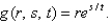 Find


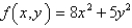
Use Lagrange multipliers to find the minimum value of the function subject to the given constraints. 
(Essay)
4.8/5 (81)
(81) Find the absolute minimum value of the function  on the set D. D is the region bounded by the parabola
 and the line

on the set D. D is the region bounded by the parabola and the line (Multiple Choice)
4.8/5 (76)
(76) The length l, width w and height h of a box change with time. At a certain instant the dimensions are  and
 , and l and w are increasing at a rate of 10 m/s while h is decreasing at a rate of 1 m/s. At that instant find the rates at which the surface area is changing.
and , and l and w are increasing at a rate of 10 m/s while h is decreasing at a rate of 1 m/s. At that instant find the rates at which the surface area is changing. (Essay)
4.8/5 (85)
(85)  Find


Filters
- Essay(0)
- Multiple Choice(0)
- Short Answer(0)
- True False(0)
- Matching(0)