



 Chat with AI
Exam 7: The Birth and Evolution of Planetary Systems

Exam 1: Why Learn Astronomy92 Questions
Exam 2: Patterns in the Skymotions of Earth96 Questions
Exam 3: Motion of Astronomical Bodies91 Questions
Exam 4: Gravity and Orbits88 Questions
Exam 5: Light87 Questions
Exam 6: The Tools of the Astronomer94 Questions
Exam 7: The Birth and Evolution of Planetary Systems87 Questions
Exam 8: The Terrestrial Planets and Earths Moon99 Questions
Exam 9: Atmospheres of the Terrestrial Planets92 Questions
Exam 10: Worlds of Gas and Liquid the Giant Planets92 Questions
Exam 11: Planetary Adornmentsmoons and Rings93 Questions
Exam 12: Dwarf Planets and Small Solar System Bodies89 Questions
Exam 13: Taking the Measure of Stars88 Questions
Exam 14: Our Starthe Sun88 Questions
Exam 15: Star Formation and the Interstellar Medium89 Questions
Exam 16: Evolution of Low-Mass Stars90 Questions
Exam 17: Evolution of High-Mass Stars90 Questions
Exam 18: Relativity and Black Holes90 Questions
Exam 19: The Expanding Universe90 Questions
Exam 20: Galaxies95 Questions
Exam 21: The Milky Waya Normal Spiral Galaxy96 Questions
Exam 22: Modern Cosmology92 Questions
Exam 23: Large-Scale Structure in the Universe65 Questions
Exam 24: Life61 Questions
Select questions type


Earth-sized planets have been found using the _________ method(s).
(Multiple Choice)
4.8/5  (90)
(90) Which of the following is NOT considered evidence of cataclysmic impacts in the history of our Solar System?
(Multiple Choice)
4.9/5 (90)
(90) Why have astronomers using the radial velocity method found more Jupiter-sized planets at a distance of 1 AU around other stars than Earth-sized planets?
(Multiple Choice)
5.0/5 (72)
(72) Approximately how massive are most of the extra-solar planets that have been discovered using the Doppler effect, and which planet in our solar system is similar in mass? Why is the Doppler effect method more likely to find massive (rather than low-mass) planets and planets that are close to their stars?
(Essay)
4.9/5 (81)
(81) Based on the figure shown below, which planet(s) is (are) most likely to have the largest fraction of its (their) mass made of highly volatile materials such as methane and ammonia? 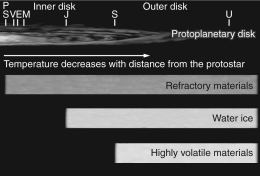
(Multiple Choice)
4.8/5 (91)
(91) Consider a small parcel of gas in the cloud out of which the Sun formed that was initially located in the accretion disk at a distance of 10 AU from the Sun and rotating around it with a speed of 10 km/s. If this parcel of gas eventually found its way to a distance of 1 AU from the Sun without changing its orbital angular momentum, then what would be its new rotation speed?
(Multiple Choice)
4.8/5 (80)
(80) 
Filters
- Essay(0)
- Multiple Choice(0)
- Short Answer(0)
- True False(0)
- Matching(0)