



 Chat with AI
Exam 7: The Birth and Evolution of Planetary Systems

Exam 1: Why Learn Astronomy92 Questions
Exam 2: Patterns in the Skymotions of Earth96 Questions
Exam 3: Motion of Astronomical Bodies91 Questions
Exam 4: Gravity and Orbits88 Questions
Exam 5: Light87 Questions
Exam 6: The Tools of the Astronomer94 Questions
Exam 7: The Birth and Evolution of Planetary Systems87 Questions
Exam 8: The Terrestrial Planets and Earths Moon99 Questions
Exam 9: Atmospheres of the Terrestrial Planets92 Questions
Exam 10: Worlds of Gas and Liquid the Giant Planets92 Questions
Exam 11: Planetary Adornmentsmoons and Rings93 Questions
Exam 12: Dwarf Planets and Small Solar System Bodies89 Questions
Exam 13: Taking the Measure of Stars88 Questions
Exam 14: Our Starthe Sun88 Questions
Exam 15: Star Formation and the Interstellar Medium89 Questions
Exam 16: Evolution of Low-Mass Stars90 Questions
Exam 17: Evolution of High-Mass Stars90 Questions
Exam 18: Relativity and Black Holes90 Questions
Exam 19: The Expanding Universe90 Questions
Exam 20: Galaxies95 Questions
Exam 21: The Milky Waya Normal Spiral Galaxy96 Questions
Exam 22: Modern Cosmology92 Questions
Exam 23: Large-Scale Structure in the Universe65 Questions
Exam 24: Life61 Questions
Select questions type


Explain the two primary reasons why the inner solar nebula was hotter than the outer solar nebula.
(Essay)
4.8/5  (68)
(68) When you push your palms together and rub them back and forth, you are demonstrating one way of converting _________ energy into _________ energy.
(Multiple Choice)
4.8/5 (74)
(74) Two competing models of the formation of giant gaseous planets suggest they form either from gas accreting onto a rocky core or from:
(Multiple Choice)
4.8/5 (80)
(80) Consider four spheres of equal mass and size. Which has the most potential energy?
(Multiple Choice)
4.9/5 (82)
(82) Explain why astronomers believe that the formation of planets is a natural by-product of star formation.
(Essay)
4.8/5 (82)
(82) When astronomers began searching for extrasolar planets, they were surprised to discover Jupiter-sized planets much closer than 1 AU from their parent stars. Why is this surprising?
(Multiple Choice)
4.9/5 (94)
(94) What is the most important factor in determining whether or not a planet will be rocky like terrestrial planets or gaseous like giant planets?
(Multiple Choice)
4.9/5 (72)
(72) If an interstellar cloud having a diameter of 1016 m and a rotation period of a million years were to collapse to form a sphere that had the diameter of our Solar System, approximately 40 AU, what would its rotation period be? Assume the cloud's total mass and angular momentum did not change.
(Multiple Choice)
4.8/5 (87)
(87) Astronomers believe that the "hot Jupiters" found orbiting other stars must have migrated inward over time:
(Multiple Choice)
4.8/5 (81)
(81) Compare the orbital angular momentum of the Earth and Jupiter. Which is larger and by how much? (Note that Jupiter's mass is 318 times that of the Earth; the semimajor axis of Jupiter's orbit is 5.2 AU; and Jupiter's orbital period is 12 years.)
(Essay)
4.8/5 (80)
(80) Briefly explain the four different observational methods we use to detect extrasolar planets. Which has detected the largest number of extrasolar planets to date?
(Essay)
4.8/5 (76)
(76) Explain why most of the extrasolar planets that astronomers first detected were so-called "hot Jupiters."
(Essay)
4.9/5 (66)
(66) Hundreds of extrasolar planets have been detected by direct imaging of the planets.
(True/False)
4.7/5 (83)
(83) What property of an extrasolar planet can be determined directly from the Doppler effect data shown in the figure below? What other properties of the planet can then be determined? 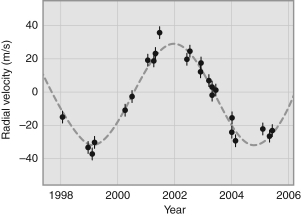
(Essay)
4.9/5 (68)
(68) Explain how astronomers use the Doppler effect to detect the presence of extrasolar planets.
(Essay)
4.8/5 (74)
(74) How did the formation of our Moon differ from the formation of the Galilean moons of Jupiter?
(Essay)
4.9/5 (75)
(75) 
Filters
- Essay(0)
- Multiple Choice(0)
- Short Answer(0)
- True False(0)
- Matching(0)