



 Chat with AI
Exam 7: The Birth and Evolution of Planetary Systems

Exam 1: Why Learn Astronomy92 Questions
Exam 2: Patterns in the Skymotions of Earth96 Questions
Exam 3: Motion of Astronomical Bodies91 Questions
Exam 4: Gravity and Orbits88 Questions
Exam 5: Light87 Questions
Exam 6: The Tools of the Astronomer94 Questions
Exam 7: The Birth and Evolution of Planetary Systems87 Questions
Exam 8: The Terrestrial Planets and Earths Moon99 Questions
Exam 9: Atmospheres of the Terrestrial Planets92 Questions
Exam 10: Worlds of Gas and Liquid the Giant Planets92 Questions
Exam 11: Planetary Adornmentsmoons and Rings93 Questions
Exam 12: Dwarf Planets and Small Solar System Bodies89 Questions
Exam 13: Taking the Measure of Stars88 Questions
Exam 14: Our Starthe Sun88 Questions
Exam 15: Star Formation and the Interstellar Medium89 Questions
Exam 16: Evolution of Low-Mass Stars90 Questions
Exam 17: Evolution of High-Mass Stars90 Questions
Exam 18: Relativity and Black Holes90 Questions
Exam 19: The Expanding Universe90 Questions
Exam 20: Galaxies95 Questions
Exam 21: The Milky Waya Normal Spiral Galaxy96 Questions
Exam 22: Modern Cosmology92 Questions
Exam 23: Large-Scale Structure in the Universe65 Questions
Exam 24: Life61 Questions
Select questions type


Consider the figure shown below. At which point in time does the collapsing cloud have the greatest angular momentum? 
(Multiple Choice)
4.7/5  (76)
(76) 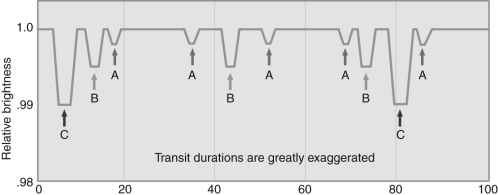 Figure 2
-In Figure 2, which of the dips in the brightness of the star are caused by the transit of the planet with the largest orbital period?
Figure 2
-In Figure 2, which of the dips in the brightness of the star are caused by the transit of the planet with the largest orbital period? (Multiple Choice)
4.9/5 (76)
(76) Why might a newly discovered comet contain clues to the composition of the early solar nebula?
(Essay)
4.9/5 (76)
(76) Consider a star that is more massive and hotter than the Sun. For such a star, the habitable zone would:
(Multiple Choice)
4.8/5 (79)
(79) Current technology is sensitive enough to detect some extrasolar planets by a dip in brightness of the parent star as the planets pass between us and it.
(True/False)
4.7/5 (86)
(86) Inside a solar nebula, as smaller particles collide and stick together, forming larger particles, their self-gravity prevents them from breaking apart, regardless of the strength of the collision.
(True/False)
4.7/5 (84)
(84) Was it ever possible (or is it currently possible) for Jupiter to become a star?
(Multiple Choice)
4.9/5 (74)
(74) The primordial atmosphere of the Earth consisted of what type of chemical elements and from where did it originate? What chemical elements did the secondary atmosphere of the Earth consist of and from where did it originate?
(Essay)
4.9/5 (78)
(78) Which property of an extrasolar planet CANNOT be determined using the Doppler effect?
(Multiple Choice)
4.7/5 (81)
(81) Detecting a planet around another star using the transit method is difficult because the:
(Multiple Choice)
4.9/5 (82)
(82) The Kepler mission is designed to search for extrasolar planets using the _________ method.
(Multiple Choice)
4.9/5 (77)
(77) What sets the temperature of the pocket of gas in a protoplanetary disk?
(Multiple Choice)
4.8/5 (85)
(85) What happens to the kinetic energy of gas as it falls toward and eventually hits the accretion disk surrounding a protostar?
(Multiple Choice)
4.9/5 (91)
(91) Astronomers believe that Venus initially formed with the thick atmosphere, primarily made of carbon dioxide, which it currently has.
(True/False)
4.8/5 (67)
(67) If a collapsing interstellar cloud formed only a protostar without an accretion disk around it, what would happen?
(Multiple Choice)
4.9/5 (72)
(72) Planets like Earth are found closer to the Sun than planets like Jupiter.
(True/False)
4.9/5 (74)
(74) The fact that Jupiter's radius is contracting at a rate of 1 mm per year results in:
(Multiple Choice)
5.0/5 (67)
(67) The temperature gradient in the accretion disk surrounding a protostar is due in part to the fact that material closer to the protostar has converted less of its kinetic energy into thermal energy compared to materials farther away.
(True/False)
4.7/5 (86)
(86) 
Filters
- Essay(0)
- Multiple Choice(0)
- Short Answer(0)
- True False(0)
- Matching(0)