



 Chat with AI
Exam 9: Atmospheres of the Terrestrial Planets

Exam 1: Why Learn Astronomy92 Questions
Exam 2: Patterns in the Skymotions of Earth96 Questions
Exam 3: Motion of Astronomical Bodies91 Questions
Exam 4: Gravity and Orbits88 Questions
Exam 5: Light87 Questions
Exam 6: The Tools of the Astronomer94 Questions
Exam 7: The Birth and Evolution of Planetary Systems87 Questions
Exam 8: The Terrestrial Planets and Earths Moon99 Questions
Exam 9: Atmospheres of the Terrestrial Planets92 Questions
Exam 10: Worlds of Gas and Liquid the Giant Planets92 Questions
Exam 11: Planetary Adornmentsmoons and Rings93 Questions
Exam 12: Dwarf Planets and Small Solar System Bodies89 Questions
Exam 13: Taking the Measure of Stars88 Questions
Exam 14: Our Starthe Sun88 Questions
Exam 15: Star Formation and the Interstellar Medium89 Questions
Exam 16: Evolution of Low-Mass Stars90 Questions
Exam 17: Evolution of High-Mass Stars90 Questions
Exam 18: Relativity and Black Holes90 Questions
Exam 19: The Expanding Universe90 Questions
Exam 20: Galaxies95 Questions
Exam 21: The Milky Waya Normal Spiral Galaxy96 Questions
Exam 22: Modern Cosmology92 Questions
Exam 23: Large-Scale Structure in the Universe65 Questions
Exam 24: Life61 Questions
Select questions type


The temperature differences between night and day on the Moon and Mercury are very small because they have so little atmosphere.
(True/False)
4.8/5  (73)
(73) Would water molecules in Venus's atmosphere, whose temperature is 740 K, eventually escape into outer space? Note that a water molecule has a mass that is 18 times that of a hydrogen atom. The escape velocity of Venus is 10 km/s. For comparison, a hydrogen atom has an average velocity of 2.5 km/s at a temperature of 300 K.
(Multiple Choice)
4.8/5 (72)
(72) When learning about light, we predicted that Venus should have a temperature of 250 K based on its albedo and distance from the Sun. Why is Venus's observed average surface temperature equal to 740 K, which is hot enough to melt lead?
(Multiple Choice)
4.9/5 (75)
(75) When frozen water on the surface of Mars heats up during summer time, the water:
(Multiple Choice)
4.9/5 (74)
(74) Based solely on mass and distance from the Sun, which of the following terrestrial planets would you expect to retain the densest secondary atmosphere?
(Multiple Choice)
4.9/5 (66)
(66) According to the way the layers of Earth's atmosphere are defined in the figure shown below, the atmosphere of Venus has only _________ distinct layer(s). 
(Multiple Choice)
4.8/5 (77)
(77) Over the last century, why has the ozone hole over the Earth grown larger? How long might it take to revert to its former state?
(Essay)
4.8/5 (81)
(81) The global winds on Earth are the result of a combination of what three things?
(Essay)
4.8/5 (85)
(85) If the carbon dioxide in Earth's rocks were suddenly released into its atmosphere, Earth could possibly undergo a runaway greenhouse effect.
(True/False)
4.7/5 (83)
(83) 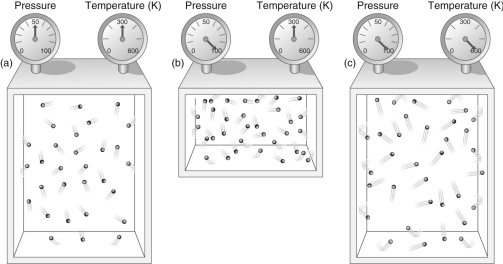 Figure 2
-According to Figure 2, what effect does doubling the pressure on a gas while keeping its temperature constant have on the volume of the gas?
Figure 2
-According to Figure 2, what effect does doubling the pressure on a gas while keeping its temperature constant have on the volume of the gas? (Essay)
4.8/5 (73)
(73) What is the reason Mercury has so little gas in its atmosphere?
(Multiple Choice)
4.8/5 (80)
(80) If there are 104 kg of air above every square meter of the surface of Earth, and Earth is modeled as a sphere of radius 6.4 * 106 m, what is the mass of Earth's atmosphere and what fraction is it of the total mass of the Earth? Show your calculation.
(Essay)
4.8/5 (80)
(80) 
Filters
- Essay(0)
- Multiple Choice(0)
- Short Answer(0)
- True False(0)
- Matching(0)