



 Chat with AI
Exam 9: Atmospheres of the Terrestrial Planets

Exam 1: Why Learn Astronomy92 Questions
Exam 2: Patterns in the Skymotions of Earth96 Questions
Exam 3: Motion of Astronomical Bodies91 Questions
Exam 4: Gravity and Orbits88 Questions
Exam 5: Light87 Questions
Exam 6: The Tools of the Astronomer94 Questions
Exam 7: The Birth and Evolution of Planetary Systems87 Questions
Exam 8: The Terrestrial Planets and Earths Moon99 Questions
Exam 9: Atmospheres of the Terrestrial Planets92 Questions
Exam 10: Worlds of Gas and Liquid the Giant Planets92 Questions
Exam 11: Planetary Adornmentsmoons and Rings93 Questions
Exam 12: Dwarf Planets and Small Solar System Bodies89 Questions
Exam 13: Taking the Measure of Stars88 Questions
Exam 14: Our Starthe Sun88 Questions
Exam 15: Star Formation and the Interstellar Medium89 Questions
Exam 16: Evolution of Low-Mass Stars90 Questions
Exam 17: Evolution of High-Mass Stars90 Questions
Exam 18: Relativity and Black Holes90 Questions
Exam 19: The Expanding Universe90 Questions
Exam 20: Galaxies95 Questions
Exam 21: The Milky Waya Normal Spiral Galaxy96 Questions
Exam 22: Modern Cosmology92 Questions
Exam 23: Large-Scale Structure in the Universe65 Questions
Exam 24: Life61 Questions
Select questions type


According to the figure shown below, as you increase in altitude in the Earth's lower atmosphere, the atmospheric pressure _________ dramatically at a(n) _________ rate. 
(Multiple Choice)
4.9/5  (78)
(78) By examining the images shown below, what can you conclude? 
(Multiple Choice)
4.8/5 (88)
(88) Most of Earth's present-day atmosphere comes from a combination of what three sources?
(Essay)
4.8/5 (84)
(84) A gas eventually will escape from a planet's atmosphere if the average velocity of the atoms exceeds 1/6 times the escape velocity of the planet. If the average velocity of water vapor in Venus's atmosphere is 0.9 km/s, would it eventually escape into outer space? Note that Venus's mass is 5 * 1024 kg and its radius is 6,050 km.
(Multiple Choice)
4.7/5 (81)
(81) 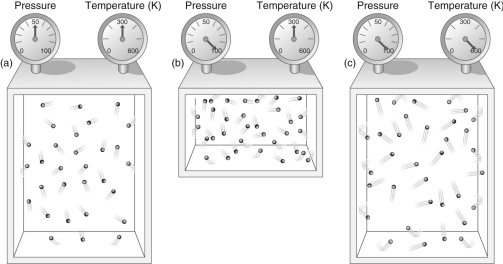 Figure 2
-According to Figure 2, what effect does doubling the temperature of a gas while keeping its volume constant have on the pressure of the gas?
Figure 2
-According to Figure 2, what effect does doubling the temperature of a gas while keeping its volume constant have on the pressure of the gas? (Essay)
4.8/5 (64)
(64) Venus rotates so rapidly that the dominant form of atmospheric circulation is powered by hurricanes moving from its equator to its poles.
(True/False)
4.9/5 (76)
(76) When the Martian summer occurs and the daytime temperature is 20°C, water on the surface melts and forms small pools of liquid.
(True/False)
4.9/5 (85)
(85) According to the figure shown below, the different layers of Earth's atmosphere are defined by: 
(Multiple Choice)
4.7/5 (87)
(87) The main greenhouse gases in the atmosphere of the terrestrial planets are:
(Multiple Choice)
4.8/5 (76)
(76) Venus and Earth probably formed with similar amounts of carbon dioxide in their secondary atmospheres. Which of the following is TRUE?
(Multiple Choice)
5.0/5 (86)
(86) If sunlight cannot penetrate Venus's cloud layer efficiently, why does the temperature of the planet remain so high?
(Essay)
4.9/5 (76)
(76) Which of the following contributes most to the large difference in the average daytime and nighttime temperatures on the Moon?
(Multiple Choice)
4.9/5 (77)
(77) In the absence of a greenhouse effect, water on the surface of Earth would be frozen.
(True/False)
4.8/5 (73)
(73) Earth releases the energy it receives from the Sun by emitting _________ radiation.
(Multiple Choice)
4.9/5 (74)
(74) If water vapor were released from Venus's surface due to tectonic activity into its upper atmosphere, what would most likely happen to it?
(Multiple Choice)
4.8/5 (92)
(92) Without the ozone layer, life on Earth would be in danger from increased levels of _________ radiation.
(Multiple Choice)
4.9/5 (84)
(84) If the average CO2 molecule in Venus's atmosphere has a velocity of 0.6 km/s, what would the velocity be for a hydrogen atom in Venus's atmosphere? Note the mass of a CO2 molecule is 44 times that of a hydrogen atom.
(Essay)
4.7/5 (80)
(80) 
Filters
- Essay(0)
- Multiple Choice(0)
- Short Answer(0)
- True False(0)
- Matching(0)