



 Chat with AI
Exam 9: Atmospheres of the Terrestrial Planets

Exam 1: Why Learn Astronomy92 Questions
Exam 2: Patterns in the Skymotions of Earth96 Questions
Exam 3: Motion of Astronomical Bodies91 Questions
Exam 4: Gravity and Orbits88 Questions
Exam 5: Light87 Questions
Exam 6: The Tools of the Astronomer94 Questions
Exam 7: The Birth and Evolution of Planetary Systems87 Questions
Exam 8: The Terrestrial Planets and Earths Moon99 Questions
Exam 9: Atmospheres of the Terrestrial Planets92 Questions
Exam 10: Worlds of Gas and Liquid the Giant Planets92 Questions
Exam 11: Planetary Adornmentsmoons and Rings93 Questions
Exam 12: Dwarf Planets and Small Solar System Bodies89 Questions
Exam 13: Taking the Measure of Stars88 Questions
Exam 14: Our Starthe Sun88 Questions
Exam 15: Star Formation and the Interstellar Medium89 Questions
Exam 16: Evolution of Low-Mass Stars90 Questions
Exam 17: Evolution of High-Mass Stars90 Questions
Exam 18: Relativity and Black Holes90 Questions
Exam 19: The Expanding Universe90 Questions
Exam 20: Galaxies95 Questions
Exam 21: The Milky Waya Normal Spiral Galaxy96 Questions
Exam 22: Modern Cosmology92 Questions
Exam 23: Large-Scale Structure in the Universe65 Questions
Exam 24: Life61 Questions
Select questions type


In the stratosphere of the Earth's atmosphere, how does the temperature vary with increasing altitude and what causes this variation?
(Essay)
4.7/5  (91)
(91) For the first 1 billion years of the Earth's evolution, the fraction of oxygen in its atmosphere was approximately:
(Multiple Choice)
4.7/5 (78)
(78) _________ in our atmosphere is a direct consequence of the emergence of life.
(Multiple Choice)
4.9/5 (70)
(70) Earth has roughly _________ times more atmospheric pressure than Mars and _________ times less than Venus.
(Multiple Choice)
4.9/5 (93)
(93) If you found absorption rising from _________ in the spectrum of a planet, you could conclude that it might contain some form of life.
(Multiple Choice)
4.9/5 (96)
(96) The best way to look for life on other planets is to search for absorption from nitrogen in their atmospheres in the infrared region of the spectrum.
(True/False)
4.8/5 (84)
(84) According to the figure shown below, approximately how many years ago did oxygen finally get to half its current abundance in Earth's atmosphere? 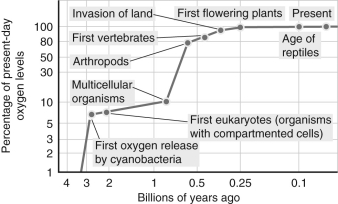
(Multiple Choice)
4.7/5 (83)
(83) Aurorae are produced only near the northern and southern magnetic poles of a planet because charged particles arriving in the solar wind cannot cross the magnetic field lines.
(True/False)
4.8/5 (76)
(76) The amount of carbon dioxide in the Earth's atmosphere has been increasing over the last 50 years because of:
(Multiple Choice)
4.9/5 (79)
(79) Given the thickness and chemical composition of Venus's atmosphere, by how much would you expect its average surface temperature to change between day and night?
(Multiple Choice)
4.7/5 (73)
(73) Carbon dioxide levels in Earth's atmosphere have been rising by about 4 percent per decade due to the use of fossil fuels. If this trend continues, what could happen to Earth?
(Essay)
4.8/5 (73)
(73) Why does the temperature decrease as you go higher up in altitude in the troposphere on Earth?
(Essay)
4.7/5 (80)
(80) The atmosphere of Mars is mostly composed of carbon dioxide; therefore the greenhouse effect makes the average temperature 35 degrees warmer than it would be without its atmosphere.
(True/False)
4.7/5 (70)
(70) What makes carbon dioxide a highly effective greenhouse gas?
(Multiple Choice)
4.8/5 (92)
(92) Would a nitrogen atom in Venus's atmosphere, whose temperature is 740 K, eventually escape into outer space? Note that a nitrogen atom has a mass that is 14 times that of a hydrogen atom. Recall that atoms eventually will escape if their average velocity is greater than 1/6 times the escape velocity of the planet. The escape velocity of Venus is 10 km/s. For comparison, a hydrogen atom has an average velocity of 2.5 km/s at a temperature of 300 K.
(Multiple Choice)
4.7/5 (92)
(92) Like Mars and Venus, Earth originally had a significant amount of carbon dioxide in its atmosphere. Where is the majority of the carbon now?
(Multiple Choice)
5.0/5 (90)
(90) If an average hydrogen atom in Earth's atmosphere has a velocity of 2.5 km/s, what would be the average velocity of an oxygen molecule in the Earth's atmosphere? Note that the atomic mass of an oxygen atom is 16 times that of a hydrogen atom.
(Multiple Choice)
4.8/5 (73)
(73) 
Filters
- Essay(0)
- Multiple Choice(0)
- Short Answer(0)
- True False(0)
- Matching(0)