



 Chat with AI
Exam 10: Worlds of Gas and Liquid the Giant Planets

Exam 1: Why Learn Astronomy92 Questions
Exam 2: Patterns in the Skymotions of Earth96 Questions
Exam 3: Motion of Astronomical Bodies91 Questions
Exam 4: Gravity and Orbits88 Questions
Exam 5: Light87 Questions
Exam 6: The Tools of the Astronomer94 Questions
Exam 7: The Birth and Evolution of Planetary Systems87 Questions
Exam 8: The Terrestrial Planets and Earths Moon99 Questions
Exam 9: Atmospheres of the Terrestrial Planets92 Questions
Exam 10: Worlds of Gas and Liquid the Giant Planets92 Questions
Exam 11: Planetary Adornmentsmoons and Rings93 Questions
Exam 12: Dwarf Planets and Small Solar System Bodies89 Questions
Exam 13: Taking the Measure of Stars88 Questions
Exam 14: Our Starthe Sun88 Questions
Exam 15: Star Formation and the Interstellar Medium89 Questions
Exam 16: Evolution of Low-Mass Stars90 Questions
Exam 17: Evolution of High-Mass Stars90 Questions
Exam 18: Relativity and Black Holes90 Questions
Exam 19: The Expanding Universe90 Questions
Exam 20: Galaxies95 Questions
Exam 21: The Milky Waya Normal Spiral Galaxy96 Questions
Exam 22: Modern Cosmology92 Questions
Exam 23: Large-Scale Structure in the Universe65 Questions
Exam 24: Life61 Questions
Select questions type


_________ has the most extreme seasons of any planet in the Solar System.
(Multiple Choice)
5.0/5  (80)
(80) The Jovian atmospheric vortices are created by a combination of the Coriolis effect and:
(Multiple Choice)
4.8/5 (71)
(71) How does the discovery of Neptune relate to the discovery of extrasolar planets?
(Essay)
4.9/5 (80)
(80) The compositions of Uranus and Neptune differ primarily from that of Jupiter and Saturn in that the outer two planets contain more:
(Multiple Choice)
4.9/5 (82)
(82) If you monitor Saturn's atmosphere and you see a storm near its equator at a longitude of 0° west on one day and at a longitude of 90° west three days later, what is the average wind speed on Saturn at this storm's latitude? Note that these positions are measured on a coordinate system that rotates with the planet's interior, and the radius of Saturn is 6* 107 m.
(Multiple Choice)
5.0/5 (66)
(66) Based on the flux of sunlight that it gets, Jupiter should have a temperature of 109 K. However its temperature is observed to be 124 K. How much more energy is Jupiter radiating out into space compared to what it gets from the Sun?
(Essay)
4.8/5 (88)
(88) On which of the giant planets do we think we can find deep oceans of water? Why do we think this, when we can't directly see inside the giant planets?
(Essay)
4.8/5 (83)
(83) The strongest magnetic fields in the Solar System are found on which planet?
(Multiple Choice)
4.8/5 (69)
(69) Suppose Neptune moves with an average orbital speed of 3.5 km/s. If it takes Neptune four hours to pass directly in front of a star, what is Neptune's diameter? Give Neptune's radius in units of Earth diameters, where the diameter of Earth is 12,800 km.
(Essay)
4.9/5 (78)
(78) Jupiter radiates more energy than it receives from the Sun, mostly because it is still contracting under its own gravity.
(True/False)
4.7/5 (74)
(74) The figure below shows a drawing of bands in the atmosphere of Jupiter, and the arrows indicate the direction the winds are blowing in those bands. 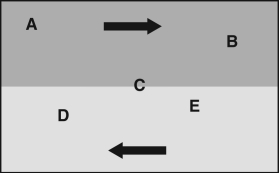 At which of the labeled locations would you be most likely to find a vortex storm?
 (Multiple Choice)
4.7/5 (68)
(68) As a group, the giant planets all rotate _________ terrestrial planets.
(Multiple Choice)
4.9/5 (84)
(84) What is the angular diameter of Neptune if its diameter is 50,000 km and its distance is 30 AU?
(Multiple Choice)
4.8/5 (73)
(73) What could have caused the planets to migrate through the Solar System?
(Multiple Choice)
4.8/5 (87)
(87) When you look at the visible surface of a gas giant planet, you are looking at that planet's _________.
(Multiple Choice)
4.7/5 (66)
(66) If Saturn's orbital period is 30 years and the obliquity is 26 degrees, how long is it from the first day of spring to the first day of autumn on Saturn?
(Essay)
4.9/5 (80)
(80) 
Filters
- Essay(0)
- Multiple Choice(0)
- Short Answer(0)
- True False(0)
- Matching(0)