



 Chat with AI
Exam 10: Worlds of Gas and Liquid the Giant Planets

Exam 1: Why Learn Astronomy92 Questions
Exam 2: Patterns in the Skymotions of Earth96 Questions
Exam 3: Motion of Astronomical Bodies91 Questions
Exam 4: Gravity and Orbits88 Questions
Exam 5: Light87 Questions
Exam 6: The Tools of the Astronomer94 Questions
Exam 7: The Birth and Evolution of Planetary Systems87 Questions
Exam 8: The Terrestrial Planets and Earths Moon99 Questions
Exam 9: Atmospheres of the Terrestrial Planets92 Questions
Exam 10: Worlds of Gas and Liquid the Giant Planets92 Questions
Exam 11: Planetary Adornmentsmoons and Rings93 Questions
Exam 12: Dwarf Planets and Small Solar System Bodies89 Questions
Exam 13: Taking the Measure of Stars88 Questions
Exam 14: Our Starthe Sun88 Questions
Exam 15: Star Formation and the Interstellar Medium89 Questions
Exam 16: Evolution of Low-Mass Stars90 Questions
Exam 17: Evolution of High-Mass Stars90 Questions
Exam 18: Relativity and Black Holes90 Questions
Exam 19: The Expanding Universe90 Questions
Exam 20: Galaxies95 Questions
Exam 21: The Milky Waya Normal Spiral Galaxy96 Questions
Exam 22: Modern Cosmology92 Questions
Exam 23: Large-Scale Structure in the Universe65 Questions
Exam 24: Life61 Questions
Select questions type


Assume you want to deduce the radius of a planet in our Solar System as it occults a background star when the relative velocity between the planet and the Earth is 30 km/s. If the star crosses through the middle of the planet and disappears for a total of 26 minutes, what is the planet's radius?
(Multiple Choice)
4.8/5  (87)
(87) Uranus and Neptune contain smaller percentages of hydrogen and helium than Jupiter and Saturn probably because Uranus and Neptune _________ than Jupiter and Saturn.
(Multiple Choice)
4.9/5 (84)
(84) Why do we find methane clouds above water clouds in the atmosphere of Saturn?
(Multiple Choice)
4.8/5 (77)
(77) Which of these planets has a composition that is most like the Sun?
(Multiple Choice)
4.8/5 (78)
(78) Calculate Jupiter's mass (in Earth masses) based on its gravitational pull on its moon, Io, using Newton's version of Kepler's third law: P2 = A3/MJ. In order to do so, you will need the following information: Io's period =1.769 days; Io's semimajor axis = 422,000 km; the mass of the Sun = 2* 1030 kg; the mass of Earth = 6 * 1024 kg (also, 1 AU = 1.5* 108 km).
(Essay)
4.9/5 (58)
(58) Which planet receives the least amount of energy from the Sun?
(Multiple Choice)
4.8/5 (77)
(77) Which giant planet does NOT radiate more energy into space than it receives from the Sun?
(Multiple Choice)
4.8/5 (81)
(81) The different cloud layers seen in Jupiter's bands represent clouds at different altitudes in Jupiter's atmosphere.
(True/False)
4.9/5 (72)
(72) Suppose you attach a weight to one end of a spring and then hold the other end of the spring and spin it above your head. The faster you spin the spring, the farther away the weight will move from your hand. This example illustrates:
(Multiple Choice)
4.7/5 (88)
(88) Compare the flux of sunlight at the Earth's orbit to that at Saturn's orbit. Note that Saturn's average distance from the Sun is 9.5 AU.
(Essay)
4.8/5 (76)
(76) Uranus and Neptune do not have bands as distinct as those on Jupiter and Saturn, because Uranus and Neptune:
(Multiple Choice)
4.9/5 (83)
(83) The giant planets are made primarily of water and carbon dioxide.
(True/False)
4.8/5 (91)
(91) On the giant planets, the atmospheric vortices that occur almost always lie between oppositely directed zonal winds.
(True/False)
4.8/5 (88)
(88) If Saturn's rotational period is 11 hours and its radius is 6 * 107 m, what is the average speed of a cloud in its atmosphere that is rotating with Saturn? (Neglect differential speeds due to winds.)
(Essay)
4.9/5 (75)
(75) The colors of the cloud bands on Jupiter and Saturn are due primarily to differences in their:
(Multiple Choice)
4.7/5 (83)
(83) How is the atmosphere of Saturn similar to the atmosphere of Earth?
(Multiple Choice)
4.9/5 (79)
(79) Assume that you discovered a new planet in the Solar System. To study it, you measured the orbital period and semimajor axis of one of its moons and deduced that the planet's mass was 4 * 1025 kg (7 MEarth), then you observed the planet occult a background star and deduced that its radius is 12,000 km (2 REarth). What is this planet's average density? Is this planet's chemical composition more similar to a rocky terrestrial planet or a giant planet? For comparison, the density of iron, rock, and water are approximately 9,000 kg/m3, 3,000 kg/m3, and 1,000 kg/m3, respectively.
(Multiple Choice)
4.8/5 (78)
(78) Jupiter's strong aurorae result from particles ejected by Io's volcanoes.
(True/False)
4.9/5 (81)
(81) Uranus and Neptune are bluish green in color because they contain large amounts of:
(Multiple Choice)
4.9/5 (82)
(82) The figure below shows a drawing of some of the layers inside the atmosphere of Jupiter. The layer at the top of the figure is closest to the outer surface of Jupiter, while the bottom layer is closer to the core. 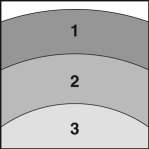 Which of these is a possible list of what the layers contain, starting with layer 1 and moving to layer 3?
 (Multiple Choice)
5.0/5 (63)
(63) 
Filters
- Essay(0)
- Multiple Choice(0)
- Short Answer(0)
- True False(0)
- Matching(0)