



 Chat with AI
Exam 10: Worlds of Gas and Liquid the Giant Planets

Exam 1: Why Learn Astronomy92 Questions
Exam 2: Patterns in the Skymotions of Earth96 Questions
Exam 3: Motion of Astronomical Bodies91 Questions
Exam 4: Gravity and Orbits88 Questions
Exam 5: Light87 Questions
Exam 6: The Tools of the Astronomer94 Questions
Exam 7: The Birth and Evolution of Planetary Systems87 Questions
Exam 8: The Terrestrial Planets and Earths Moon99 Questions
Exam 9: Atmospheres of the Terrestrial Planets92 Questions
Exam 10: Worlds of Gas and Liquid the Giant Planets92 Questions
Exam 11: Planetary Adornmentsmoons and Rings93 Questions
Exam 12: Dwarf Planets and Small Solar System Bodies89 Questions
Exam 13: Taking the Measure of Stars88 Questions
Exam 14: Our Starthe Sun88 Questions
Exam 15: Star Formation and the Interstellar Medium89 Questions
Exam 16: Evolution of Low-Mass Stars90 Questions
Exam 17: Evolution of High-Mass Stars90 Questions
Exam 18: Relativity and Black Holes90 Questions
Exam 19: The Expanding Universe90 Questions
Exam 20: Galaxies95 Questions
Exam 21: The Milky Waya Normal Spiral Galaxy96 Questions
Exam 22: Modern Cosmology92 Questions
Exam 23: Large-Scale Structure in the Universe65 Questions
Exam 24: Life61 Questions
Select questions type


Uranus has an orbital period of 84 Earth years, a rotation period of 17.2 hours, and an obliquity of 98°. Explain what solar days are like near the north pole of Uranus, and how long they last.
(Essay)
4.9/5  (72)
(72) The poles of Uranus can have a higher temperature than its equator because Uranus:
(Multiple Choice)
5.0/5 (83)
(83) What measurement tells us that the interiors of Uranus and Neptune are made of mostly water?
(Multiple Choice)
4.8/5 (69)
(69) If you could find a large enough ocean, which one of these planets would float in it?
(Multiple Choice)
4.9/5 (82)
(82) Despite the high temperatures deep in the interior of giant planets, their cores remain liquid because:
(Multiple Choice)
4.8/5 (69)
(69) In addition to the visible light that we can see with our own eyes, Jupiter emits a large amount of radio waves. Explain the processes that allow Jupiter to give off each of these types of light.
(Essay)
4.9/5 (87)
(87) If you tracked the motion of the clouds near Jupiter's Great Red Spot, which of the following diagrams shows the correct motion you would observe? 
(Multiple Choice)
5.0/5 (66)
(66) Which of the giant planets was predicted to exist mathematically before it was ever seen through a telescope?
(Multiple Choice)
4.9/5 (83)
(83) As you move from the top atmospheric layer toward the center of a gas planet, the temperature _________ and the pressure _________.
(Multiple Choice)
4.8/5 (79)
(79) The radiation belts around Jupiter are much stronger than those found around the Earth because:
(Multiple Choice)
4.9/5 (77)
(77) Explain why the ice giants likely formed at a different time than the gas giant planets, and describe how this led to their different compositions.
(Essay)
4.9/5 (74)
(74) What is the ratio of Jupiter's volume to that of Earth's if both planets can be modeled as spheres and Jupiter's radius is 11 times that of the Earth's?
(Essay)
4.8/5 (74)
(74) Explain why the densest materials in Jupiter are found in the core of the planet. How does this differ from the formation of the Earth's dense core?
(Essay)
4.8/5 (87)
(87) How does the structure of the solar nebula help explain why Jupiter is so much larger than the other giant planets?
(Essay)
4.8/5 (73)
(73) The Great Red Spot, Jupiter's most prominent storm system, has a diameter that is _________ times the Earth's diameter.
(Multiple Choice)
4.7/5 (79)
(79) If you could watch Saturn form starting from the beginning of the Solar System, which of these features of Saturn would come together first?
(Multiple Choice)
4.8/5 (67)
(67) A diagram of the interior of Jupiter is shown below, with layers labeled A-D. 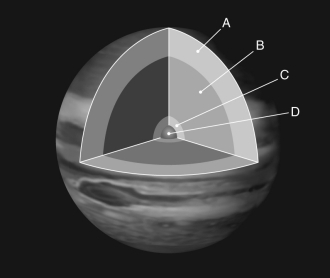 Describe what each of the four labeled layers is made of.
 (Essay)
4.9/5 (83)
(83) Uranus and Neptune are less massive than Jupiter and Saturn, probably because they formed earlier than Jupiter or Saturn.
(True/False)
4.8/5 (77)
(77) Each season is on Uranus lasts approximate 21 Earth years because:
(Multiple Choice)
4.8/5 (72)
(72) 
Filters
- Essay(0)
- Multiple Choice(0)
- Short Answer(0)
- True False(0)
- Matching(0)