



 Chat with AI
Exam 21: The Milky Waya Normal Spiral Galaxy

Exam 1: Why Learn Astronomy92 Questions
Exam 2: Patterns in the Skymotions of Earth96 Questions
Exam 3: Motion of Astronomical Bodies91 Questions
Exam 4: Gravity and Orbits88 Questions
Exam 5: Light87 Questions
Exam 6: The Tools of the Astronomer94 Questions
Exam 7: The Birth and Evolution of Planetary Systems87 Questions
Exam 8: The Terrestrial Planets and Earths Moon99 Questions
Exam 9: Atmospheres of the Terrestrial Planets92 Questions
Exam 10: Worlds of Gas and Liquid the Giant Planets92 Questions
Exam 11: Planetary Adornmentsmoons and Rings93 Questions
Exam 12: Dwarf Planets and Small Solar System Bodies89 Questions
Exam 13: Taking the Measure of Stars88 Questions
Exam 14: Our Starthe Sun88 Questions
Exam 15: Star Formation and the Interstellar Medium89 Questions
Exam 16: Evolution of Low-Mass Stars90 Questions
Exam 17: Evolution of High-Mass Stars90 Questions
Exam 18: Relativity and Black Holes90 Questions
Exam 19: The Expanding Universe90 Questions
Exam 20: Galaxies95 Questions
Exam 21: The Milky Waya Normal Spiral Galaxy96 Questions
Exam 22: Modern Cosmology92 Questions
Exam 23: Large-Scale Structure in the Universe65 Questions
Exam 24: Life61 Questions
Select questions type


You find a star orbiting about the center of the galaxy at a speed of 220 km/s at a distance of 15 kpc. How much mass is within the orbit of that star? You can assume the star is on a circular orbit around the center of the Milky Way.
(Essay)
4.7/5  (97)
(97) The oldest disk stars are both __________ and __________ compared to halo stars.
(Multiple Choice)
4.8/5 (77)
(77) If we found a star cluster at the edge of the disk of the Milky Way at a distance of 10 kpc from the center, which orbited with a velocity of 300 km/s, what would be the total mass enclosed within this radius?
(Multiple Choice)
4.8/5 (79)
(79) Imagine you discovered a barred spiral galaxy that was a "Milky Way twin" because the size of the bulge and disk, the arrangement of spiral arms, and other characteristics were just like those in our galaxy. Then you measured its rotation curve and plotted the figure shown below. What would you conclude about this galaxy? 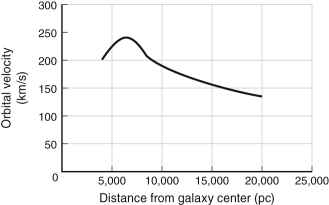
(Multiple Choice)
4.8/5 (65)
(65) Globular clusters have much higher stellar densities than the local solar neighborhood.
(True/False)
4.9/5 (78)
(78) Cosmic rays come mostly from extragalactic sources and contribute little to the overall energy balance in the Milky Way disk.
(True/False)
4.9/5 (83)
(83) If the Large Magellanic Cloud is orbiting the Milky Way in a circular orbit with a speed of 175 km/s and a distance of 50 kpc from the center, how long would it take for the Large Magellanic Cloud to complete one orbit around the Milky Way?
(Multiple Choice)
4.7/5 (98)
(98) Stars in the Milky Way that are 12 to 13 billion years old are only found in globular clusters.
(True/False)
4.9/5 (77)
(77) How do we know that globular cluster stars were not the first stars that formed in our galaxy? Would this still be true if some or all globular clusters came into the galaxy by accretion of small satellite galaxies?
(Essay)
4.7/5 (87)
(87) Why is the supermassive black hole in the center of our galaxy not an AGN right now? Could it be active in the future? Why or why not?
(Essay)
4.8/5 (83)
(83) Based on the chemical abundances and velocities of stars in the Milky Way's disk and halo, we can conclude that the protogalactic fragments that came together to form the galaxy merged when the fragments had:
(Multiple Choice)
4.9/5 (75)
(75) The Sun has 2 percent of its mass in heavy elements (those elements that are not hydrogen and helium). What does this tell us about chemical enrichment in the galaxy?
(Essay)
4.8/5 (69)
(69) We find that interstellar gas and the youngest disk stars are found in a very narrow distribution along the galactic plane, but that older disk stars can be found in a thicker disk. What might this mean?
(Multiple Choice)
4.7/5 (69)
(69) What is the radius of the event horizon for the 4 *106 M black hole at the center of the Milky Way?
(Multiple Choice)
4.9/5 (60)
(60) Describe the population of globular star clusters in the Milky Way: how many are there, where do they reside in the Milky Way, and how do their ages and chemical abundances compare to the Sun?
(Essay)
4.9/5 (69)
(69) 
Filters
- Essay(0)
- Multiple Choice(0)
- Short Answer(0)
- True False(0)
- Matching(0)