



 Chat with AI
Exam 21: The Milky Waya Normal Spiral Galaxy

Exam 1: Why Learn Astronomy92 Questions
Exam 2: Patterns in the Skymotions of Earth96 Questions
Exam 3: Motion of Astronomical Bodies91 Questions
Exam 4: Gravity and Orbits88 Questions
Exam 5: Light87 Questions
Exam 6: The Tools of the Astronomer94 Questions
Exam 7: The Birth and Evolution of Planetary Systems87 Questions
Exam 8: The Terrestrial Planets and Earths Moon99 Questions
Exam 9: Atmospheres of the Terrestrial Planets92 Questions
Exam 10: Worlds of Gas and Liquid the Giant Planets92 Questions
Exam 11: Planetary Adornmentsmoons and Rings93 Questions
Exam 12: Dwarf Planets and Small Solar System Bodies89 Questions
Exam 13: Taking the Measure of Stars88 Questions
Exam 14: Our Starthe Sun88 Questions
Exam 15: Star Formation and the Interstellar Medium89 Questions
Exam 16: Evolution of Low-Mass Stars90 Questions
Exam 17: Evolution of High-Mass Stars90 Questions
Exam 18: Relativity and Black Holes90 Questions
Exam 19: The Expanding Universe90 Questions
Exam 20: Galaxies95 Questions
Exam 21: The Milky Waya Normal Spiral Galaxy96 Questions
Exam 22: Modern Cosmology92 Questions
Exam 23: Large-Scale Structure in the Universe65 Questions
Exam 24: Life61 Questions
Select questions type


Stars in the halo are most easily identified passing by the Sun because of their distinctively redder colors.
(True/False)
4.9/5  (80)
(80) Sagittarius A*, the radio source located at the center of our galaxy, is believed to be:
(Multiple Choice)
4.9/5 (70)
(70) Cosmic rays in our galaxy can produce synchrotron radiation at what wavelengths?
(Multiple Choice)
4.7/5 (73)
(73) There are no known processes that can change the orbits of disk stars over time.
(True/False)
4.9/5 (70)
(70) If you found a star cluster that was 13 billion years old and whose stars had fractions of heavy elements that were 100 times less than that in the Sun, what type of star cluster would this be and where would it most likely be located?
(Multiple Choice)
4.8/5 (80)
(80) What are the main observational difficulties in observing the shape and spiral arm pattern of the Milky Way?
(Essay)
4.9/5 (67)
(67) The ratio of the diameter of the galaxy's disk to the thickness of its disk is about:
(Multiple Choice)
4.8/5 (65)
(65) By comparing globular clusters, you find that Cluster A's RR Lyrae stars are 100 times fainter than Cluster B's RR Lyrae stars. You know that Cluster A's stars are 1.5 times more luminous than Cluster B's stars, because Cluster A is more metal-rich and somewhat younger. How do the clusters' distances compare?
(Multiple Choice)
4.7/5 (90)
(90) The Milky Way has lived out its life mainly in isolation and has not experienced many mergers with other galaxies.
(True/False)
4.9/5 (89)
(89) Describe a scale model of the disk of the Milky Way using a scale in which 1 cm = 1000 light-years. Note that the diameter of the disk is approximately 100,000 light-years, the thickness of young stars is 500 light-years, and the thickness of the older stars is 4,000 light-years.
(Essay)
4.7/5 (72)
(72) A typical globular cluster is composed of 500,000 stars in a sphere whose radius is approximately 5 pc. The distance between stars in a globular cluster is given approximately by d r/N1/3, where r is the radius and N is the number of stars in the cluster. Calculate this distance, and determine how many times smaller it is than the typical distance between stars in the solar neighborhood, which is 3 light-years.
(Essay)
4.8/5 (90)
(90) How have astronomers measured the mass of the black hole at the center of our galaxy?
(Multiple Choice)
4.9/5 (69)
(69) How many years does it take the Sun to complete one orbit around the Milky Way? Note that the Sun is traveling at approximately 220 km/s and is 8 kpc from the center of the Milky Way.
(Multiple Choice)
4.7/5 (87)
(87) The chemical abundance of a main-sequence star usually reflects how much nuclear burning has gone on inside it.
(True/False)
5.0/5 (86)
(86) Which of the following are generally NOT found in our galaxy's halo?
(Multiple Choice)
4.9/5 (84)
(84) If you found a halo star that was 13 billion years old and had the same amount of heavy elements as the Sun, would you be surprised?
(Multiple Choice)
4.7/5 (75)
(75) Why can the observed chemical abundance of a star tell you something about its age?
(Essay)
4.7/5 (73)
(73) Which of these galaxies is most like our own, and what is the name for the type of the galaxy we live in? 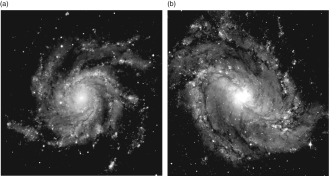
(Multiple Choice)
4.9/5 (72)
(72) 
Filters
- Essay(0)
- Multiple Choice(0)
- Short Answer(0)
- True False(0)
- Matching(0)