



 Chat with AI
Exam 21: The Milky Waya Normal Spiral Galaxy

Exam 1: Why Learn Astronomy92 Questions
Exam 2: Patterns in the Skymotions of Earth96 Questions
Exam 3: Motion of Astronomical Bodies91 Questions
Exam 4: Gravity and Orbits88 Questions
Exam 5: Light87 Questions
Exam 6: The Tools of the Astronomer94 Questions
Exam 7: The Birth and Evolution of Planetary Systems87 Questions
Exam 8: The Terrestrial Planets and Earths Moon99 Questions
Exam 9: Atmospheres of the Terrestrial Planets92 Questions
Exam 10: Worlds of Gas and Liquid the Giant Planets92 Questions
Exam 11: Planetary Adornmentsmoons and Rings93 Questions
Exam 12: Dwarf Planets and Small Solar System Bodies89 Questions
Exam 13: Taking the Measure of Stars88 Questions
Exam 14: Our Starthe Sun88 Questions
Exam 15: Star Formation and the Interstellar Medium89 Questions
Exam 16: Evolution of Low-Mass Stars90 Questions
Exam 17: Evolution of High-Mass Stars90 Questions
Exam 18: Relativity and Black Holes90 Questions
Exam 19: The Expanding Universe90 Questions
Exam 20: Galaxies95 Questions
Exam 21: The Milky Waya Normal Spiral Galaxy96 Questions
Exam 22: Modern Cosmology92 Questions
Exam 23: Large-Scale Structure in the Universe65 Questions
Exam 24: Life61 Questions
Select questions type


Which objects in our Milky Way galaxy have orbits that are NOT similar to stars in elliptical galaxies?
(Multiple Choice)
4.8/5  (70)
(70) The location and motions of interstellar gas can be strongly affected by what?
(Multiple Choice)
4.7/5 (66)
(66) Suppose it was discovered that the galaxy has constantly been absorbing large amounts of gas that never had any stars form in it. Would this complicate our interpretation of ages and chemical enrichment?
(Essay)
4.9/5 (86)
(86) By comparing globular clusters, you find that Cluster A's RR Lyrae stars are 100 times fainter than Cluster B's RR Lyrae stars. You know that both clusters have approximately the same chemical composition and age, and thus their RR Lyrae stars should have the same luminosities. Which is true about the clusters' distances?
(Multiple Choice)
4.7/5 (88)
(88) The Milky Way is like most other galaxies in that its mass is dominated by dark matter.
(True/False)
4.9/5 (79)
(79) Most of the gravity that the Sun feels in the galaxy is caused by the black hole at the center of the Milky Way.
(True/False)
4.8/5 (74)
(74) On average, we expect that __________ stars have the __________ percentage of heavy elements.
(Multiple Choice)
4.9/5 (95)
(95) Because of the ages of globular clusters in the Milky Way, we think our galaxy's early formation history was characterized by:
(Multiple Choice)
4.8/5 (75)
(75) If a globular cluster were 1,000 pc away from us and an RR Lyrae star in it had an absolute magnitude of 0.5, what would its apparent magnitude be?
(Multiple Choice)
4.9/5 (71)
(71) What is ripping apart the Sagittarius dwarf spheroidal galaxy?
(Multiple Choice)
4.8/5 (84)
(84) The Milky Way has two major spiral arms that emanate from the ends of its bar.
(True/False)
4.8/5 (81)
(81) Below are two images of the Milky Way at different wavelengths. Which one was taken at infrared wavelengths, and why do you think so? 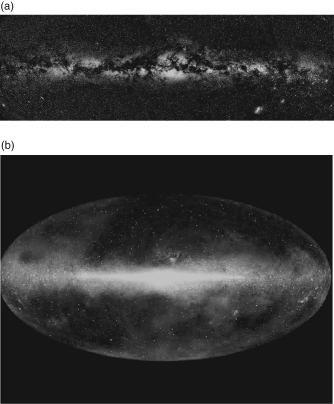
(Multiple Choice)
4.8/5 (72)
(72) Describe the basic scenario that describes the formation and evolution of the Milky Way, including a description of how the halo and disk formed.
(Essay)
4.7/5 (84)
(84) Globular clusters, when compared to open clusters, generally:
(Multiple Choice)
4.9/5 (69)
(69) In a star that has a chemical abundance similar to the Sun, what percentage of its mass is made of heavy elements?
(Multiple Choice)
4.7/5 (73)
(73) By comparing globular clusters, you find that Cluster A's RR Lyrae stars are 225 times fainter than Cluster B's RR Lyrae stars. You know that both clusters have approximately the same chemical composition and age, and thus their RR Lyrae stars should have the same luminosities. Which cluster has the larger distance, and what is the ratio of the clusters' distances?
(Essay)
4.8/5 (80)
(80) Halo stars formed before the Milky Way developed a thin stellar disk.
(True/False)
4.7/5 (84)
(84) Where would we find the stars with the richest abundance of massive elements? Where would we find those with the smallest amounts of massive elements? Why?
(Essay)
4.8/5 (83)
(83) 
Filters
- Essay(0)
- Multiple Choice(0)
- Short Answer(0)
- True False(0)
- Matching(0)