



 Chat with AI
Exam 5: Electric Current and Direct-Current Circuits

Exam 1: The Electric Field I: Discrete Charge Distributions87 Questions
Exam 2: The Electric Field II: Continuous Charge Distributions75 Questions
Exam 3: Electric Potential108 Questions
Exam 4: Capacitance73 Questions
Exam 5: Electric Current and Direct-Current Circuits160 Questions
Exam 6: The Magnetic Field71 Questions
Exam 7: Sources of the Magnetic Field115 Questions
Exam 8: Magnetic Induction84 Questions
Exam 9: Alternating-Current Circuits119 Questions
Exam 10: Maxwells Equations and Electromagnetic Waves61 Questions
Exam 11: Properties of Light116 Questions
Exam 12: Optical Images143 Questions
Exam 13: Interference and Diffraction116 Questions
Exam 14: Wave Particle Duality and Quantum Physics153 Questions
Exam 15: Applications of the Schrodinger Equation54 Questions
Exam 16: Atoms128 Questions
Exam 17: Molecules44 Questions
Exam 18: Solids and the Theory of Conduction83 Questions
Exam 19: Relativity83 Questions
Exam 20: Nuclear Physics135 Questions
Exam 21: Elementary Particles and the Beginning of the Universe68 Questions
Select questions type


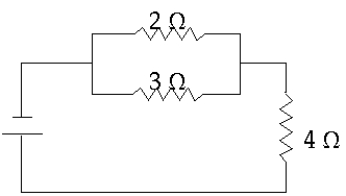 The current in the 2- resistor is 2 A. What is the potential difference across the 3- resistor?
 (Multiple Choice)
4.9/5  (68)
(68) 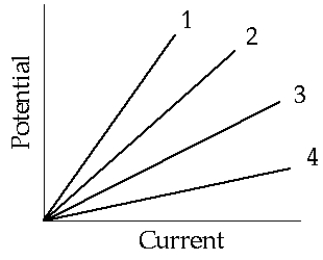 In a laboratory experiment, two unequal resistors are connected individually, then in series, and then in parallel to a group of batteries. Four sets of observations are made of the potential differences and the corresponding total currents and curves are plotted as shown. The curve that represents the smaller of the two resistors is
 (Multiple Choice)
4.9/5 (80)
(80) 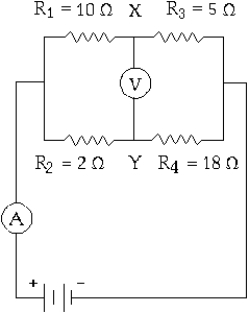 When the ammeter
 reads 7 A, the voltmeter
 reads
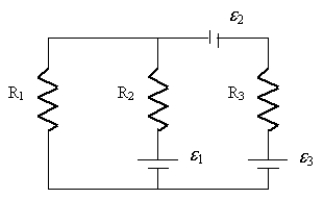 In the above circuit, 1 = 9 V, 2 = 6 V, and 3 = 6 V. Also R1 = 25 , R2 = 125 , and R3 = 55 . Find the current flowing through R3.
 (Multiple Choice)
4.9/5 (82)
(82) 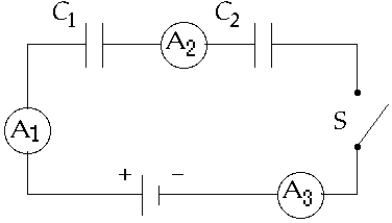 Capacitors C1 and C2 are connected in series to the battery as shown. When you close switch S, a momentary current is indicated by
 (Multiple Choice)
4.9/5 (67)
(67) You want to use a metal bar as a resistor. Its dimensions are 2 by 4 by 10 units. To get the smallest resistance from this bar, you should attach leads to the two opposite sides that have the dimensions of
(Multiple Choice)
4.8/5 (84)
(84) A sensitive galvanometer has a resistance of 180 and requires 2.40 A of current to produce a full-scale deflection. The series resistance needed to construct a voltmeter that gives full-scale deflection for a potential difference of 10.0 V is approximately
(Multiple Choice)
4.9/5 (79)
(79) By what percentage does the resistance of a copper wire ( = 3.9 *10-3/K) increase when its temperature increases from 20 to 75ºC?
(Multiple Choice)
4.8/5 (77)
(77) You connect two identical resistors in series across supply lines maintained at a constant potential difference. When you later connect them in parallel across the same supply lines, the total current furnished by the supply lines, compared with the former current, is
(Multiple Choice)
4.8/5 (75)
(75) 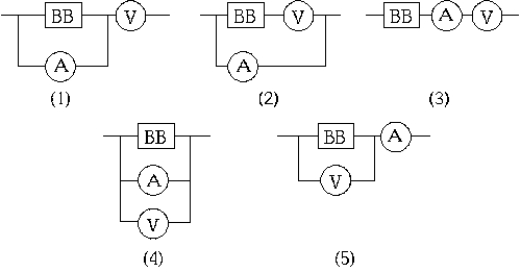 The current through and the potential difference across a black box
 is measured by which of the given ammeter
 and voltmeter
 configurations?
The current through and the potential difference across a black box is measured by which of the given ammeter and voltmeter configurations? (Multiple Choice)
4.8/5 (80)
(80) An energy efficient light bulb uses 15 W of power for an equivalent light output of a
60 W incandescent light bulb. How much energy is saved each month by using the energy efficient light bulb instead of the incandescent light bulb for 4 hours a day? Assume that there are 30 days in one month.
(Multiple Choice)
4.8/5 (83)
(83) Use the diagram for the next two problems:  -The switch S is initially at position b for a long time. It is then switched to position a. Describe what happens to the light bulb as a function of time when the switch is flipped from b to a?
 (Multiple Choice)
5.0/5 (83)
(83) 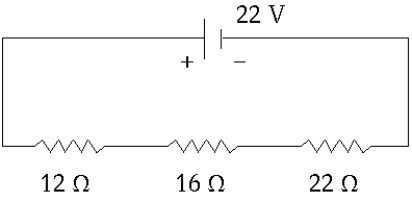 The power delivered by the battery in the circuit shown is
 (Multiple Choice)
4.8/5 (74)
(74) 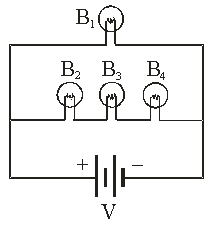 Four identical light bulbs are connected to a power supply as shown. Which light bulb consumes the most power?
 (Multiple Choice)
4.7/5 (86)
(86) An electric generator supplies power as a function of time according to the expression
P(t) = 2t + 3t2
Where the units are SI. The electric energy provided by the generator between t = 0 and t = 1 s is
(Multiple Choice)
4.9/5 (67)
(67) A heating element made of nichrome wire (temperature coefficient of resistivity,
= 0.400 *10-3 K-1) is connected to a source. When it has just been turned on and its temperature is 20ºC, it dissipates 960 W of power. What power is dissipated when its temperature has risen to 300ºC?
(Multiple Choice)
4.8/5 (75)
(75) By what percentage does the resistance of a copper wire ( = 3.9 *10-3/K) increase when its temperature increases from 20ºC to 100ºC?
(Multiple Choice)
4.8/5 (75)
(75) 
Filters
- Essay(0)
- Multiple Choice(0)
- Short Answer(0)
- True False(0)
- Matching(0)