



 Chat with AI
Exam 33: Interference and Diffraction

Exam 1: Systems of Measurement86 Questions
Exam 2: Motion in One Dimension83 Questions
Exam 3: Motion in Two and Three Dimensions60 Questions
Exam 4: Newtons Laws106 Questions
Exam 5: Applications of Newtons Laws73 Questions
Exam 6: Work and Energy60 Questions
Exam 7: Conservation of Energy56 Questions
Exam 8: Systems of Particles and Conservation of Linear Momentum92 Questions
Exam 9: Rotation105 Questions
Exam 10: Conservation of Angular Momentum66 Questions
Exam 11: Gravity84 Questions
Exam 12: Static Equilibrium and Elasticity58 Questions
Exam 13: Fluids77 Questions
Exam 14: Oscillations126 Questions
Exam 15: Wave Motion112 Questions
Exam 16: Superposition and Standing Waves87 Questions
Exam 17: Temperature and the Kinetic Theory of Gases78 Questions
Exam 18: Heat and the First Law of Thermodynamics100 Questions
Exam 19: The Second Law of Thermodynamics59 Questions
Exam 20: Thermal Properties and Processes50 Questions
Exam 21: The Electric Field I: Discrete Charge Distributions55 Questions
Exam 22: The Electric Field Ii: Continuous Charge Distributions64 Questions
Exam 23: Electric Potential87 Questions
Exam 24: Capacitance63 Questions
Exam 25: Electric Current and Direct-Current Circuits107 Questions
Exam 26: The Magnetic Field33 Questions
Exam 27: Sources of the Magnetic Field86 Questions
Exam 28: Magnetic Induction56 Questions
Exam 29: Alternating-Current Circuits106 Questions
Exam 30: Maxwells Equations and Electromagnetic Waves57 Questions
Exam 31: Properties of Light82 Questions
Exam 32: Optical Images106 Questions
Exam 33: Interference and Diffraction91 Questions
Exam 34: Wave Particle Duality and Quantum Physics140 Questions
Exam 35: Applications of the Schrodinger Equation42 Questions
Exam 36: Atoms113 Questions
Exam 37: Molecules39 Questions
Exam 38: Solids and the Theory of Conduction75 Questions
Exam 39: Relativity82 Questions
Exam 40: Nuclear Physics107 Questions
Exam 41: Elementary Particles and the Beginning of the Universe68 Questions
Select questions type


Green light of wavelength 500 nm is incident normally on a diffraction grating that has 5300 lines/cm.The second-order image is diffracted at an angle from the normal of
(Multiple Choice)
4.8/5  (84)
(84) You illuminate a slit 0.20 mm wide with monochromatic light of wavelength 600 nm,and focus the Fraunhofer diffraction pattern on a screen with a lens of focal length 1.50 m.The distance on the screen from the center of the central maximum to the first minimum is
(Multiple Choice)
4.8/5 (81)
(81) Light of wavelength 500 nm illuminates parallel slits and produces an interference pattern on a screen that is 1 m from the slits.In terms of the initial intensity I0,the light's intensity in the interference pattern at a point for which the path difference is 100 nm is
(Multiple Choice)
4.9/5 (75)
(75) A parallel beam of sodium light of wavelength 589 nm is normally incident on a diffraction grating.If the second order diffraction maximum is observed at 50.25 degrees to the normal,then calculate the number of lines per cm of the grating.
(Multiple Choice)
4.8/5 (86)
(86) Two flat planes of glass are laid on top of one another.The upper plane is slightly raised due to the insertion of a thin piece of paper at one end and an air wedge is thus formed.Light of wavelength 500 nm is normally incident on the glass from above and interference fringes are observed by reflection with 2.5 fringes per cm.Calculate the angle of the wedge.
(Multiple Choice)
4.8/5 (72)
(72) You place a convex lens on top of a flat plate of glass and illuminate it with monochromatic light of wavelength 600 nm.You observe a dark circle at the center of the lens,surrounded by a series of concentric dark rings.What is the thickness of the air space between the lens and the flat glass plate where you see the sixth dark ring?
(Multiple Choice)
4.8/5 (85)
(85) A monochromatic beam of light of wavelength 600 nm falls on a grating at normal incidence and produces a second-order image at an angle of 30º.The grating spacing must be
(Multiple Choice)
4.8/5 (73)
(73) Light of wavelength 650 nm is incident on a slit of width 25.0 µm.At what angle is the second diffraction minimum observed?
(Multiple Choice)
4.9/5 (74)
(74) In accordance with the Rayleigh criterion,two points can be just resolved if the centers of their diffraction patterns are separated by
(Multiple Choice)
4.8/5 (70)
(70) Light of wavelength 500 nm illuminates parallel slits and produces an interference pattern on a screen that is 1 m from the slits.In terms of the initial intensity I0,the light's intensity in the interference pattern at a point for which the path difference is 300 nm is
(Multiple Choice)
4.9/5 (78)
(78) The size of the smallest things that can be seen with an optical microscope is limited by diffraction.Which of the following could help a microscopist see smaller things?
(Multiple Choice)
4.9/5 (81)
(81) A single-slit diffraction pattern is displayed on a screen 0.900 m away from the slit.If the wavelength of the light is 600 nm and the slit is 1.50 10-4 m wide,the distance from the first minimum on the right to the first minimum on the left is
(Multiple Choice)
4.8/5 (80)
(80) Which,if any,of the following conditions is not necessary for the light waves from two sources to be coherent?
(Multiple Choice)
4.9/5 (73)
(73) The type of electromagnetic radiation that is employed when crystals are used as diffraction gratings is
(Multiple Choice)
4.9/5 (85)
(85) Use the figure for the next two questions. 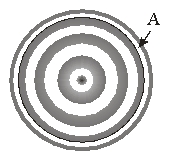 -The interference pattern is from a convex lens placed on a flat reflecting surface using a monochromatic light of wavelength = 550 nm.The distance between the lens and the flat surface at position A is
 (Multiple Choice)
4.8/5 (71)
(71) Two slits separated by 1.0 mm are illuminated with light of a single unknown wavelength.The tenth bright line from the central point of the interference pattern is observed to be at an angle of 0.34º.What is the wavelength of the light?
(Multiple Choice)
4.8/5 (84)
(84) For a grating with d = 4.5 ,the maximum order m of an interference maximum that can be observed for a specified is
(Multiple Choice)
4.7/5 (80)
(80) Two waves,one with amplitude A and the second with amplitude 2A,are out of phase by 180 .The resultant intensity is
(Multiple Choice)
4.9/5 (75)
(75) Which of two diffraction gratings,one with N1 and the other with N2 slits per centimeter,has the greater resolving power if N1 is greater than N2?
(Multiple Choice)
4.8/5 (89)
(89) 
Filters
- Essay(0)
- Multiple Choice(0)
- Short Answer(0)
- True False(0)
- Matching(0)