



 Chat with AI
Exam 33: Interference and Diffraction

Exam 1: Systems of Measurement86 Questions
Exam 2: Motion in One Dimension83 Questions
Exam 3: Motion in Two and Three Dimensions60 Questions
Exam 4: Newtons Laws106 Questions
Exam 5: Applications of Newtons Laws73 Questions
Exam 6: Work and Energy60 Questions
Exam 7: Conservation of Energy56 Questions
Exam 8: Systems of Particles and Conservation of Linear Momentum92 Questions
Exam 9: Rotation105 Questions
Exam 10: Conservation of Angular Momentum66 Questions
Exam 11: Gravity84 Questions
Exam 12: Static Equilibrium and Elasticity58 Questions
Exam 13: Fluids77 Questions
Exam 14: Oscillations126 Questions
Exam 15: Wave Motion112 Questions
Exam 16: Superposition and Standing Waves87 Questions
Exam 17: Temperature and the Kinetic Theory of Gases78 Questions
Exam 18: Heat and the First Law of Thermodynamics100 Questions
Exam 19: The Second Law of Thermodynamics59 Questions
Exam 20: Thermal Properties and Processes50 Questions
Exam 21: The Electric Field I: Discrete Charge Distributions55 Questions
Exam 22: The Electric Field Ii: Continuous Charge Distributions64 Questions
Exam 23: Electric Potential87 Questions
Exam 24: Capacitance63 Questions
Exam 25: Electric Current and Direct-Current Circuits107 Questions
Exam 26: The Magnetic Field33 Questions
Exam 27: Sources of the Magnetic Field86 Questions
Exam 28: Magnetic Induction56 Questions
Exam 29: Alternating-Current Circuits106 Questions
Exam 30: Maxwells Equations and Electromagnetic Waves57 Questions
Exam 31: Properties of Light82 Questions
Exam 32: Optical Images106 Questions
Exam 33: Interference and Diffraction91 Questions
Exam 34: Wave Particle Duality and Quantum Physics140 Questions
Exam 35: Applications of the Schrodinger Equation42 Questions
Exam 36: Atoms113 Questions
Exam 37: Molecules39 Questions
Exam 38: Solids and the Theory of Conduction75 Questions
Exam 39: Relativity82 Questions
Exam 40: Nuclear Physics107 Questions
Exam 41: Elementary Particles and the Beginning of the Universe68 Questions
Select questions type


For two identical rays of light to interfere destructively,their path lengths
(Multiple Choice)
4.8/5  (78)
(78) The distance between the slits in a double-slit experiment is increased by a factor of 4.If the distance between the fringes is small compared with the distance from the slits to the screen,the distance between adjacent fringes near the center of the interference pattern
(Multiple Choice)
4.9/5 (64)
(64) The 200-in reflecting telescope at Mt.Palomar has an objective mirror with a focal length of 16.8 m.The effective aperture is the diameter of the 200-in mirror (200 in = 5.08 m).For light in the blue region (450 nm),what is the smallest angle between two stars that this telescope can ideally resolve? (In practice,the limit of resolution is due to atmospheric turbulence.)
(Multiple Choice)
4.9/5 (84)
(84) Red light ( = 700 nm)is incident normally on a diffraction grating having 1000 lines/cm.A maximum is observed at a deflection angle of 12º.The order in which this occurs is
(Multiple Choice)
4.9/5 (86)
(86) The spacing between the adjacent lines of a diffraction grating is the same as the distance between the two slits in the Young's double slit experiment.Both are illuminated by light of the same wavelength.In which way do the interference fringes seen on the screen differ for the two methods?
(Multiple Choice)
4.9/5 (67)
(67) When a parallel beam of light is diffracted at a single slit,
(Multiple Choice)
4.9/5 (90)
(90) Two side-by-side coherent light sources radiate at 480 nm.At a point in space where the path difference to these two sources is 50 nm,the phase difference could be
(Multiple Choice)
4.8/5 (89)
(89) Hydrogen emits violet light with a wavelength of 410 nm and red light with a wavelength of 656 nm.A parallel beam of hydrogen light is normally incident on a diffraction grating that has 5500 lines per cm.What is the angle between the second order red line and the third order violet line that appear close together?
(Multiple Choice)
5.0/5 (87)
(87) The pupil of the human eye has a diameter of about 5 mm.When the wavelength of light incident on the pupil is 500 nm,the smallest angular separation of two resolvable sources is approximately
(Multiple Choice)
4.9/5 (74)
(74) The pattern of light and dark fringes formed in Young's double-slit experiment is due to
(Multiple Choice)
4.8/5 (69)
(69) Suppose you observe fifteen bright fringes in the central maximum of a double-slit interference pattern.If you know that the separation of the slits d = 0.01 mm,you can conclude that the width of each slit is
(Multiple Choice)
4.9/5 (82)
(82) You set two parallel slits 0.2 mm apart at a distance of 1 m from a screen and illuminate them with light of wavelength 400 nm.The distance between the first and second dark lines of the interference pattern on the screen is
(Multiple Choice)
4.7/5 (74)
(74) In a double slit experiment,a very thin plate of glass of refractive index 1.58 is placed in the light path of one of the slit beams.When this was done,the center of the fringe pattern was displaced by 35 fringe widths.Calculate the thickness of the glass plate if the wavelength of light is 680 nm.
(Multiple Choice)
4.9/5 (79)
(79) Which of the following statements about Young's double-slit experiment is false?
(Multiple Choice)
4.7/5 (69)
(69) Two side-by-side coherent light sources radiate at 633 nm.At a point in space where the path difference to these two sources is 30 nm,the phase difference could be
(Multiple Choice)
4.8/5 (84)
(84) White light is in one case dispersed by refraction on passing through a glass prism and in a second case diffracted by means of a grating.When the red component and the blue component are considered,it is found that
(Multiple Choice)
4.7/5 (81)
(81) Two optically flat plates lie one on top of the other.A sheet of paper 0.1 mm thick is inserted between the plates at one edge.When the plates are illuminated by light of wavelength 589 nm,the number of interference fringes observed by reflected light is approximately
(Multiple Choice)
4.9/5 (76)
(76) Use the figure for the next two questions. 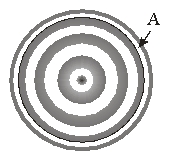 -The interference pattern is from a spherical lens placed on a flat reflecting surface using a monochromatic light of wavelength = 550 nm.If the distance from the center to A is 0.6 mm,the radius of curvature of the lens is
 (Multiple Choice)
4.9/5 (76)
(76) 
Filters
- Essay(0)
- Multiple Choice(0)
- Short Answer(0)
- True False(0)
- Matching(0)