



 Chat with AI
Exam 6: Merchandise Inventory and Cost of Sales

Exam 1: Accounting in Business245 Questions
Exam 2: Analyzing and Reporting Transactions131 Questions
Exam 3: Adjusting Accounts for Financial Statements187 Questions
Exam 4: Completing the Accounting Cycle and Classifying Accounts141 Questions
Exam 5: Accounting for Merchandising Activities127 Questions
Exam 6: Merchandise Inventory and Cost of Sales150 Questions
Exam 7: Accounting Information Systems100 Questions
Exam 8: Internal Control and Cash139 Questions
Exam 9: Receivables145 Questions
Select questions type


Rudd Company made the following merchandise purchases during the current year: 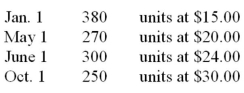 There was no beginning inventory,but ending inventory consisted of 400 units.If Rudd uses the weighted-average cost method and the periodic inventory system,what would be the cost of the ending inventory?
 (Essay)
4.7/5  (85)
(85) In applying the faithful representation principle,an accountant should choose the most realistic value available,so that the inventory value is not overstated.
(True/False)
4.8/5 (73)
(73) Because an inventory error causes an offsetting error in the next period,it is sometimes said to be self-correcting.
(True/False)
5.0/5 (70)
(70) The gross profit ratio measures how much of each dollar of net sales is gross profit.
(True/False)
4.8/5 (83)
(83) When a count of merchandise inventory is taken for the purpose of reconciling goods actually on hand to the inventory control account in the general ledger it is known as taking a(n)________________.
(Short Answer)
4.9/5 (93)
(93) Trekking Company's cost of inventory was $317,500.Due to phenomenal demand the net realizable value has increased to $323,000.Trekking Company should write up the value of inventory under the LCNRV rule.
(True/False)
4.7/5 (100)
(100) On September 30,Stark Company needed to estimate its ending inventory in order to prepare its third-quarter financial statements.The following information is available: (1)Inventory,July 1: $12,500
(2)Third quarter net sales: $40,000
(3)Third quarter net purchases: $17,500
Stark's gross profit ratio is 15%.Estimated cost of goods sold would be:
(Multiple Choice)
4.9/5 (70)
(70) The merchandise turnover ratio is calculated by dividing average merchandise inventory by cost of goods sold.
(True/False)
4.8/5 (81)
(81) A company's ability to pay its short-term obligations depends on how quickly it sells its merchandise inventory.
(True/False)
4.9/5 (81)
(81) The principle of faithful representation provides the guidance in reporting inventory at net realizable value when net realizable value is lower than cost.
(True/False)
4.9/5 (94)
(94) A business that has inventory items that are ordinarily interchangeable may use either the FIFO or moving weighted average methods to assign costs to inventory.
(True/False)
4.9/5 (79)
(79) The principle of faithful representation is used by some companies to justify allocating incidental inventory costs to cost of goods sold.
(True/False)
4.9/5 (70)
(70) An understatement of ending inventory will understate cost of goods sold and overstate net income.
(True/False)
4.9/5 (75)
(75) The retail inventory method of estimating inventory can be used to estimate the amount of inventory shortage if a physical count is also done.
(True/False)
4.7/5 (78)
(78) The days' sales in inventory ratio is calculated by dividing ending inventory by cost of goods sold and multiplying the result by 365.
(True/False)
4.8/5 (69)
(69) If the cost to retail ratio is 60% and ending inventory at retail is $45,000,then estimated ending inventory at cost is $27,000.
(True/False)
4.8/5 (73)
(73) Most businesses use expected sales price minus the cost of making the sale as the definition of net realizable value.
(True/False)
5.0/5 (81)
(81) 
Filters
- Essay(0)
- Multiple Choice(0)
- Short Answer(0)
- True False(0)
- Matching(0)