



 Chat with AI
Exam 17: Stabilization in an Integrated World Economy

Exam 1: The Nature of Economics348 Questions
Exam 2: Scarcity and the World of Trade-Offs411 Questions
Exam 3: Demand and Supply451 Questions
Exam 4: Extensions of Demand and Supply Analysis401 Questions
Exam 5: Public Spending and Public Choice362 Questions
Exam 6: Funding the Public Sector201 Questions
Exam 7: The Macroeconomy: Unemployment, Inflation, and Deflation413 Questions
Exam 8: Measuring the Economys Performance416 Questions
Exam 9: Global Economic Growth and Development290 Questions
Exam 10: Real GDP and the Price Level in the Long Run298 Questions
Exam 11: Classical and Keynesian Macro Analyses368 Questions
Exam 12: Consumption, Real GDP, and the Multiplier452 Questions
Exam 13: Fiscal Policy274 Questions
Exam 14: Deficit Spending and the Public Debt146 Questions
Exam 15: Money, Banking, and Central Banking516 Questions
Exam 16: Domestic and International Dimensions of Monetary Policy357 Questions
Exam 17: Stabilization in an Integrated World Economy321 Questions
Exam 18: Policies and Prospects for Global Economic Growth228 Questions
Exam 19: Demand and Supply Elasticity412 Questions
Exam 20: Consumer Choice459 Questions
Exam 21: Rents, Profits, and the Financial Environment of Business445 Questions
Exam 22: The Firm: Cost and Output Determination391 Questions
Exam 23: Perfect Competition432 Questions
Exam 24: Monopoly386 Questions
Exam 25: Monopolistic Competition307 Questions
Exam 26: Oligopoly and Strategic Behavior308 Questions
Exam 27: Regulation and Antitrust Policy in a Globalized Economy310 Questions
Exam 28: The Labor Market: Demand, Supply and Outsourcing376 Questions
Exam 29: Unions and Labor Market Monopoly Power319 Questions
Exam 30: Income, Poverty, and Health Care304 Questions
Exam 31: Environmental Economics299 Questions
Exam 32: Comparative Advantage and the Open Economy282 Questions
Exam 33: Exchange Rates and the Balance of Payments285 Questions
Select questions type


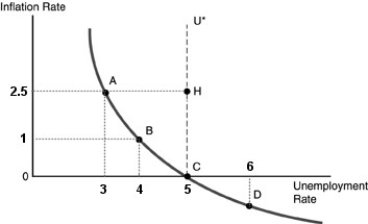 -Refer to the above figure. Suppose the natural rate of unemployment is 5 percent. If the government tried to reduce unemployment to 4 percent and keep it there, it must
 (Multiple Choice)
4.8/5  (90)
(90) Suppose that the inflation rate has been 2 percent per year for several years, and the unemployment rate has been stable at 5 percent. Unanticipated changes in government policy cause the inflation rate to increase to 5 percent. In the short run, we would expect the unemployment rate to
(Multiple Choice)
4.8/5 (76)
(76) The theory of new Keynesian inflation dynamics suggests that a fall in aggregate demand would
(Multiple Choice)
4.8/5 (83)
(83) New Keynesian inflation dynamics predicts that an increase in aggregate demand will generate, in chronological order
(Multiple Choice)
4.8/5 (72)
(72) 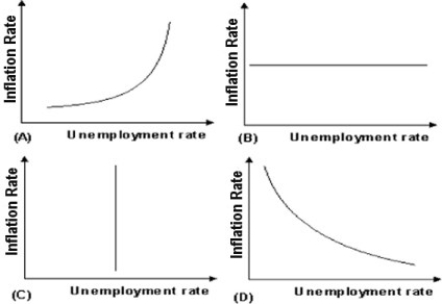 -Use the above figure. The long-run Phillips curve is best depicted by graph
 (Multiple Choice)
4.8/5 (84)
(84) Deviations of the actual unemployment rate away from the natural rate are
(Multiple Choice)
4.8/5 (76)
(76) Under which of the following assumption can activist policies have sizable effects on aggregate demand?
(Multiple Choice)
4.9/5 (78)
(78) What kinds of unemployment are associated with the natural rate of unemployment?
(Essay)
4.7/5 (87)
(87) Under the rational expectations hypothesis, if wages adjust rapidly to new information about intended policy actions, monetary policy can have an effect
(Multiple Choice)
5.0/5 (79)
(79) Which statement is TRUE when rational expectations exist and there is a change in monetary policy which is expected?
(Multiple Choice)
4.9/5 (84)
(84) More recent studies of new Keynesian inflation dynamics indicated that the average price-adjustment intervals in the United States are
(Multiple Choice)
4.9/5 (75)
(75) Those who favor active policymaking argue that all of the following exist EXCEPT
(Multiple Choice)
4.9/5 (78)
(78) Using a graph, show and explain the difference between an anticipated and an unanticipated increase in aggregate demand.
(Essay)
4.9/5 (100)
(100) According to the rational expectations hypothesis, monetary policy can have effects on such variables as real Gross Domestic Product (GDP) in the short run
(Multiple Choice)
4.8/5 (74)
(74) Which one of the following would likely reduce the level of structural unemployment?
(Multiple Choice)
4.9/5 (86)
(86) Suppose the economy is in equilibrium when there is a change in environmental policy that bans all pesticides and herbicides on farmland. We would expect to observe
(Multiple Choice)
4.7/5 (70)
(70) The rational expectations hypothesis is based on all the following assumptions EXCEPT
(Multiple Choice)
4.8/5 (85)
(85) 
Filters
- Essay(0)
- Multiple Choice(0)
- Short Answer(0)
- True False(0)
- Matching(0)