



 Chat with AI
Exam 17: Stabilization in an Integrated World Economy

Exam 1: The Nature of Economics348 Questions
Exam 2: Scarcity and the World of Trade-Offs411 Questions
Exam 3: Demand and Supply451 Questions
Exam 4: Extensions of Demand and Supply Analysis401 Questions
Exam 5: Public Spending and Public Choice362 Questions
Exam 6: Funding the Public Sector201 Questions
Exam 7: The Macroeconomy: Unemployment, Inflation, and Deflation413 Questions
Exam 8: Measuring the Economys Performance416 Questions
Exam 9: Global Economic Growth and Development290 Questions
Exam 10: Real GDP and the Price Level in the Long Run298 Questions
Exam 11: Classical and Keynesian Macro Analyses368 Questions
Exam 12: Consumption, Real GDP, and the Multiplier452 Questions
Exam 13: Fiscal Policy274 Questions
Exam 14: Deficit Spending and the Public Debt146 Questions
Exam 15: Money, Banking, and Central Banking516 Questions
Exam 16: Domestic and International Dimensions of Monetary Policy357 Questions
Exam 17: Stabilization in an Integrated World Economy321 Questions
Exam 18: Policies and Prospects for Global Economic Growth228 Questions
Exam 19: Demand and Supply Elasticity412 Questions
Exam 20: Consumer Choice459 Questions
Exam 21: Rents, Profits, and the Financial Environment of Business445 Questions
Exam 22: The Firm: Cost and Output Determination391 Questions
Exam 23: Perfect Competition432 Questions
Exam 24: Monopoly386 Questions
Exam 25: Monopolistic Competition307 Questions
Exam 26: Oligopoly and Strategic Behavior308 Questions
Exam 27: Regulation and Antitrust Policy in a Globalized Economy310 Questions
Exam 28: The Labor Market: Demand, Supply and Outsourcing376 Questions
Exam 29: Unions and Labor Market Monopoly Power319 Questions
Exam 30: Income, Poverty, and Health Care304 Questions
Exam 31: Environmental Economics299 Questions
Exam 32: Comparative Advantage and the Open Economy282 Questions
Exam 33: Exchange Rates and the Balance of Payments285 Questions
Select questions type


If people do NOT always make the same mistakes when forecasting the future, then
(Multiple Choice)
4.9/5  (81)
(81) 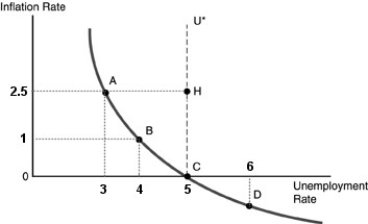 -Refer to the above figure. Line ABCD is a(n)
Deviations of the actual unemployment rate from the natural rate of unemployment are called
(Multiple Choice)
4.8/5 (77)
(77) When it comes to active policymaking most economists agree that
(Multiple Choice)
4.9/5 (60)
(60) An increase in unemployment insurance and other transfer payments may
(Multiple Choice)
4.9/5 (72)
(72) Which type of unemployment is associated with the slump in aggregate demand that accompanies a recession?
(Multiple Choice)
5.0/5 (91)
(91) According to the rational inattention theory, during the periods between informational updates
(Multiple Choice)
4.8/5 (83)
(83) Economists who believe in activist policymaking argue that
(Multiple Choice)
4.8/5 (83)
(83) An unexpected increase in aggregate demand typically causes
(Multiple Choice)
4.9/5 (74)
(74) Those who accept both the rational expectations hypothesis and the assumption of flexibility of wages and price would likely argue that
(Multiple Choice)
4.9/5 (77)
(77) If all the assumptions underpinning the policy irrelevance proposition are in place, fully anticipated monetary policy will
(Multiple Choice)
4.7/5 (78)
(78) According to the theory based on rational expectations and flexible wages and prices,
(Multiple Choice)
4.7/5 (88)
(88) The longer is the interval between firms' price adjustments
(Multiple Choice)
4.9/5 (80)
(80) If a policymaker is convinced that time lags frequently negate the impact of short-run stabilization efforts, it is likely she would favor ________ policymaking.
(Multiple Choice)
4.8/5 (65)
(65) Policymakers' attempts to use the Phillips curve to reduce the unemployment rate below the natural rate
(Multiple Choice)
5.0/5 (77)
(77) According to the rational expectations hypothesis, individuals form their expectations about future values of economic variables by all of the following EXCEPT
(Multiple Choice)
4.8/5 (83)
(83) According to some New Keynesian theories, one possible rationale for active policy making is
(Multiple Choice)
4.7/5 (82)
(82) What kind of relationship appears to actually exist, if one examines the actual data regarding the inflation rate and the unemployment rate for all years since 1953?
(Multiple Choice)
4.8/5 (82)
(82) 
Filters
- Essay(0)
- Multiple Choice(0)
- Short Answer(0)
- True False(0)
- Matching(0)