



 Chat with AI
Exam 17: Stabilization in an Integrated World Economy

Exam 1: The Nature of Economics348 Questions
Exam 2: Scarcity and the World of Trade-Offs411 Questions
Exam 3: Demand and Supply451 Questions
Exam 4: Extensions of Demand and Supply Analysis401 Questions
Exam 5: Public Spending and Public Choice362 Questions
Exam 6: Funding the Public Sector201 Questions
Exam 7: The Macroeconomy: Unemployment, Inflation, and Deflation413 Questions
Exam 8: Measuring the Economys Performance416 Questions
Exam 9: Global Economic Growth and Development290 Questions
Exam 10: Real GDP and the Price Level in the Long Run298 Questions
Exam 11: Classical and Keynesian Macro Analyses368 Questions
Exam 12: Consumption, Real GDP, and the Multiplier452 Questions
Exam 13: Fiscal Policy274 Questions
Exam 14: Deficit Spending and the Public Debt146 Questions
Exam 15: Money, Banking, and Central Banking516 Questions
Exam 16: Domestic and International Dimensions of Monetary Policy357 Questions
Exam 17: Stabilization in an Integrated World Economy321 Questions
Exam 18: Policies and Prospects for Global Economic Growth228 Questions
Exam 19: Demand and Supply Elasticity412 Questions
Exam 20: Consumer Choice459 Questions
Exam 21: Rents, Profits, and the Financial Environment of Business445 Questions
Exam 22: The Firm: Cost and Output Determination391 Questions
Exam 23: Perfect Competition432 Questions
Exam 24: Monopoly386 Questions
Exam 25: Monopolistic Competition307 Questions
Exam 26: Oligopoly and Strategic Behavior308 Questions
Exam 27: Regulation and Antitrust Policy in a Globalized Economy310 Questions
Exam 28: The Labor Market: Demand, Supply and Outsourcing376 Questions
Exam 29: Unions and Labor Market Monopoly Power319 Questions
Exam 30: Income, Poverty, and Health Care304 Questions
Exam 31: Environmental Economics299 Questions
Exam 32: Comparative Advantage and the Open Economy282 Questions
Exam 33: Exchange Rates and the Balance of Payments285 Questions
Select questions type


We observe the duration of unemployment rising and wage rates falling. It is likely that
(Multiple Choice)
4.9/5  (82)
(82) 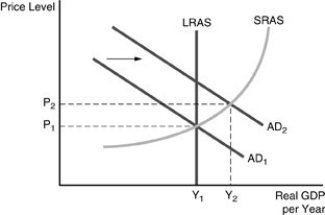 -Refer to the above figure. Unexpected expansionary monetary policy has caused the aggregate demand curve to shift to AD2. In the long run
 (Multiple Choice)
4.8/5 (77)
(77) According to the hypothesis of New Keynesian inflation dynamics, an increase in aggregate demand brings about
(Multiple Choice)
4.9/5 (78)
(78) The U.S. economic data for the last 50 years indicates that
(Multiple Choice)
4.8/5 (81)
(81) A plot of points representing the rate of inflation and the unemployment for the United States since 1953 reveals that
(Multiple Choice)
4.9/5 (79)
(79) Those who favor passive policymaking do so because they conclude that
(Multiple Choice)
4.9/5 (81)
(81) 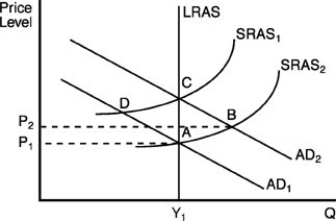 -In the above figure, if initial equilibrium is at point A and if there is an unanticipated increase in aggregate demand from AD1 to AD2, then
 (Multiple Choice)
4.8/5 (76)
(76) A key implication of the policy irrelevance proposition is that
(Multiple Choice)
5.0/5 (77)
(77) Suppose the natural rate of unemployment is 6 percent. If the actual unemployment rate is 5 percent, then the cyclical unemployment rate is
(Multiple Choice)
5.0/5 (72)
(72) One economic hypothesis states that people form expectations by combining the effects of past policy changes on important economic variables with their own judgment about the future effects of current and future policy changes, and then react accordingly. This is known as the
(Multiple Choice)
4.9/5 (68)
(68) During the 1970s, the shocks to the United States' economy resulted in
(Multiple Choice)
4.8/5 (92)
(92) If you accept the rational expectations hypothesis as accurate, what would you tell monetary policy makers who ask you how to more effectively manage the economy?
(Multiple Choice)
4.9/5 (72)
(72)
-Refer to the above figure. Unexpected expansionary monetary policy has caused the aggregate demand curve to shift to AD2. In the short run
-Refer to the above figure. Unexpected expansionary monetary policy has caused the aggregate demand curve to shift to AD2. In the short run (Multiple Choice)
4.9/5 (71)
(71) Suppose the Fed permanently increases the money supply by a given amount. Which of the following is most likely to occur in the long run as a result of this monetary policy action?
(Multiple Choice)
4.9/5 (82)
(82) 
Filters
- Essay(0)
- Multiple Choice(0)
- Short Answer(0)
- True False(0)
- Matching(0)