



 Chat with AI
Exam 20: Electric Potential and Capacitance

Exam 1: Introduction and Vectors69 Questions
Exam 2: Motion in One Dimension55 Questions
Exam 3: Motion in Two Dimensions82 Questions
Exam 4: The Laws of Motion97 Questions
Exam 5: More Applications of Newtons Laws80 Questions
Exam 6: Energy of a System81 Questions
Exam 7: Conservation of Energy77 Questions
Exam 8: Momentum and Collisions84 Questions
Exam 9: Relativity31 Questions
Exam 10: Rotational Motion121 Questions
Exam 11: Gravity,planetary Orbits,and the Hydrogen Atom62 Questions
Exam 12: Oscillatory Motion44 Questions
Exam 13: Mechanical Waves56 Questions
Exam 14: Superposition and Standing Waves57 Questions
Exam 15: Fluid Mechanics48 Questions
Exam 16: Temperature and the Kinetic Theory of Gases54 Questions
Exam 17: Energy in Thermal Processes: the First Law of Thermodynamics69 Questions
Exam 18: Heat Engines,entropy,and the Second Law of Thermodynamics51 Questions
Exam 19: Electric Forces and Electric Fields156 Questions
Exam 20: Electric Potential and Capacitance158 Questions
Exam 21: Current and Direct Current Circuits113 Questions
Exam 22: Magnetic Forces and Magnetic Fields157 Questions
Exam 23: Faradays Law and Inductance76 Questions
Exam 24: Electromagnetic Waves41 Questions
Exam 25: Reflection and Refraction of Light34 Questions
Exam 26: Image Formation by Mirrors and Lenses41 Questions
Exam 27: Wave Optics72 Questions
Exam 28: Quantum Physics69 Questions
Exam 29: Atomic Physics35 Questions
Exam 30: Nuclear Physics62 Questions
Exam 31: Particle Physics31 Questions
Select questions type


An infinite plane of charge with is tilted at a 45 angle to the vertical direction as shown below.The potential difference,VB -VA,in volts,between points A and B,a 4.50 m distance apart,is 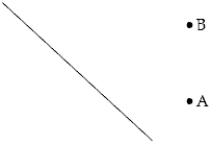
(Multiple Choice)
4.9/5  (76)
(76) A 60- C charge is held fixed at the origin and a -20- C charge is held fixed on the x axis at a point x = 1.0 m.If a 10- C charge is released from rest at a point x = 40 cm,what is its kinetic energy the instant it passes the point x = 70 cm?
(Multiple Choice)
4.8/5 (94)
(94) What is the equivalent capacitance of the combination shown? 
(Multiple Choice)
4.8/5 (79)
(79) A charge per unit length given by (x)= bx,where b = 12 nC/m2,is distributed along the x axis from x = +9.0 cm to x = +16 cm.If the electric potential at infinity is taken to be zero,what is the electric potential at the point P on the y axis at y = 12 cm?
(Multiple Choice)
4.9/5 (75)
(75) If VA - VB = 50 V,how much energy is stored in the 36- F capacitor? 
(Multiple Choice)
4.9/5 (83)
(83) 
A rod (length = 2.0 m)is uniformly charged and has a total charge of 5.0 nC.What is the electric potential (relative to zero at infinity)at a point which lies along the axis of the rod and is 3.0 m from the center of the rod?
(Multiple Choice)
4.9/5 (88)
(88) What is the equivalent capacitance of the combination shown? 
(Multiple Choice)
4.9/5 (85)
(85) A 0.120 pF parallel-plate capacitor is charged to a potential difference of 10.0 V and then disconnected from the battery.A cosmic ray burst creates 1.00*106 electrons and 1.00 * 106 positive charges between the plates.If the charges do not recombine,but reach the oppositely charged plates,by how much is the potential difference between the capacitor plates reduced?
(Multiple Choice)
4.9/5 (81)
(81) What is the total energy stored in the group of capacitors shown if the charge on the 30- F capacitor is 0.90 mC? 
(Multiple Choice)
4.9/5 (80)
(80) Several charges in the neighborhood of point P produce an electric potential of 6.0 kV (relative to zero at infinity)and an electric field of N/C at point P.Determine the work required of an external agent to move a 3.0- C charge along the x axis from infinity to point P without any net change in the kinetic energy of the particle.
(Multiple Choice)
4.8/5 (71)
(71) When introduced into a region where an electric field is present,an electron with initial velocity will eventually move
(Multiple Choice)
4.9/5 (78)
(78) A parallel plate capacitor of capacitance C0 has plates of area A with separation d between them.When it is connected to a battery of voltage V0,it has charge of magnitude Q0 on its plates.It is then disconnected from the battery and the space between the plates is filled with a material of dielectric constant 3.After the dielectric is added,the magnitudes of the charge on the plates and the potential difference between them are
(Multiple Choice)
4.9/5 (76)
(76) 
A particle (mass = 6.7*10 - 27 kg,charge = 3.2 *10 - 19 C)moves along the positive x axis with a speed of 4.8 *105 m/s.It enters a region of uniform electric field parallel to its motion and comes to rest after moving 2.0 m into the field.What is the magnitude of the electric field?
(Multiple Choice)
4.7/5 (89)
(89) A particle (q = +5.0 C)is released from rest when it is 2.0 m from a charged particle which is held at rest.After the positively charged particle has moved 1.0 m toward the fixed particle,it has a kinetic energy of 50 mJ.What is the charge on the fixed particle?
(Multiple Choice)
4.9/5 (87)
(87) Four identical point charges (+4.0 C)are placed at the corners of a square which has 20-cm sides.How much work is required to assemble this charge arrangement starting with each of the charges a very large distance from any of the other charges?
(Multiple Choice)
4.9/5 (76)
(76) 
Filters
- Essay(0)
- Multiple Choice(0)
- Short Answer(0)
- True False(0)
- Matching(0)