



 Chat with AI
Exam 20: Electric Potential and Capacitance

Exam 1: Introduction and Vectors69 Questions
Exam 2: Motion in One Dimension55 Questions
Exam 3: Motion in Two Dimensions82 Questions
Exam 4: The Laws of Motion97 Questions
Exam 5: More Applications of Newtons Laws80 Questions
Exam 6: Energy of a System81 Questions
Exam 7: Conservation of Energy77 Questions
Exam 8: Momentum and Collisions84 Questions
Exam 9: Relativity31 Questions
Exam 10: Rotational Motion121 Questions
Exam 11: Gravity,planetary Orbits,and the Hydrogen Atom62 Questions
Exam 12: Oscillatory Motion44 Questions
Exam 13: Mechanical Waves56 Questions
Exam 14: Superposition and Standing Waves57 Questions
Exam 15: Fluid Mechanics48 Questions
Exam 16: Temperature and the Kinetic Theory of Gases54 Questions
Exam 17: Energy in Thermal Processes: the First Law of Thermodynamics69 Questions
Exam 18: Heat Engines,entropy,and the Second Law of Thermodynamics51 Questions
Exam 19: Electric Forces and Electric Fields156 Questions
Exam 20: Electric Potential and Capacitance158 Questions
Exam 21: Current and Direct Current Circuits113 Questions
Exam 22: Magnetic Forces and Magnetic Fields157 Questions
Exam 23: Faradays Law and Inductance76 Questions
Exam 24: Electromagnetic Waves41 Questions
Exam 25: Reflection and Refraction of Light34 Questions
Exam 26: Image Formation by Mirrors and Lenses41 Questions
Exam 27: Wave Optics72 Questions
Exam 28: Quantum Physics69 Questions
Exam 29: Atomic Physics35 Questions
Exam 30: Nuclear Physics62 Questions
Exam 31: Particle Physics31 Questions
Select questions type


Identical 8.0- C point charges are positioned on the x axis at x = 1.0 m and released from rest simultaneously.What is the kinetic energy of either of the charges after it has moved 2.0 m?
(Multiple Choice)
4.9/5  (89)
(89) Three identical point charges (+2.0 nC)are placed at the corners of an equilateral triangle with sides of 2.0-m length.If the electric potential is taken to be zero at infinity,what is the potential at the midpoint of any one of the sides of the triangle?
(Multiple Choice)
4.8/5 (81)
(81) Two particles,each having a mass of 3.0 g and having equal but opposite charges of magnitude 5.0 nC,are released simultaneously from rest when the two are 5.0 cm apart.What is the speed of either particle at the instant when the two are separated by 2.0 cm?
(Multiple Choice)
4.9/5 (77)
(77) A charge of uniform density (0.80 nC/m)is distributed along the x axis from the origin to the point x = 10 cm.What is the electric potential (relative to zero at infinity)at a point,x = 18 cm,on the x axis?
(Multiple Choice)
4.8/5 (73)
(73) A charge of +3.0 C is distributed uniformly along the circumference of a circle with a radius of 20 cm.How much external energy is required to bring a charge of 25 C from infinity to the center of the circle?
(Multiple Choice)
5.0/5 (82)
(82) What is the potential difference across C2 when C1 = 5.0 F,C2 = 15 F,C3 = 30 F,and V0 = 24 V? 
(Multiple Choice)
4.8/5 (78)
(78) If C = 10 F,what is the equivalent capacitance for the combination shown? 
(Multiple Choice)
4.9/5 (73)
(73) In the Bohr model of the hydrogen atom,the electron circles the proton at a distance of 0.529 *10 - 10 m.Find the potential at the position of the electron.
(Short Answer)
4.9/5 (84)
(84) A charge of 20 nC is distributed uniformly along the x axis from x = -2.0 m to x = +2.0 m.What is the electric potential (relative to zero at infinity)at the point x = 5.0 m on the x axis?
(Multiple Choice)
4.8/5 (66)
(66) How much electrical charge is needed to raise an isolated metal sphere of radius 1.0 m to a potential of 1.0 *106 V?
(Short Answer)
4.9/5 (71)
(71) For the potential ,what is the corresponding electric field at the point (2,2,2)?
(Multiple Choice)
4.7/5 (79)
(79) When a capacitor has a charge of magnitude 80 C on each plate the potential difference across the plates is 16 V.How much energy is stored in this capacitor when the potential difference across its plates is 42 V?
(Multiple Choice)
4.9/5 (78)
(78) An electron (m = 9.1 *10 - 31 kg,q = -1.6*10 - 19 C)starts from rest at point A and has a speed of 5.0 *106 m/s at point B.Only electric forces act on it during this motion.Determine the electric potential difference VA -VB.
(Multiple Choice)
4.8/5 (79)
(79) An electric dipole having dipole moment of magnitude p is placed in a uniform electric field having magnitude E.What is the magnitude of the greatest change in potential energy that can happen for this dipole in this field?
(Multiple Choice)
4.9/5 (87)
(87) Point charges of equal magnitudes (25 nC)and opposite signs are placed on (diagonally)opposite corners of a 60-cm *80-cm rectangle.If point A is the corner of this rectangle nearest the positive charge and point B is located at the intersection of the diagonals of the rectangle,determine the potential difference,VB -VA.
(Multiple Choice)
4.7/5 (74)
(74) Determine the energy stored by C4 when C1 = 20 F,C2 = 10 F,C3 = 14 F,C4 = 30 F,and V0 = 45 V. 
(Multiple Choice)
4.7/5 (73)
(73) The electric potential at the surface of a charged conductor
(Multiple Choice)
4.7/5 (89)
(89) The Bohr model pictures a hydrogen atom in its ground state as a proton and an electron separated by the distance a0 = 0.529 * 10 - 10 m.The electric potential created by the proton at the position of the electron is
(Multiple Choice)
4.7/5 (88)
(88) Charge of uniform density (3.5 nC/m)is distributed along the circular arc shown.Determine the electric potential (relative to zero at infinity)at point P. 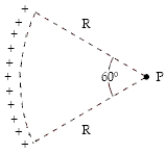
(Multiple Choice)
4.9/5 (76)
(76) Two particles,each having a mass of 3.0 g and having equal but opposite charges of magnitude of 6.0 nC,are released simultaneously from rest when they are a very large distance apart.What distance separates the two at the instant when each has a speed of 5.0 m/s?
(Multiple Choice)
4.9/5 (77)
(77) 
Filters
- Essay(0)
- Multiple Choice(0)
- Short Answer(0)
- True False(0)
- Matching(0)