



 Chat with AI
Exam 20: Electric Potential and Capacitance

Exam 1: Introduction and Vectors69 Questions
Exam 2: Motion in One Dimension55 Questions
Exam 3: Motion in Two Dimensions82 Questions
Exam 4: The Laws of Motion97 Questions
Exam 5: More Applications of Newtons Laws80 Questions
Exam 6: Energy of a System81 Questions
Exam 7: Conservation of Energy77 Questions
Exam 8: Momentum and Collisions84 Questions
Exam 9: Relativity31 Questions
Exam 10: Rotational Motion121 Questions
Exam 11: Gravity,planetary Orbits,and the Hydrogen Atom62 Questions
Exam 12: Oscillatory Motion44 Questions
Exam 13: Mechanical Waves56 Questions
Exam 14: Superposition and Standing Waves57 Questions
Exam 15: Fluid Mechanics48 Questions
Exam 16: Temperature and the Kinetic Theory of Gases54 Questions
Exam 17: Energy in Thermal Processes: the First Law of Thermodynamics69 Questions
Exam 18: Heat Engines,entropy,and the Second Law of Thermodynamics51 Questions
Exam 19: Electric Forces and Electric Fields156 Questions
Exam 20: Electric Potential and Capacitance158 Questions
Exam 21: Current and Direct Current Circuits113 Questions
Exam 22: Magnetic Forces and Magnetic Fields157 Questions
Exam 23: Faradays Law and Inductance76 Questions
Exam 24: Electromagnetic Waves41 Questions
Exam 25: Reflection and Refraction of Light34 Questions
Exam 26: Image Formation by Mirrors and Lenses41 Questions
Exam 27: Wave Optics72 Questions
Exam 28: Quantum Physics69 Questions
Exam 29: Atomic Physics35 Questions
Exam 30: Nuclear Physics62 Questions
Exam 31: Particle Physics31 Questions
Select questions type


A particle (charge = +2.0 mC)moving in a region where only electric forces act on it has a kinetic energy of 5.0 J at point A.The particle subsequently passes through point B which has an electric potential of +1.5 kV relative to point A.Determine the kinetic energy of the particle as it moves through point B.
(Multiple Choice)
4.7/5  (80)
(80) A 30- F capacitor is charged to 80 V and then connected across an initially uncharged capacitor of unknown capacitance C.If the final potential difference across the 30- F capacitor is 20 V,determine C.
(Multiple Choice)
4.9/5 (76)
(76) A particle (charge = 50 C)moves in a region where the only force on it is an electric force.As the particle moves 25 cm from point A to point B,its kinetic energy increases by 1.5 mJ.Determine the electric potential difference,VB - VA.
(Multiple Choice)
4.8/5 (76)
(76) A 25- F capacitor charged to 50 V and a capacitor C charged to 20 V are connected to each other,with the two positive plates connected and the two negative plates connected.The final potential difference across the 25- F capacitor is 36 V.What is the value of the capacitance of C?
(Multiple Choice)
4.9/5 (81)
(81) Determine the equivalent capacitance of the combination shown when C = 12 nF. 
(Multiple Choice)
4.9/5 (75)
(75) A parallel plate capacitor is connected to a battery and charged to voltage V.Leah says that the charge on the plates will decrease if the distance between the plates is increased while they are still connected to the battery.Gertie says that the charge will remain the same.Which one,if either,is correct,and why?
(Multiple Choice)
4.7/5 (85)
(85) Two flat conductors are placed with their inner faces separated by 6.0 mm.If the surface charge density on one of the inner faces is 40 pC/m2,what is the magnitude of the electric potential differences between the two conductors?
(Multiple Choice)
4.8/5 (76)
(76) Which of the following represents the equipotential lines of a dipole?
(Multiple Choice)
4.7/5 (82)
(82) A particle (charge = 5.0 C)is released from rest at a point x = 10 cm.If a 5.0- C charge is held fixed at the origin,what is the kinetic energy of the particle after it has moved 90 cm?
(Multiple Choice)
4.8/5 (98)
(98) Points A [at (3,6)m] and B [at (8,-3)m] are in a region where the electric field is uniform and given by N/C.What is the electric potential difference VA - VB?
(Multiple Choice)
4.9/5 (80)
(80) A parallel plate capacitor of capacitance C0 has plates of area A with separation d between them.When it is connected to a battery of voltage V0,it has charge of magnitude Q0 on its plates.While it is connected to the battery the space between the plates is filled with a material of dielectric constant 3.After the dielectric is added,the magnitude of the charge on the plates and the potential difference between them are
(Multiple Choice)
4.9/5 (71)
(71) A parallel plate capacitor of capacitance C0 has plates of area A with separation d between them.When it is connected to a battery of voltage V0,it has charge of magnitude Q0 on its plates.While it is connected to the battery,the space between the plates is filled with a material of dielectric constant 3.After the dielectric is added,the magnitude of the charge on the plates and the new capacitance are
(Multiple Choice)
4.8/5 (81)
(81) The electric field in the region defined by the y-z plane and the positive x axis is given by E = ax,where a is a constant.(There is no field for negative values of x. )As x increases in magnitude,relative to V = 0 at the origin,the electric potential in the region defined above is
(Multiple Choice)
5.0/5 (83)
(83) Which statement is always correct when applied to a charge distribution located in a finite region of space?
(Multiple Choice)
4.8/5 (68)
(68) If a = 30 cm,b = 20 cm,q = +2.0 nC,and Q = -3.0 nC in the figure,what is the potential difference VA - VB? 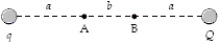
(Multiple Choice)
4.8/5 (83)
(83) If VA- VB = 50 V,how much energy is stored in the 54- F capacitor? 
(Multiple Choice)
4.8/5 (84)
(84) The Bohr model pictures a hydrogen atom in its ground state as a proton and an electron separated by the distance a0 = 0.529 *10 - 10 m.The electric potential created by the electron at the position of the proton is
(Multiple Choice)
4.7/5 (76)
(76) Two identical particles,each with a mass of 4.5 g and a charge of 30 nC,are moving directly toward each other with equal speeds of 4.0 m/s at an instant when the distance separating the two is equal to 25 cm.How far apart will they be when closest to one another?
(Multiple Choice)
4.8/5 (78)
(78) A 3.0- F capacitor charged to 40 V and a 5.0- F capacitor charged to 18 V are connected to each other,with the positive plate of each connected to the negative plate of the other.What is the final charge on the 3.0- F capacitor?
(Multiple Choice)
4.8/5 (88)
(88) 
Filters
- Essay(0)
- Multiple Choice(0)
- Short Answer(0)
- True False(0)
- Matching(0)