



 Chat with AI
Exam 13: Meiosis

Exam 1: Biology and the Tree of Life37 Questions
Exam 2: Water and Carbon: the Chemical Basis of Life59 Questions
Exam 3: Protein Structure and Function59 Questions
Exam 4: Nucleic Acids and the Rna World43 Questions
Exam 5: An Introduction to Carbohydrates44 Questions
Exam 53: Ecosystems and Global Ecology57 Questions
Exam 6: Lipids, Membranes, and the First Cells59 Questions
Exam 7: Inside the Cell60 Questions
Exam 8: Energy and Enzymes: an Introduction to Metabolism60 Questions
Exam 9: Cellular Respiration and Fermentation61 Questions
Exam 10: Photosynthesis58 Questions
Exam 11: Cellcell Interactions52 Questions
Exam 12: The Cell Cycle59 Questions
Exam 13: Meiosis63 Questions
Exam 14: Mendel and the Gene60 Questions
Exam 15: Dna and the Gene: Synthesis and Repair51 Questions
Exam 16: How Genes Work48 Questions
Exam 17: Transcription, Rna Processing, and Translation58 Questions
Exam 18: Control of Gene Expression in Bacteria29 Questions
Exam 19: Control of Gene Expression in Eukaryotes56 Questions
Exam 20: The Molecular Revolution: Biotechnology and Beyond70 Questions
Exam 21: Genes, Development, and Evolution38 Questions
Exam 22: Evolution by Natural Selection38 Questions
Exam 23: Evolutionary Processes37 Questions
Exam 24: Speciation56 Questions
Exam 25: Phylogenies and the History of Life63 Questions
Exam 26: Bacteria and Archaea38 Questions
Exam 27: Protists37 Questions
Exam 28: Green Algae and Land Plants59 Questions
Exam 29: Fungi47 Questions
Exam 30: An Introduction to Animals48 Questions
Exam 31: Protostome Animals54 Questions
Exam 32: Deuterostome Animals60 Questions
Exam 33: Viruses44 Questions
Exam 34: Plant Form and Function46 Questions
Exam 35: Water and Sugar Transport in Plants47 Questions
Exam 36: Plant Nutrition54 Questions
Exam 37: Plant Sensory Systems, Signals, and Responses48 Questions
Exam 38: Plant Reproduction and Development51 Questions
Exam 39: Animal Form and Function53 Questions
Exam 40: Water and Electrolyte Balance in Animals60 Questions
Exam 41: Animal Nutrition94 Questions
Exam 42: Gas Exchange and Circulation93 Questions
Exam 43: Animal Nervous Systems100 Questions
Exam 44: Animal Sensory Systems50 Questions
Exam 45: Animal Movement40 Questions
Exam 46: Chemical Signals in Animals59 Questions
Exam 47: Animal Reproduction and Development104 Questions
Exam 48: The Immune System in Animals77 Questions
Exam 49: An Introduction to Ecology40 Questions
Exam 50: Behavioral Ecology40 Questions
Exam 51: Population Ecology57 Questions
Exam 52: Community Ecology55 Questions
Exam 54: Biodiversity and Conservation Biology43 Questions
Select questions type


Which of the following is a TRUE statement about sexual versus asexual reproduction?
(Multiple Choice)
4.8/5  (74)
(74) There is a group of invertebrate animals called rotifers, among which a particular group of species reproduces, as far as is known, only asexually. These rotifers, however, have survived a long evolutionary history without evidence of having been overcome by excessive mutations. Since the rotifers develop from eggs, but asexually, what can you predict?
(Multiple Choice)
4.8/5 (82)
(82) 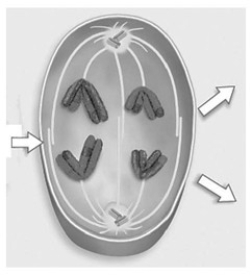 What phase of meiosis is seen in the accompanying figure?
What is a major difference between mitosis and meiosis I in a diploid organism?
(Multiple Choice)
4.9/5 (74)
(74) The diploid number of a roundworm species is 4. Assuming there is no crossover, and random segregation of homologs during meiosis, how many different possible combinations of chromosomes might there be in the offspring?
(Multiple Choice)
4.8/5 (84)
(84) What is a major difference between meiosis II and mitosis in a diploid animal?
(Multiple Choice)
5.0/5 (77)
(77) All individuals of a particular species of whiptail lizards are females. Their reproductive efforts depend on ________.
(Multiple Choice)
4.7/5 (87)
(87) In the snail Pomacea patula catemacensis, n = 13. What is the diploid number for this organism?
(Multiple Choice)
4.8/5 (82)
(82) Sister chromatids separate from each other during ________.
(Multiple Choice)
5.0/5 (84)
(84) Independent assortment of chromosomes is a result of ________.
(Multiple Choice)
4.9/5 (79)
(79) A couple has a child with Down syndrome. The mother is 39 years old at the time of delivery. Which of the following is the most probable cause of the child's condition?
(Multiple Choice)
4.7/5 (76)
(76) Crossing over normally takes place during which of the following processes?
(Multiple Choice)
4.8/5 (77)
(77) Refer to the information and associated figure to answer the following question(s).
-A female with a paternal set of one orange and one long gene chromosome and a maternal set comprised of one blue and one short gene chromosome is expected to produce which of the following types of eggs after meiosis?
(Multiple Choice)
4.7/5 (89)
(89) Somatic cells of roundworms have four individual chromosomes per cell. How many chromosomes would you expect to find in an ovum from a roundworm?
(Multiple Choice)
4.8/5 (82)
(82) If a cell has completed meiosis I and is just beginning meiosis II, which of the following is an appropriate description of its contents?
(Multiple Choice)
4.8/5 (74)
(74) If meiosis produces haploid cells, how is the diploid number restored for those organisms that spend most of their life cycle in the diploid state?
(Multiple Choice)
4.7/5 (79)
(79) 
Filters
- Essay(0)
- Multiple Choice(0)
- Short Answer(0)
- True False(0)
- Matching(0)