



 Chat with AI
Exam 15: Dna and the Gene: Synthesis and Repair

Exam 1: Biology and the Tree of Life37 Questions
Exam 2: Water and Carbon: the Chemical Basis of Life59 Questions
Exam 3: Protein Structure and Function59 Questions
Exam 4: Nucleic Acids and the Rna World43 Questions
Exam 5: An Introduction to Carbohydrates44 Questions
Exam 53: Ecosystems and Global Ecology57 Questions
Exam 6: Lipids, Membranes, and the First Cells59 Questions
Exam 7: Inside the Cell60 Questions
Exam 8: Energy and Enzymes: an Introduction to Metabolism60 Questions
Exam 9: Cellular Respiration and Fermentation61 Questions
Exam 10: Photosynthesis58 Questions
Exam 11: Cellcell Interactions52 Questions
Exam 12: The Cell Cycle59 Questions
Exam 13: Meiosis63 Questions
Exam 14: Mendel and the Gene60 Questions
Exam 15: Dna and the Gene: Synthesis and Repair51 Questions
Exam 16: How Genes Work48 Questions
Exam 17: Transcription, Rna Processing, and Translation58 Questions
Exam 18: Control of Gene Expression in Bacteria29 Questions
Exam 19: Control of Gene Expression in Eukaryotes56 Questions
Exam 20: The Molecular Revolution: Biotechnology and Beyond70 Questions
Exam 21: Genes, Development, and Evolution38 Questions
Exam 22: Evolution by Natural Selection38 Questions
Exam 23: Evolutionary Processes37 Questions
Exam 24: Speciation56 Questions
Exam 25: Phylogenies and the History of Life63 Questions
Exam 26: Bacteria and Archaea38 Questions
Exam 27: Protists37 Questions
Exam 28: Green Algae and Land Plants59 Questions
Exam 29: Fungi47 Questions
Exam 30: An Introduction to Animals48 Questions
Exam 31: Protostome Animals54 Questions
Exam 32: Deuterostome Animals60 Questions
Exam 33: Viruses44 Questions
Exam 34: Plant Form and Function46 Questions
Exam 35: Water and Sugar Transport in Plants47 Questions
Exam 36: Plant Nutrition54 Questions
Exam 37: Plant Sensory Systems, Signals, and Responses48 Questions
Exam 38: Plant Reproduction and Development51 Questions
Exam 39: Animal Form and Function53 Questions
Exam 40: Water and Electrolyte Balance in Animals60 Questions
Exam 41: Animal Nutrition94 Questions
Exam 42: Gas Exchange and Circulation93 Questions
Exam 43: Animal Nervous Systems100 Questions
Exam 44: Animal Sensory Systems50 Questions
Exam 45: Animal Movement40 Questions
Exam 46: Chemical Signals in Animals59 Questions
Exam 47: Animal Reproduction and Development104 Questions
Exam 48: The Immune System in Animals77 Questions
Exam 49: An Introduction to Ecology40 Questions
Exam 50: Behavioral Ecology40 Questions
Exam 51: Population Ecology57 Questions
Exam 52: Community Ecology55 Questions
Exam 54: Biodiversity and Conservation Biology43 Questions
Select questions type


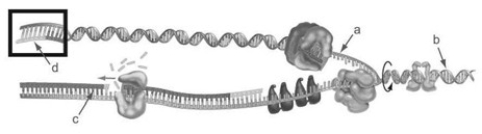 Identify the lagging strand during duplication of DNA starting from a double helix in the accompanying figure.
 (Multiple Choice)
4.9/5  (62)
(62) What is a major difference between eukaryotic DNA replication and prokaryotic DNA replication?
(Multiple Choice)
4.8/5 (76)
(76) Use the following information to answer the question below.
The herpes viruses are important enveloped DNA viruses that cause disease in vertebrates and in some invertebrates such as oysters. Some of the human forms are herpes simplex virus (HSV) types I and II, causing facial and genital lesions, and the varicella zoster virus (VSV), causing chicken pox and shingles. Each of these three actively infects nervous tissue. Primary infections are fairly mild, but the virus is not then cleared from the host; rather, viral genomes are maintained in cells in a latent phase. The virus can later reactivate, replicate again, and infect others.
In electron micrographs of HSV infection, it can be seen that the intact virus initially reacts with cell surface proteoglycans, then with specific receptors. This is later followed by viral capsids docking with nuclear pores. Afterward, the capsids go from being full to being "empty." Which of the following best fits these observations?
(Multiple Choice)
4.8/5 (92)
(92) 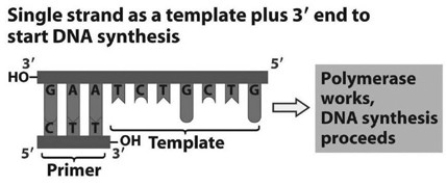 Refer to the figure associated with this question. What bases will be added to the primer as DNA replication proceeds? The bases should appear in the new strand in the order that they will be added starting at the 3' end of the primer.
 (Multiple Choice)
4.7/5 (84)
(84) Telomere shortening puts a limit on the number of times a cell can divide. Research has shown that telomerase can extend the life span of cultured human cells. How might adding telomerase affect cellular aging?
(Multiple Choice)
4.8/5 (79)
(79) In trying to determine whether DNA or protein is the genetic material, Hershey and Chase made use of which of the following facts?
(Multiple Choice)
4.8/5 (77)
(77) E. coli cells grown on 15N medium are transferred to 14N medium and allowed to grow for two more generations (two rounds of DNA replication). DNA extracted from these cells is centrifuged. What density distribution of DNA would you expect in this experiment?
(Multiple Choice)
4.9/5 (68)
(68) 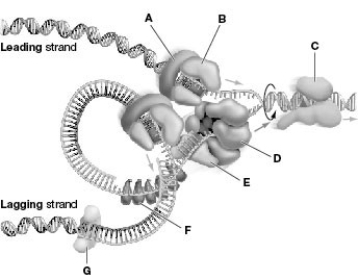 In the accompanying figure, which structure causes the two strands of DNA to separate?
 (Multiple Choice)
4.8/5 (87)
(87) In analyzing the number of different bases in a DNA sample, which result would be consistent with the base-pairing rules?
(Multiple Choice)
5.0/5 (65)
(65) DNA contains the template needed to copy itself, but it has no catalytic activity in cells. What catalyzes the formation of phosphodiester bonds between adjacent nucleotides in the DNA polymer being formed?
(Multiple Choice)
4.9/5 (84)
(84) 
Filters
- Essay(0)
- Multiple Choice(0)
- Short Answer(0)
- True False(0)
- Matching(0)