



 Chat with AI
Exam 16: How Genes Work

Exam 1: Biology and the Tree of Life37 Questions
Exam 2: Water and Carbon: the Chemical Basis of Life59 Questions
Exam 3: Protein Structure and Function59 Questions
Exam 4: Nucleic Acids and the Rna World43 Questions
Exam 5: An Introduction to Carbohydrates44 Questions
Exam 53: Ecosystems and Global Ecology57 Questions
Exam 6: Lipids, Membranes, and the First Cells59 Questions
Exam 7: Inside the Cell60 Questions
Exam 8: Energy and Enzymes: an Introduction to Metabolism60 Questions
Exam 9: Cellular Respiration and Fermentation61 Questions
Exam 10: Photosynthesis58 Questions
Exam 11: Cellcell Interactions52 Questions
Exam 12: The Cell Cycle59 Questions
Exam 13: Meiosis63 Questions
Exam 14: Mendel and the Gene60 Questions
Exam 15: Dna and the Gene: Synthesis and Repair51 Questions
Exam 16: How Genes Work48 Questions
Exam 17: Transcription, Rna Processing, and Translation58 Questions
Exam 18: Control of Gene Expression in Bacteria29 Questions
Exam 19: Control of Gene Expression in Eukaryotes56 Questions
Exam 20: The Molecular Revolution: Biotechnology and Beyond70 Questions
Exam 21: Genes, Development, and Evolution38 Questions
Exam 22: Evolution by Natural Selection38 Questions
Exam 23: Evolutionary Processes37 Questions
Exam 24: Speciation56 Questions
Exam 25: Phylogenies and the History of Life63 Questions
Exam 26: Bacteria and Archaea38 Questions
Exam 27: Protists37 Questions
Exam 28: Green Algae and Land Plants59 Questions
Exam 29: Fungi47 Questions
Exam 30: An Introduction to Animals48 Questions
Exam 31: Protostome Animals54 Questions
Exam 32: Deuterostome Animals60 Questions
Exam 33: Viruses44 Questions
Exam 34: Plant Form and Function46 Questions
Exam 35: Water and Sugar Transport in Plants47 Questions
Exam 36: Plant Nutrition54 Questions
Exam 37: Plant Sensory Systems, Signals, and Responses48 Questions
Exam 38: Plant Reproduction and Development51 Questions
Exam 39: Animal Form and Function53 Questions
Exam 40: Water and Electrolyte Balance in Animals60 Questions
Exam 41: Animal Nutrition94 Questions
Exam 42: Gas Exchange and Circulation93 Questions
Exam 43: Animal Nervous Systems100 Questions
Exam 44: Animal Sensory Systems50 Questions
Exam 45: Animal Movement40 Questions
Exam 46: Chemical Signals in Animals59 Questions
Exam 47: Animal Reproduction and Development104 Questions
Exam 48: The Immune System in Animals77 Questions
Exam 49: An Introduction to Ecology40 Questions
Exam 50: Behavioral Ecology40 Questions
Exam 51: Population Ecology57 Questions
Exam 52: Community Ecology55 Questions
Exam 54: Biodiversity and Conservation Biology43 Questions
Select questions type


Which of the following mutations would be most likely to have a harmful effect on an organism?
(Multiple Choice)
4.9/5  (72)
(72) According to the central dogma, what molecule should go in the blank?
DNA → ________ → Proteins
(Multiple Choice)
4.8/5 (73)
(73) A mutation that results in premature termination of translation ________.
(Multiple Choice)
4.9/5 (88)
(88) HIV, the causative agent of AIDS, is a retrovirus. A retrovirus ________.
(Multiple Choice)
4.9/5 (70)
(70) Why might a point mutation in DNA make a difference in the level of a protein's activity?
(Multiple Choice)
4.9/5 (87)
(87) Which of the following is NOT synthesized from a DNA template?
(Multiple Choice)
4.7/5 (69)
(69) Knockout mice have been genetically altered to knock out specific genes. How are these mice most often used in research?
(Multiple Choice)
4.7/5 (76)
(76) 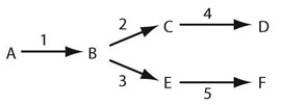 Refer to the associated figure. A branched metabolic pathway synthesizes two related amino acids (D and F) If there is a genetic defect, resulting in a nonfunctional enzyme (3), how could you ensure that adequate amounts of the amino acid F are synthesized?
 (Multiple Choice)
4.8/5 (86)
(86) 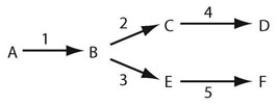 Refer to the associated figure. In the branched metabolic pathway indicated in the figure, if enzyme 3 is defective and the amount of each enzyme is constant, you might expect to see an increase in the amount of which intermediate or product?
 (Multiple Choice)
4.9/5 (87)
(87) In the first step of their experiments, Jacob and Monod treated E. coli cells with ultraviolet light or X-rays to ________.
(Multiple Choice)
4.8/5 (84)
(84) How does the simple primary and secondary structure of DNA hold the information needed to code for the many features of multicellular organisms?
(Multiple Choice)
4.8/5 (78)
(78) Which of the following types of mutation, resulting in an error in the mRNA just after the AUG start of translation, is likely to have the most serious effect on the polypeptide product?
(Multiple Choice)
4.9/5 (84)
(84) Point mutations are referred to as missense, silent, frameshift, or nonsense when they change the protein-coding potential of a gene. What is another group of mutations that may have important consequences for gene expression?
(Multiple Choice)
4.9/5 (94)
(94) A particular triplet of bases in the template strand of DNA is 5' AGT 3'. The corresponding codon for the mRNA transcribed is ________.
(Multiple Choice)
4.9/5 (73)
(73) 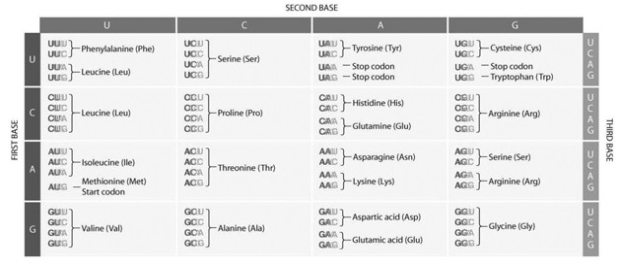 Consider the following section of mRNA:
UCUGAUGGGCUUU…
Beginning with the start codon, which amino acids, in order, are coded for by this section of mRNA? Consult the codon table provided if necessary.
Consider the following section of mRNA:
UCUGAUGGGCUUU…
Beginning with the start codon, which amino acids, in order, are coded for by this section of mRNA? Consult the codon table provided if necessary. (Multiple Choice)
4.9/5 (90)
(90) The following question(s) refer to this table of codons. 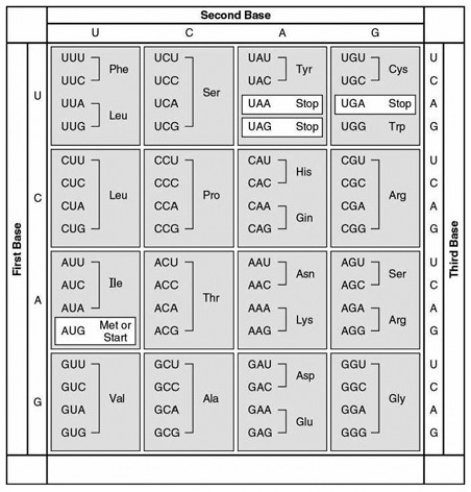 -A peptide has the sequence NH2-phe-pro-lys-gly-phe-pro-COOH. Which of the following sequences in the coding strand of the DNA could code for this peptide?
 (Multiple Choice)
4.9/5 (67)
(67) In the Morse code, a series of dots and dashes code for letters of the alphabet. How is this analogous to the genetic code?
(Multiple Choice)
4.7/5 (89)
(89) The mutation resulting in sickle cell disease changes one base pair of DNA so that a codon now codes for a different amino acid, making it an example of a ________.
(Multiple Choice)
4.7/5 (72)
(72) 
Filters
- Essay(0)
- Multiple Choice(0)
- Short Answer(0)
- True False(0)
- Matching(0)