



 Chat with AI
Exam 23: Evolutionary Processes

Exam 1: Biology and the Tree of Life37 Questions
Exam 2: Water and Carbon: the Chemical Basis of Life59 Questions
Exam 3: Protein Structure and Function59 Questions
Exam 4: Nucleic Acids and the Rna World43 Questions
Exam 5: An Introduction to Carbohydrates44 Questions
Exam 53: Ecosystems and Global Ecology57 Questions
Exam 6: Lipids, Membranes, and the First Cells59 Questions
Exam 7: Inside the Cell60 Questions
Exam 8: Energy and Enzymes: an Introduction to Metabolism60 Questions
Exam 9: Cellular Respiration and Fermentation61 Questions
Exam 10: Photosynthesis58 Questions
Exam 11: Cellcell Interactions52 Questions
Exam 12: The Cell Cycle59 Questions
Exam 13: Meiosis63 Questions
Exam 14: Mendel and the Gene60 Questions
Exam 15: Dna and the Gene: Synthesis and Repair51 Questions
Exam 16: How Genes Work48 Questions
Exam 17: Transcription, Rna Processing, and Translation58 Questions
Exam 18: Control of Gene Expression in Bacteria29 Questions
Exam 19: Control of Gene Expression in Eukaryotes56 Questions
Exam 20: The Molecular Revolution: Biotechnology and Beyond70 Questions
Exam 21: Genes, Development, and Evolution38 Questions
Exam 22: Evolution by Natural Selection38 Questions
Exam 23: Evolutionary Processes37 Questions
Exam 24: Speciation56 Questions
Exam 25: Phylogenies and the History of Life63 Questions
Exam 26: Bacteria and Archaea38 Questions
Exam 27: Protists37 Questions
Exam 28: Green Algae and Land Plants59 Questions
Exam 29: Fungi47 Questions
Exam 30: An Introduction to Animals48 Questions
Exam 31: Protostome Animals54 Questions
Exam 32: Deuterostome Animals60 Questions
Exam 33: Viruses44 Questions
Exam 34: Plant Form and Function46 Questions
Exam 35: Water and Sugar Transport in Plants47 Questions
Exam 36: Plant Nutrition54 Questions
Exam 37: Plant Sensory Systems, Signals, and Responses48 Questions
Exam 38: Plant Reproduction and Development51 Questions
Exam 39: Animal Form and Function53 Questions
Exam 40: Water and Electrolyte Balance in Animals60 Questions
Exam 41: Animal Nutrition94 Questions
Exam 42: Gas Exchange and Circulation93 Questions
Exam 43: Animal Nervous Systems100 Questions
Exam 44: Animal Sensory Systems50 Questions
Exam 45: Animal Movement40 Questions
Exam 46: Chemical Signals in Animals59 Questions
Exam 47: Animal Reproduction and Development104 Questions
Exam 48: The Immune System in Animals77 Questions
Exam 49: An Introduction to Ecology40 Questions
Exam 50: Behavioral Ecology40 Questions
Exam 51: Population Ecology57 Questions
Exam 52: Community Ecology55 Questions
Exam 54: Biodiversity and Conservation Biology43 Questions
Select questions type


The recessive allele that causes sickle cell anemia is harmful to homozygous individuals. What maintains the presence of this allele in a population's gene pool?
(Multiple Choice)
5.0/5  (80)
(80) Why doesn't inbreeding depression, by itself, cause evolution?
(Multiple Choice)
4.8/5 (80)
(80) Three-spined stickleback fish (Gasterosteus aculeatus) show substantial heritable variation in gill-raker length related to differences in their diets. Longer gill rakers appear to function better for capturing open-water prey, while shorter gill rakers function better for capturing shallow-water prey. Which of the following types of selection is most likely to be found in a large lake (open water in the middle and shallow water around the sides) with a high density of these fish?
(Multiple Choice)
4.9/5 (84)
(84) Two frog populations (same species) living in two neighboring lakes sing slightly different courtship songs. Increased irrigation makes the land between the two lakes wetter, allowing frogs to expand their ranges to the area between the lakes. Females in both populations prefer loud frogs to quieter frogs but do not distinguish between the two slightly different songs. Assuming that courtship song differences have a genetic basis, predict what will likely happen to the songs of the two frog populations.
(Multiple Choice)
4.7/5 (82)
(82) In all three species of phalarope, a taxon of wading shorebirds, the majority of parental care is provided by the male. Based on the Bateman-Trivers hypothesis of sexual selection, what would you expect to see in phalaropes?
(Multiple Choice)
4.9/5 (76)
(76) In 1986, a nuclear power accident in Chernobyl, USSR (now Ukraine), led to high radiation levels for miles surrounding the plant. The high levels of radiation caused elevated mutation rates in the surviving organisms, and evolutionary biologists have been studying rodent populations in the Chernobyl area ever since. Based on your understanding of evolutionary mechanisms, which of the following most likely occurred in the rodent populations following the accident?
(Multiple Choice)
4.9/5 (78)
(78) 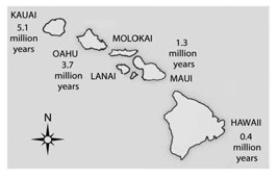 Soon after the island of Hawaii rose above the sea surface (somewhat less than 1 million years ago) and organisms colonized the island, the evolution of life on this new island should have been most strongly influenced by ________.
 (Multiple Choice)
4.8/5 (78)
(78) Which of the following is the most predictable outcome of increased gene flow between two populations?
(Multiple Choice)
5.0/5 (84)
(84) Pea aphids (Acyrthosiphon pisum) are the only animals able to synthesize their own carotenoid pigments, due to lateral gene transfer from the genome of a fungus to the genome of a recent ancestor of the pea aphids. The resulting red or green coloration alters the risk the aphids face from specific predators and parasites. Select the correct statement below.
(Multiple Choice)
4.8/5 (80)
(80) Evolution in a population of island iguanas can be caused by the following agent(s):
(Multiple Choice)
4.8/5 (78)
(78) Use the following information to answer the question below.
Researchers studying a small milkweed population note that some plants produce a toxin and other plants do not. They identify the gene responsible for toxin production. The dominant allele (T) codes for an enzyme that makes the toxin, and the recessive allele (t) codes for a nonfunctional enzyme that cannot produce the toxin. Heterozygotes produce an intermediate amount of toxin. The genotypes of all individuals in the population are determined (see chart) and used to determine the actual allele frequencies in the population.  Refer to the accompanying figure. Is this population in Hardy-Weinberg equilibrium?
 (Multiple Choice)
5.0/5 (71)
(71) Most Swiss starlings produce four to five eggs in each clutch. Starlings producing fewer or more than this have reduced fitness. Which of the following terms best describes this situation?
(Multiple Choice)
5.0/5 (84)
(84) Which of the following is most likely to produce an African butterfly species in the wild whose populations show two strikingly different color patterns?
(Multiple Choice)
4.7/5 (79)
(79) Swine are vulnerable to infection by bird flu virus and human flu virus, which can both be present in an individual pig at the same time. When this occurs, it is possible for genes from bird flu virus and human flu virus to be combined. If the human flu virus contributes a gene for Tamiflu resistance (Tamiflu is an antiviral drug) to the new virus, and if the new virus is introduced to an environment lacking Tamiflu, then what is most likely to occur?
(Multiple Choice)
4.9/5 (83)
(83) For biologists studying a large flatworm population in the lab, which Hardy-Weinberg condition is most difficult to meet?
(Multiple Choice)
4.7/5 (79)
(79) 
Filters
- Essay(0)
- Multiple Choice(0)
- Short Answer(0)
- True False(0)
- Matching(0)