



 Chat with AI
Exam 27: Protists

Exam 1: Biology and the Tree of Life37 Questions
Exam 2: Water and Carbon: the Chemical Basis of Life59 Questions
Exam 3: Protein Structure and Function59 Questions
Exam 4: Nucleic Acids and the Rna World43 Questions
Exam 5: An Introduction to Carbohydrates44 Questions
Exam 53: Ecosystems and Global Ecology57 Questions
Exam 6: Lipids, Membranes, and the First Cells59 Questions
Exam 7: Inside the Cell60 Questions
Exam 8: Energy and Enzymes: an Introduction to Metabolism60 Questions
Exam 9: Cellular Respiration and Fermentation61 Questions
Exam 10: Photosynthesis58 Questions
Exam 11: Cellcell Interactions52 Questions
Exam 12: The Cell Cycle59 Questions
Exam 13: Meiosis63 Questions
Exam 14: Mendel and the Gene60 Questions
Exam 15: Dna and the Gene: Synthesis and Repair51 Questions
Exam 16: How Genes Work48 Questions
Exam 17: Transcription, Rna Processing, and Translation58 Questions
Exam 18: Control of Gene Expression in Bacteria29 Questions
Exam 19: Control of Gene Expression in Eukaryotes56 Questions
Exam 20: The Molecular Revolution: Biotechnology and Beyond70 Questions
Exam 21: Genes, Development, and Evolution38 Questions
Exam 22: Evolution by Natural Selection38 Questions
Exam 23: Evolutionary Processes37 Questions
Exam 24: Speciation56 Questions
Exam 25: Phylogenies and the History of Life63 Questions
Exam 26: Bacteria and Archaea38 Questions
Exam 27: Protists37 Questions
Exam 28: Green Algae and Land Plants59 Questions
Exam 29: Fungi47 Questions
Exam 30: An Introduction to Animals48 Questions
Exam 31: Protostome Animals54 Questions
Exam 32: Deuterostome Animals60 Questions
Exam 33: Viruses44 Questions
Exam 34: Plant Form and Function46 Questions
Exam 35: Water and Sugar Transport in Plants47 Questions
Exam 36: Plant Nutrition54 Questions
Exam 37: Plant Sensory Systems, Signals, and Responses48 Questions
Exam 38: Plant Reproduction and Development51 Questions
Exam 39: Animal Form and Function53 Questions
Exam 40: Water and Electrolyte Balance in Animals60 Questions
Exam 41: Animal Nutrition94 Questions
Exam 42: Gas Exchange and Circulation93 Questions
Exam 43: Animal Nervous Systems100 Questions
Exam 44: Animal Sensory Systems50 Questions
Exam 45: Animal Movement40 Questions
Exam 46: Chemical Signals in Animals59 Questions
Exam 47: Animal Reproduction and Development104 Questions
Exam 48: The Immune System in Animals77 Questions
Exam 49: An Introduction to Ecology40 Questions
Exam 50: Behavioral Ecology40 Questions
Exam 51: Population Ecology57 Questions
Exam 52: Community Ecology55 Questions
Exam 54: Biodiversity and Conservation Biology43 Questions
Select questions type


One of the fish in your aquarium dies. Adding which protist to the water would allow you to avoid flushing the dead fish by speeding its decay?
(Multiple Choice)
4.9/5  (62)
(62) Diatoms are mostly asexual members of the phytoplankton. They obtain their nutrition from functional chloroplasts, and each diatom is encased within two porous, glass-like valves. Which question would be most important for one interested in the day-to-day survival of individual diatoms?
(Multiple Choice)
4.9/5 (90)
(90) Protists and bacteria are grouped into different domains because ________.
(Multiple Choice)
4.8/5 (78)
(78) Encouraging the growth (via nutrient fertilization) of photosynthetic protists in marine environments may help reduce global warming because ________.
(Multiple Choice)
4.7/5 (72)
(72) Amoeboid movement via long slender pseudopodia is characteristic of ________.
(Multiple Choice)
5.0/5 (75)
(75) According to the endosymbiotic theory, why was it adaptive for the larger (host) cell to keep the engulfed cell alive, rather than digesting it as food?
(Multiple Choice)
5.0/5 (73)
(73) Protists from which of the following taxonomic groups are most likely to lead to paralytic shellfish poisoning?
(Multiple Choice)
4.8/5 (77)
(77) A snail-like, coiled, porous test (shell) of calcium carbonate is characteristic of ________.
(Multiple Choice)
4.9/5 (77)
(77) When a mosquito infected with Plasmodium first bites a human, the Plasmodium ________.
(Multiple Choice)
4.8/5 (83)
(83) Use the following information to answer the question(s) below.
The mechanism of cell crawling in protist species is not well defined. Pseudopodia extension involves interactions between actin and myosin (the same molecules that are involved in vertebrate muscle contraction). However, prior to the study described below, no one had provided convincing data that actin and myosin were actually involved in cell crawling in protists. Anatomical studies had identified the cytoskeletal protein actin just below the surface of the cell membrane in several species of protist, but physiological studies had failed to show a functional link between actin, myosin, and cell crawling.
In a study by N. Poulsen et al. (Diatom gliding is the result of an actin-myosin motility system, Cell Motility and the Cytoskeleton 44 (1999):23-22), researchers tested whether motility in a particular species of diatom involves interactions between actin and myosin. 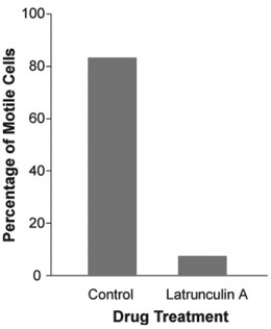 -Refer to the study by Poulsen et al. and the accompanying figure. The data graphed in the figure could be an artifact if latrunculin A kills this species of diatoms (that is, that may be why the cells are not moving). Which of the following would be the best evidence that latrunculin A is NOT killing the cells?
 (Multiple Choice)
4.9/5 (74)
(74) By examining the phylogenetic tree diagrammed in the accompanying figure, what conclusion can you draw about the species G. microti?
(Multiple Choice)
4.8/5 (71)
(71) In examining a protist, you notice that it lacks a cell wall, and has movement with cytoplasmic streaming. These data allow you to infer that the species belongs to which of the following protist groups?
(Multiple Choice)
4.9/5 (77)
(77) Which of the following eukaryotic lineages contains species that all lack functioning mitochondria?
(Multiple Choice)
4.8/5 (73)
(73) A particular species of protist has obtained a chloroplast via secondary endosymbiosis. You know this because the chloroplasts ________.
(Multiple Choice)
4.8/5 (81)
(81) 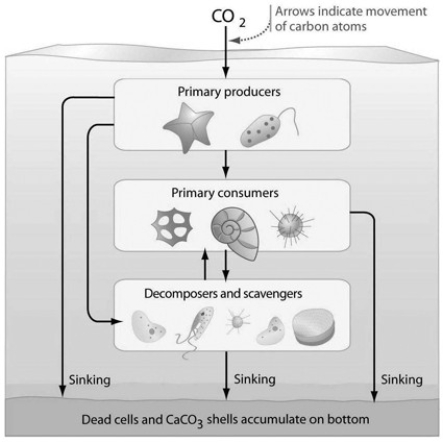 Which of the following might be a result of adding a secondary consumer to the aquatic ecosystem in the accompanying illustration?
 (Multiple Choice)
4.8/5 (79)
(79) Imagine that there are 25 different species of protists living in a tide pool. Some of these species reproduce both sexually and asexually, and some of them can reproduce only asexually. The pool gradually becomes infested with disease-causing viruses and bacteria. Which species are more likely to thrive in the changing environment?
(Multiple Choice)
4.7/5 (88)
(88) 
Filters
- Essay(0)
- Multiple Choice(0)
- Short Answer(0)
- True False(0)
- Matching(0)