



 Chat with AI
Exam 28: Green Algae and Land Plants

Exam 1: Biology and the Tree of Life37 Questions
Exam 2: Water and Carbon: the Chemical Basis of Life59 Questions
Exam 3: Protein Structure and Function59 Questions
Exam 4: Nucleic Acids and the Rna World43 Questions
Exam 5: An Introduction to Carbohydrates44 Questions
Exam 53: Ecosystems and Global Ecology57 Questions
Exam 6: Lipids, Membranes, and the First Cells59 Questions
Exam 7: Inside the Cell60 Questions
Exam 8: Energy and Enzymes: an Introduction to Metabolism60 Questions
Exam 9: Cellular Respiration and Fermentation61 Questions
Exam 10: Photosynthesis58 Questions
Exam 11: Cellcell Interactions52 Questions
Exam 12: The Cell Cycle59 Questions
Exam 13: Meiosis63 Questions
Exam 14: Mendel and the Gene60 Questions
Exam 15: Dna and the Gene: Synthesis and Repair51 Questions
Exam 16: How Genes Work48 Questions
Exam 17: Transcription, Rna Processing, and Translation58 Questions
Exam 18: Control of Gene Expression in Bacteria29 Questions
Exam 19: Control of Gene Expression in Eukaryotes56 Questions
Exam 20: The Molecular Revolution: Biotechnology and Beyond70 Questions
Exam 21: Genes, Development, and Evolution38 Questions
Exam 22: Evolution by Natural Selection38 Questions
Exam 23: Evolutionary Processes37 Questions
Exam 24: Speciation56 Questions
Exam 25: Phylogenies and the History of Life63 Questions
Exam 26: Bacteria and Archaea38 Questions
Exam 27: Protists37 Questions
Exam 28: Green Algae and Land Plants59 Questions
Exam 29: Fungi47 Questions
Exam 30: An Introduction to Animals48 Questions
Exam 31: Protostome Animals54 Questions
Exam 32: Deuterostome Animals60 Questions
Exam 33: Viruses44 Questions
Exam 34: Plant Form and Function46 Questions
Exam 35: Water and Sugar Transport in Plants47 Questions
Exam 36: Plant Nutrition54 Questions
Exam 37: Plant Sensory Systems, Signals, and Responses48 Questions
Exam 38: Plant Reproduction and Development51 Questions
Exam 39: Animal Form and Function53 Questions
Exam 40: Water and Electrolyte Balance in Animals60 Questions
Exam 41: Animal Nutrition94 Questions
Exam 42: Gas Exchange and Circulation93 Questions
Exam 43: Animal Nervous Systems100 Questions
Exam 44: Animal Sensory Systems50 Questions
Exam 45: Animal Movement40 Questions
Exam 46: Chemical Signals in Animals59 Questions
Exam 47: Animal Reproduction and Development104 Questions
Exam 48: The Immune System in Animals77 Questions
Exam 49: An Introduction to Ecology40 Questions
Exam 50: Behavioral Ecology40 Questions
Exam 51: Population Ecology57 Questions
Exam 52: Community Ecology55 Questions
Exam 54: Biodiversity and Conservation Biology43 Questions
Select questions type


You want to get rid of your cough and stuffy nose, and a friend offers you a cup of tea. After you drink the tea, you realize that you are feeling relief from your symptoms. What plant compound was most likely found in the tea?
(Multiple Choice)
4.8/5  (77)
(77) Which of the following is a land plant that has flagellated sperm and a sporophyte-dominated life cycle?
(Multiple Choice)
4.8/5 (88)
(88) As you stroll through a moist forest, you are most likely to see a ________.
(Multiple Choice)
4.8/5 (79)
(79) Some green algae exhibit alternation of generations. All land plants exhibit alternation of generations. No charophytes (stoneworts) exhibit alternation of generations. Keeping in mind the recent evidence from molecular systematics, the correct interpretation of these observations is that ________.
(Multiple Choice)
4.8/5 (76)
(76) Which of the following is TRUE of the life cycle of mosses?
(Multiple Choice)
4.8/5 (90)
(90) If humans had been present to build log structures during the Carboniferous period (though they were not!), which plant types would have been suitable sources of logs?
(Multiple Choice)
4.8/5 (72)
(72) The functional role of sporopollenin is primarily to ________.
(Multiple Choice)
4.8/5 (75)
(75) Which plant group is notable for the independence of gametophyte and sporophyte generations from each other?
(Multiple Choice)
4.9/5 (76)
(76) Which of the following statements is TRUE of the pine life cycle?
(Multiple Choice)
4.9/5 (68)
(68) Which of the following features of how seedless land plants get sperm to egg are the same as for some of their algal ancestors?
(Multiple Choice)
4.8/5 (66)
(66) Why are seedless vascular plants considered paraphyletic rather than monophyletic?
(Multiple Choice)
4.9/5 (76)
(76) Use the following information to answer the question(s) below.
Harold and Kumar are pre-med and pre-pharmacy students, respectively. They complain to their biology professor that they should not have to study about plants because plants have little relevance to their chosen professions.
-Which of the following lines of evidence would best support your assertion that a particular plant is an angiosperm?
(Multiple Choice)
4.8/5 (87)
(87) Use the following information to answer the question(s) below.
Harold and Kumar are pre-med and pre-pharmacy students, respectively. They complain to their biology professor that they should not have to study about plants because plants have little relevance to their chosen professions.
-Which adaptations of land plants are likely to provide Harold with future patients?
I. sporophyte dominance
II. defenses against herbivory
III. adaptations related to wind dispersal of pollen
(Multiple Choice)
4.8/5 (76)
(76) Which of the following statements correctly describes a portion of the pine life cycle?
(Multiple Choice)
4.9/5 (81)
(81) Which of the following should have had gene sequences most similar to the charophyte (stonewort) that was the common ancestor of land plants?
(Multiple Choice)
4.9/5 (80)
(80) Liverworts, hornworts, and mosses are grouped together as Bryophytes. Besides not having vascular tissue, what do they all have in common?
(Multiple Choice)
4.9/5 (88)
(88) Researchers tested nitrogen loss from soil where the moss Dawsonia was growing and compared it to soil from which Dawsonia had been removed. The data are presented in the accompanying figure. 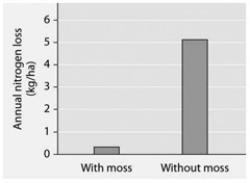 -In the figure, which graph of soil nitrogen loss over time most strongly supports the hypothesis that if the 20-cm-tall Dawsonia acts as a physical buffer, then it reduces water's ability to erode the soil and carry away its nitrogen?
 (Multiple Choice)
4.8/5 (74)
(74) 
Filters
- Essay(0)
- Multiple Choice(0)
- Short Answer(0)
- True False(0)
- Matching(0)