



 Chat with AI
Exam 33: Viruses

Exam 1: Biology and the Tree of Life37 Questions
Exam 2: Water and Carbon: the Chemical Basis of Life59 Questions
Exam 3: Protein Structure and Function59 Questions
Exam 4: Nucleic Acids and the Rna World43 Questions
Exam 5: An Introduction to Carbohydrates44 Questions
Exam 53: Ecosystems and Global Ecology57 Questions
Exam 6: Lipids, Membranes, and the First Cells59 Questions
Exam 7: Inside the Cell60 Questions
Exam 8: Energy and Enzymes: an Introduction to Metabolism60 Questions
Exam 9: Cellular Respiration and Fermentation61 Questions
Exam 10: Photosynthesis58 Questions
Exam 11: Cellcell Interactions52 Questions
Exam 12: The Cell Cycle59 Questions
Exam 13: Meiosis63 Questions
Exam 14: Mendel and the Gene60 Questions
Exam 15: Dna and the Gene: Synthesis and Repair51 Questions
Exam 16: How Genes Work48 Questions
Exam 17: Transcription, Rna Processing, and Translation58 Questions
Exam 18: Control of Gene Expression in Bacteria29 Questions
Exam 19: Control of Gene Expression in Eukaryotes56 Questions
Exam 20: The Molecular Revolution: Biotechnology and Beyond70 Questions
Exam 21: Genes, Development, and Evolution38 Questions
Exam 22: Evolution by Natural Selection38 Questions
Exam 23: Evolutionary Processes37 Questions
Exam 24: Speciation56 Questions
Exam 25: Phylogenies and the History of Life63 Questions
Exam 26: Bacteria and Archaea38 Questions
Exam 27: Protists37 Questions
Exam 28: Green Algae and Land Plants59 Questions
Exam 29: Fungi47 Questions
Exam 30: An Introduction to Animals48 Questions
Exam 31: Protostome Animals54 Questions
Exam 32: Deuterostome Animals60 Questions
Exam 33: Viruses44 Questions
Exam 34: Plant Form and Function46 Questions
Exam 35: Water and Sugar Transport in Plants47 Questions
Exam 36: Plant Nutrition54 Questions
Exam 37: Plant Sensory Systems, Signals, and Responses48 Questions
Exam 38: Plant Reproduction and Development51 Questions
Exam 39: Animal Form and Function53 Questions
Exam 40: Water and Electrolyte Balance in Animals60 Questions
Exam 41: Animal Nutrition94 Questions
Exam 42: Gas Exchange and Circulation93 Questions
Exam 43: Animal Nervous Systems100 Questions
Exam 44: Animal Sensory Systems50 Questions
Exam 45: Animal Movement40 Questions
Exam 46: Chemical Signals in Animals59 Questions
Exam 47: Animal Reproduction and Development104 Questions
Exam 48: The Immune System in Animals77 Questions
Exam 49: An Introduction to Ecology40 Questions
Exam 50: Behavioral Ecology40 Questions
Exam 51: Population Ecology57 Questions
Exam 52: Community Ecology55 Questions
Exam 54: Biodiversity and Conservation Biology43 Questions
Select questions type


A researcher lyses a cell that contains nucleic acid molecules and capsomeres of tobacco mosaic virus (TMV). The cell contents are left in a covered test tube overnight. The next day this mixture is sprayed on tobacco plants. We expect that the plants would ________.
(Multiple Choice)
4.9/5  (88)
(88) The first class of drugs developed to treat AIDS, such as AZT, were known as reverse transcriptase inhibitors. They worked because they ________.
(Multiple Choice)
4.9/5 (82)
(82) You have isolated a newly discovered virus and are attempting to characterize it. You begin with its genome. You first isolate the virion-producing mRNA from cultured cells infected with the virus. When you compare this mRNA to the viral genome, you find that they are complementary. What does this tell you?
(Multiple Choice)
4.9/5 (71)
(71) 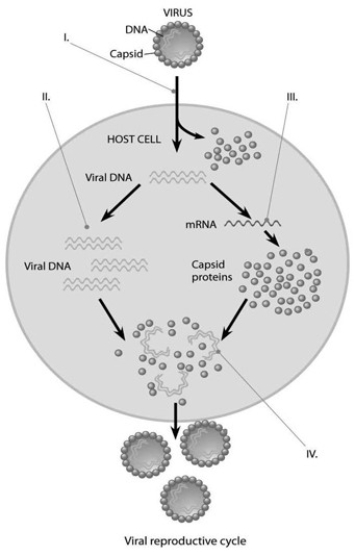 -In the accompanying figure, at the arrow marked II, what enzyme(s) are being utilized?
 (Multiple Choice)
4.9/5 (87)
(87) Viruses use the host's machinery to make copies of themselves. However, some human viruses require a type of replication that humans do not normally have. For example, humans normally do not have the ability to convert RNA into DNA. How can these types of viruses infect humans, when human cells cannot perform a particular role that the virus requires?
(Multiple Choice)
4.9/5 (93)
(93) Some viruses can be crystallized and their structures analyzed. One such virus is yellow mottle virus, which infects beans. This virus has a single-stranded RNA genome containing about 6300 nucleotides. Its capsid is 25-30 nm in diameter and contains 180 identical capsomeres. If the yellow mottle virus begins its infection of a cell by using its genome as mRNA, which of the following would you expect to be able to measure?
(Multiple Choice)
4.8/5 (79)
(79)
-In the figure, when new viruses are being assembled at the point marked IV, what mediates the assembly?
-In the figure, when new viruses are being assembled at the point marked IV, what mediates the assembly? (Multiple Choice)
4.9/5 (75)
(75) What is the main structural difference between enveloped and nonenveloped viruses?
(Multiple Choice)
4.9/5 (80)
(80) When people die from HIV infections, it is usually because they ________.
(Multiple Choice)
4.8/5 (67)
(67) Which of the following could use reverse transcriptase to transcribe its genome?
(Multiple Choice)
4.9/5 (80)
(80) Use the accompanying figure and information to answer the question(s) below. 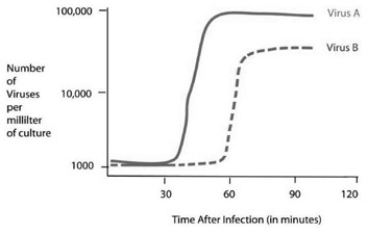 -Using the data in the figure, how long does it take for virus B to go through one lytic cycle?
 (Multiple Choice)
4.8/5 (74)
(74) Which of the following characteristics, structures, or processes is common to bacteria and viruses?
(Multiple Choice)
4.8/5 (83)
(83) The virus genome and viral proteins are assembled into virions (virus particles) during ________.
(Multiple Choice)
4.8/5 (83)
(83) The HIV protease has been the target of several anti-HIV medications called protease inhibitors. This antiviral strategy is possible because protease inhibitors ________.
(Multiple Choice)
4.8/5 (79)
(79) A virus consisting of a single strand of RNA, which is transcribed into complementary DNA, is a ________.
(Multiple Choice)
4.8/5 (80)
(80) Use the accompanying figure and information to answer the question(s) below.
-Using the data in the figure, how long does it take for virus A to go through one lytic cycle?
-Using the data in the figure, how long does it take for virus A to go through one lytic cycle? (Multiple Choice)
4.9/5 (82)
(82) Which of the following supports the argument that viruses are nonliving?
(Multiple Choice)
4.9/5 (86)
(86) 
Filters
- Essay(0)
- Multiple Choice(0)
- Short Answer(0)
- True False(0)
- Matching(0)