



 Chat with AI
Exam 45: Animal Movement

Exam 1: Biology and the Tree of Life37 Questions
Exam 2: Water and Carbon: the Chemical Basis of Life59 Questions
Exam 3: Protein Structure and Function59 Questions
Exam 4: Nucleic Acids and the Rna World43 Questions
Exam 5: An Introduction to Carbohydrates44 Questions
Exam 53: Ecosystems and Global Ecology57 Questions
Exam 6: Lipids, Membranes, and the First Cells59 Questions
Exam 7: Inside the Cell60 Questions
Exam 8: Energy and Enzymes: an Introduction to Metabolism60 Questions
Exam 9: Cellular Respiration and Fermentation61 Questions
Exam 10: Photosynthesis58 Questions
Exam 11: Cellcell Interactions52 Questions
Exam 12: The Cell Cycle59 Questions
Exam 13: Meiosis63 Questions
Exam 14: Mendel and the Gene60 Questions
Exam 15: Dna and the Gene: Synthesis and Repair51 Questions
Exam 16: How Genes Work48 Questions
Exam 17: Transcription, Rna Processing, and Translation58 Questions
Exam 18: Control of Gene Expression in Bacteria29 Questions
Exam 19: Control of Gene Expression in Eukaryotes56 Questions
Exam 20: The Molecular Revolution: Biotechnology and Beyond70 Questions
Exam 21: Genes, Development, and Evolution38 Questions
Exam 22: Evolution by Natural Selection38 Questions
Exam 23: Evolutionary Processes37 Questions
Exam 24: Speciation56 Questions
Exam 25: Phylogenies and the History of Life63 Questions
Exam 26: Bacteria and Archaea38 Questions
Exam 27: Protists37 Questions
Exam 28: Green Algae and Land Plants59 Questions
Exam 29: Fungi47 Questions
Exam 30: An Introduction to Animals48 Questions
Exam 31: Protostome Animals54 Questions
Exam 32: Deuterostome Animals60 Questions
Exam 33: Viruses44 Questions
Exam 34: Plant Form and Function46 Questions
Exam 35: Water and Sugar Transport in Plants47 Questions
Exam 36: Plant Nutrition54 Questions
Exam 37: Plant Sensory Systems, Signals, and Responses48 Questions
Exam 38: Plant Reproduction and Development51 Questions
Exam 39: Animal Form and Function53 Questions
Exam 40: Water and Electrolyte Balance in Animals60 Questions
Exam 41: Animal Nutrition94 Questions
Exam 42: Gas Exchange and Circulation93 Questions
Exam 43: Animal Nervous Systems100 Questions
Exam 44: Animal Sensory Systems50 Questions
Exam 45: Animal Movement40 Questions
Exam 46: Chemical Signals in Animals59 Questions
Exam 47: Animal Reproduction and Development104 Questions
Exam 48: The Immune System in Animals77 Questions
Exam 49: An Introduction to Ecology40 Questions
Exam 50: Behavioral Ecology40 Questions
Exam 51: Population Ecology57 Questions
Exam 52: Community Ecology55 Questions
Exam 54: Biodiversity and Conservation Biology43 Questions
Select questions type


Against which structure do the circular and longitudinal muscles of annelids work?
(Multiple Choice)
4.8/5  (83)
(83) Among these choices, the most energetically efficient locomotion per unit mass is likely ________.
(Multiple Choice)
4.9/5 (95)
(95) When an action potential from a motor neuron arrives at the neuromuscular junction (NMJ), a series of events occurs that leads to muscle contraction. Which of the following events will occur last (that is, after all of the others)?
(Multiple Choice)
4.9/5 (74)
(74) The functions of the vertebrate skeleton include which of the following?
I. maintenance of body posture
II. calcium homeostasis
III. transfer of muscle forces
(Multiple Choice)
4.8/5 (83)
(83) An endoskeleton is the primary body support for the ________.
(Multiple Choice)
4.9/5 (83)
(83) Compared to slow oxidative muscle fibers, those classified as fast glycolytic fibers typically have ________.
(Multiple Choice)
4.7/5 (74)
(74) Food moves along the digestive tract as the result of contractions by ________.
(Multiple Choice)
4.8/5 (81)
(81) What is an explanation for the pectoral or breast meat of ducks being very dark in color?
(Multiple Choice)
4.9/5 (73)
(73) 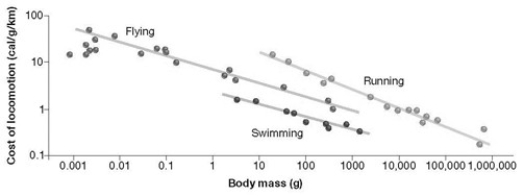
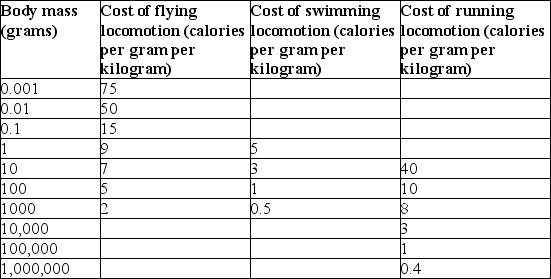 For a 100-gram animal, what is the most costly form of locomotion?
 (Multiple Choice)
4.9/5 (80)
(80) How does skeletal muscle return to its starting length after a contraction?
(Multiple Choice)
4.8/5 (83)
(83) The structure that connects bone to bone in vertebrate skeletal systems is a ________.
(Multiple Choice)
4.8/5 (70)
(70) 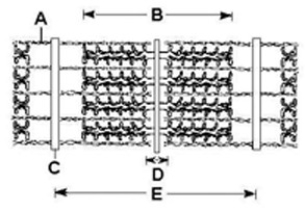 -The structure pictured in the figure is found in ________.
 (Multiple Choice)
4.9/5 (93)
(93) What is the best explanation for why elephants stand with a more upright posture and have relatively thicker bones than cats?
(Multiple Choice)
4.8/5 (100)
(100) The hydrostatic skeleton of the earthworm allows it to move around in its environment by ________.
(Multiple Choice)
4.9/5 (83)
(83) Skeletal muscle contraction begins when calcium ions bind to ________.
(Multiple Choice)
4.7/5 (73)
(73) What cell types within bone are responsible for the breakdown of bone tissue to permit reabsorption of calcium?
(Multiple Choice)
4.8/5 (84)
(84) 
Filters
- Essay(0)
- Multiple Choice(0)
- Short Answer(0)
- True False(0)
- Matching(0)