



 Chat with AI
Exam 50: Behavioral Ecology

Exam 1: Biology and the Tree of Life37 Questions
Exam 2: Water and Carbon: the Chemical Basis of Life59 Questions
Exam 3: Protein Structure and Function59 Questions
Exam 4: Nucleic Acids and the Rna World43 Questions
Exam 5: An Introduction to Carbohydrates44 Questions
Exam 53: Ecosystems and Global Ecology57 Questions
Exam 6: Lipids, Membranes, and the First Cells59 Questions
Exam 7: Inside the Cell60 Questions
Exam 8: Energy and Enzymes: an Introduction to Metabolism60 Questions
Exam 9: Cellular Respiration and Fermentation61 Questions
Exam 10: Photosynthesis58 Questions
Exam 11: Cellcell Interactions52 Questions
Exam 12: The Cell Cycle59 Questions
Exam 13: Meiosis63 Questions
Exam 14: Mendel and the Gene60 Questions
Exam 15: Dna and the Gene: Synthesis and Repair51 Questions
Exam 16: How Genes Work48 Questions
Exam 17: Transcription, Rna Processing, and Translation58 Questions
Exam 18: Control of Gene Expression in Bacteria29 Questions
Exam 19: Control of Gene Expression in Eukaryotes56 Questions
Exam 20: The Molecular Revolution: Biotechnology and Beyond70 Questions
Exam 21: Genes, Development, and Evolution38 Questions
Exam 22: Evolution by Natural Selection38 Questions
Exam 23: Evolutionary Processes37 Questions
Exam 24: Speciation56 Questions
Exam 25: Phylogenies and the History of Life63 Questions
Exam 26: Bacteria and Archaea38 Questions
Exam 27: Protists37 Questions
Exam 28: Green Algae and Land Plants59 Questions
Exam 29: Fungi47 Questions
Exam 30: An Introduction to Animals48 Questions
Exam 31: Protostome Animals54 Questions
Exam 32: Deuterostome Animals60 Questions
Exam 33: Viruses44 Questions
Exam 34: Plant Form and Function46 Questions
Exam 35: Water and Sugar Transport in Plants47 Questions
Exam 36: Plant Nutrition54 Questions
Exam 37: Plant Sensory Systems, Signals, and Responses48 Questions
Exam 38: Plant Reproduction and Development51 Questions
Exam 39: Animal Form and Function53 Questions
Exam 40: Water and Electrolyte Balance in Animals60 Questions
Exam 41: Animal Nutrition94 Questions
Exam 42: Gas Exchange and Circulation93 Questions
Exam 43: Animal Nervous Systems100 Questions
Exam 44: Animal Sensory Systems50 Questions
Exam 45: Animal Movement40 Questions
Exam 46: Chemical Signals in Animals59 Questions
Exam 47: Animal Reproduction and Development104 Questions
Exam 48: The Immune System in Animals77 Questions
Exam 49: An Introduction to Ecology40 Questions
Exam 50: Behavioral Ecology40 Questions
Exam 51: Population Ecology57 Questions
Exam 52: Community Ecology55 Questions
Exam 54: Biodiversity and Conservation Biology43 Questions
Select questions type


How do altruistic behaviors arise through natural selection?
(Multiple Choice)
4.8/5  (83)
(83) If you ask a question about behavior that concerns how it works or what its mechanism is, you are asking a question that involves ________.
(Multiple Choice)
4.9/5 (95)
(95) A cage containing male mosquitoes has a small earphone placed on top, through which the sound of a female mosquito is played. All the males immediately fly to the earphone and go through all of the steps of copulation. What is the best explanation for this behavior?
(Multiple Choice)
4.9/5 (82)
(82) Use the following information to answer the following question(s).
The following are an abstract and figure from a paper that explores the evolutionary relationship between a protein kinase and behavior (M. Fitzpatrick and M. Sokolowski. 2004. In search of food: Exploring the evolutionary link between cGMP-dependent protein kinase (PKG) and behavior. Integrative and Comparative Biology 44:28-36).
Abstract:
Despite an immense amount of variation in organisms throughout the animal kingdom, many of their genes show substantial conservation in DNA sequence and protein function. Here we explore the potential for a conserved evolutionary relationship between genes and their behavioral phenotypes. We investigate the evolutionary history of cGMP-dependent protein kinase (PKG) and its possible conserved function in food-related behaviors. First identified for its role in the foraging behavior of fruit flies, the PKG encoded by the foraging gene had since been associated with the maturation of behavior (from nurse to forager) in honey bees and the roaming and dwelling food-related locomotion in nematodes. These parallels encouraged us to construct protein phylogenies using 32 PKG sequences that include 19 species. Our analyses suggest five possible evolutionary histories that can explain the apparent conserved link between PKG and behavior in fruit flies, honey bees, and nematodes. Three of these raise the hypothesis that PKG influences the food-related behaviors of a wide variety of animals including vertebrates. Moreover it appears that the PKG gene was duplicated some time between the evolution of nematodes and a common ancestor of vertebrates and insects whereby current evidence suggests only the for-like PKG might be associated with food-related behavior. 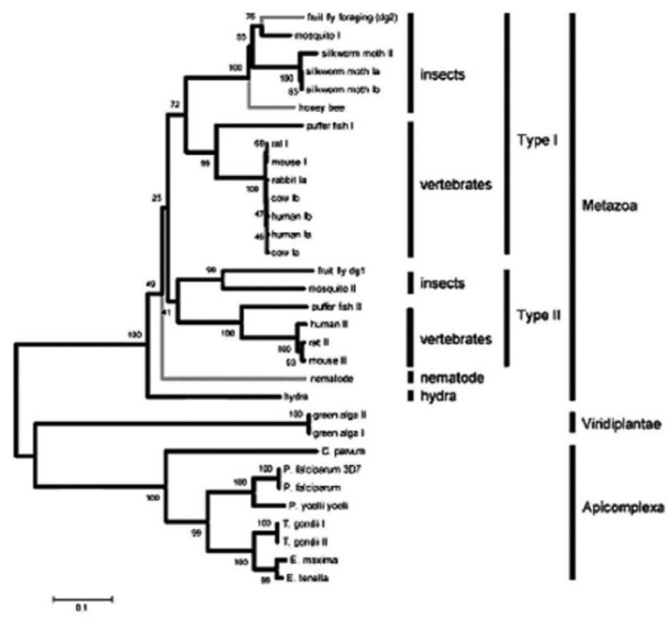 These are neighbor joining trees that depict the evolutionary relationships of 32 PKG kinase domain and C-terminal amino acid sequences spanning 19 species of protozoans and metazoans. Values at the nodes represent the results of 5000 bootstrap replications. Lineages with known behavioral links with PKG are indicated by gray branches.
-Look at the evolutionary relationship of protein kinases in the figure. Knowing that there is evidence that this particular protein kinase is linked to food-related behaviors in the animals studied, what conclusions can you draw?
These are neighbor joining trees that depict the evolutionary relationships of 32 PKG kinase domain and C-terminal amino acid sequences spanning 19 species of protozoans and metazoans. Values at the nodes represent the results of 5000 bootstrap replications. Lineages with known behavioral links with PKG are indicated by gray branches.
-Look at the evolutionary relationship of protein kinases in the figure. Knowing that there is evidence that this particular protein kinase is linked to food-related behaviors in the animals studied, what conclusions can you draw? (Multiple Choice)
4.8/5 (78)
(78) Which of the following might affect the foraging behavior of an animal in the context of optimal foraging?
I. risk of predation
II. prey size
III. prey defenses
IV. prey density
(Multiple Choice)
4.9/5 (78)
(78) Feeding behavior with a high-energy intake-to-expenditure ratio is called ________.
(Multiple Choice)
5.0/5 (77)
(77) In Belding's ground squirrels, it is mostly the females that behave altruistically by sounding alarm calls. What is the likely reason for this distinction?
(Multiple Choice)
5.0/5 (75)
(75) A pied kingfisher in its first year of life helps in the feeding of three full siblings who would not have made it without the helper's efforts. In this first year the bird does not raise any of its own offspring. In the second year of its life the pied kingfisher mates and raises two of its own offspring. After the first two years, what is the inclusive fitness of the pied kingfisher?
(Multiple Choice)
4.7/5 (71)
(71) Animal communication involves what type of sensory information?
I. visual
II. auditory
III. olfactory
IV. tactile
(Multiple Choice)
4.8/5 (83)
(83) Animals that help other animals of the same species ________.
(Multiple Choice)
4.8/5 (60)
(60) The presence of altruistic behavior is most likely due to kin selection, a theory maintaining that ________.
(Multiple Choice)
4.8/5 (79)
(79) 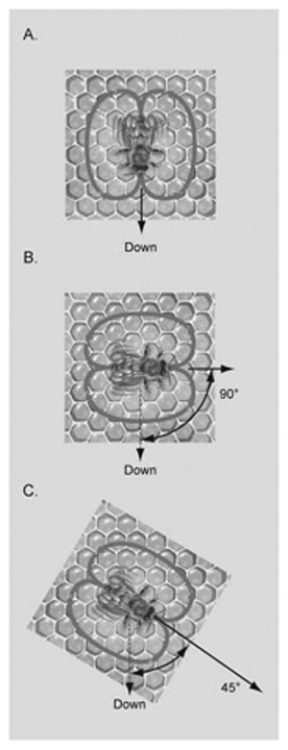 If the accompanying figure shows the dances of bees in a hive at twelve noon on March 21 in the northern hemisphere, which dance is communicating that the food is to the south of the hive?
 (Multiple Choice)
4.9/5 (81)
(81) Which of the following has a coefficient of relatedness of 0.25? Assume all are blood relatives.
(Multiple Choice)
4.8/5 (77)
(77) Why would you expect some white-fronted bee-eaters to fly very far away from their nests to forage when there are food sources nearby? Base your answer on your knowledge of cost-benefit analyses,
(Multiple Choice)
4.9/5 (88)
(88) 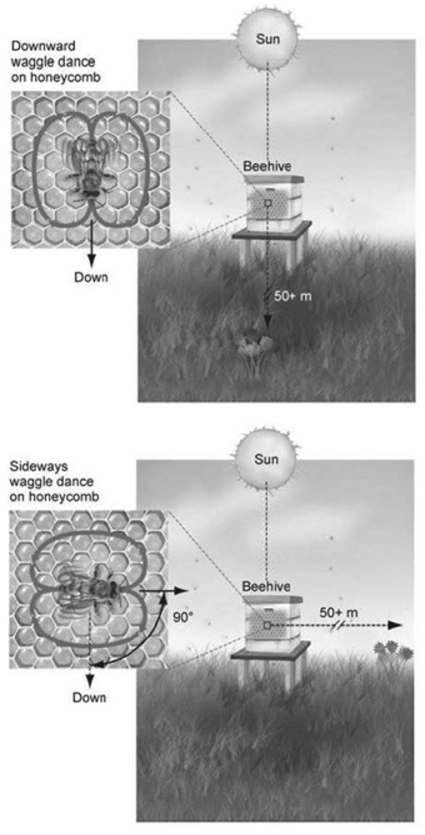 From the accompanying figure, what can we determine about the location of the food source?
 (Multiple Choice)
4.9/5 (84)
(84) In house sparrows (Passer domesticus) it is generally found that both males and females care for the eggs and young. However, some male house sparrows do not provide parental care. In addition, it is known that young that receive parental care from both the male and female are more likely to survive to fledging (leaving the nest). Which of the following activities by males that do NOT provide parental care would represent the most beneficial trade-off for the reduced survival of their offspring?
(Multiple Choice)
4.8/5 (88)
(88) The proximate causes of behavior are interactions with the environment, but behavior is ultimately shaped by ________.
(Multiple Choice)
4.8/5 (75)
(75) The accompanying graph shows data collected to test the hypothesis that the dewlap extension and the push-up displays of Anolis lizards play a role in sexual selection. Given this data, what can you conclude? 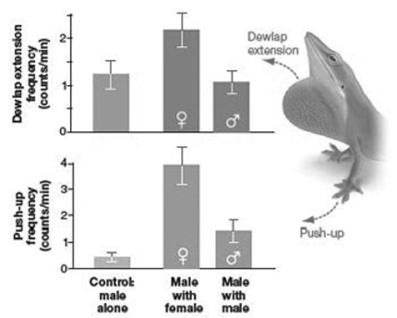
(Multiple Choice)
4.7/5 (75)
(75) A lizard's bobbing dewlap (a colorful flap of skin hanging from an Anolis lizard's throat) is an example of a(n) ________.
(Multiple Choice)
4.7/5 (75)
(75) 
Filters
- Essay(0)
- Multiple Choice(0)
- Short Answer(0)
- True False(0)
- Matching(0)