



 Chat with AI
Exam 51: Population Ecology

Exam 1: Biology and the Tree of Life37 Questions
Exam 2: Water and Carbon: the Chemical Basis of Life59 Questions
Exam 3: Protein Structure and Function59 Questions
Exam 4: Nucleic Acids and the Rna World43 Questions
Exam 5: An Introduction to Carbohydrates44 Questions
Exam 53: Ecosystems and Global Ecology57 Questions
Exam 6: Lipids, Membranes, and the First Cells59 Questions
Exam 7: Inside the Cell60 Questions
Exam 8: Energy and Enzymes: an Introduction to Metabolism60 Questions
Exam 9: Cellular Respiration and Fermentation61 Questions
Exam 10: Photosynthesis58 Questions
Exam 11: Cellcell Interactions52 Questions
Exam 12: The Cell Cycle59 Questions
Exam 13: Meiosis63 Questions
Exam 14: Mendel and the Gene60 Questions
Exam 15: Dna and the Gene: Synthesis and Repair51 Questions
Exam 16: How Genes Work48 Questions
Exam 17: Transcription, Rna Processing, and Translation58 Questions
Exam 18: Control of Gene Expression in Bacteria29 Questions
Exam 19: Control of Gene Expression in Eukaryotes56 Questions
Exam 20: The Molecular Revolution: Biotechnology and Beyond70 Questions
Exam 21: Genes, Development, and Evolution38 Questions
Exam 22: Evolution by Natural Selection38 Questions
Exam 23: Evolutionary Processes37 Questions
Exam 24: Speciation56 Questions
Exam 25: Phylogenies and the History of Life63 Questions
Exam 26: Bacteria and Archaea38 Questions
Exam 27: Protists37 Questions
Exam 28: Green Algae and Land Plants59 Questions
Exam 29: Fungi47 Questions
Exam 30: An Introduction to Animals48 Questions
Exam 31: Protostome Animals54 Questions
Exam 32: Deuterostome Animals60 Questions
Exam 33: Viruses44 Questions
Exam 34: Plant Form and Function46 Questions
Exam 35: Water and Sugar Transport in Plants47 Questions
Exam 36: Plant Nutrition54 Questions
Exam 37: Plant Sensory Systems, Signals, and Responses48 Questions
Exam 38: Plant Reproduction and Development51 Questions
Exam 39: Animal Form and Function53 Questions
Exam 40: Water and Electrolyte Balance in Animals60 Questions
Exam 41: Animal Nutrition94 Questions
Exam 42: Gas Exchange and Circulation93 Questions
Exam 43: Animal Nervous Systems100 Questions
Exam 44: Animal Sensory Systems50 Questions
Exam 45: Animal Movement40 Questions
Exam 46: Chemical Signals in Animals59 Questions
Exam 47: Animal Reproduction and Development104 Questions
Exam 48: The Immune System in Animals77 Questions
Exam 49: An Introduction to Ecology40 Questions
Exam 50: Behavioral Ecology40 Questions
Exam 51: Population Ecology57 Questions
Exam 52: Community Ecology55 Questions
Exam 54: Biodiversity and Conservation Biology43 Questions
Select questions type


You observe two female fish of the same species breeding. One female lays 100 eggs and the other female lays 1000 eggs. Which one of the following is LEAST likely given the limits of fitness trade-offs?
(Multiple Choice)
4.9/5  (78)
(78) Which of the following statements regarding the future of populations in developing countries are correct?
I. The fecundity is predicted to increase.
II. Survivorship will increase.
III. Overall population size will increase dramatically.
IV. The number of offspring each year is predicted to remain high.
(Multiple Choice)
4.9/5 (76)
(76) 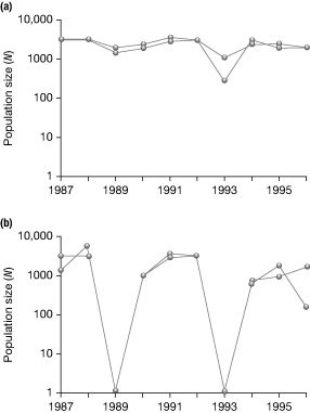 Graph (b) in the accompanying figure shows the normal fluctuations of a population of grouse. Assuming graph (a) in the figure is the result of some experimental treatment in the grouse population, what can be concluded?
 (Multiple Choice)
4.8/5 (89)
(89) 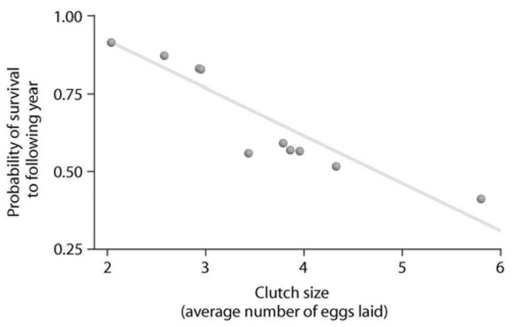 Looking at the data in the accompanying figure, what can be said about survival and clutch size?
 (Multiple Choice)
4.9/5 (93)
(93) Natural selection involves energetic trade-offs between ________.
(Multiple Choice)
4.9/5 (89)
(89) What cannot be determined from examining age pyramids of human populations?
(Multiple Choice)
4.8/5 (74)
(74) Conservationists will take snow geese off the endangered species list when the population hits 10,000. If populations are sustaining growth at r = 0.088 and the population in 2001 is 3000 individuals, in what year will snow geese be taken off the endangered species list?
(Multiple Choice)
4.9/5 (75)
(75) 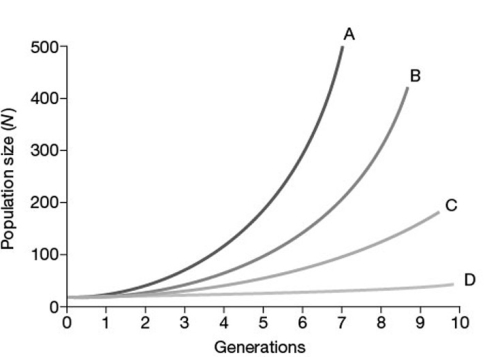 -In the accompanying figure, which of the lines represents exponential growth?
 (Multiple Choice)
4.9/5 (98)
(98) What is the primary limiting factor that determines why no female animal can produce a very large number of very large eggs?
(Multiple Choice)
4.9/5 (69)
(69) Imagine that you are managing a large game ranch. You know from historical accounts that a species of deer used to live there, but they have been extirpated. After doing some research to determine what might be an appropriately sized founding population, you reintroduce them. You then watch the population increase for several generations, and graph the number of individuals (vertical axis) against the number of generations (horizontal axis). With no natural predators impacting the population, the graph will likely appear as ________.
(Multiple Choice)
4.8/5 (89)
(89) Use the survivorship curves in the accompanying figure to answer the following questions. 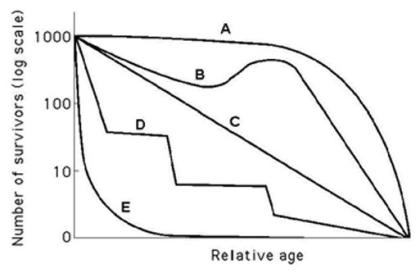 Referring to the figure, which curve best describes survivorship in elephants?
 (Multiple Choice)
4.8/5 (74)
(74) Which of the following groups would be most likely to exhibit uniform dispersion?
(Multiple Choice)
4.9/5 (82)
(82) A population is correctly defined as having which of the following characteristics?
I. inhabiting the same general area
II. belonging to the same species
III. possessing a constant and uniform density and dispersion
(Multiple Choice)
4.9/5 (82)
(82) Which of the following terms defines how the individual organism allocates resources to growth, reproduction, and activities or structures related to survival?
(Multiple Choice)
4.9/5 (87)
(87) 
Filters
- Essay(0)
- Multiple Choice(0)
- Short Answer(0)
- True False(0)
- Matching(0)