



 Chat with AI
Exam 53: Ecosystems and Global Ecology

Exam 1: Biology and the Tree of Life37 Questions
Exam 2: Water and Carbon: the Chemical Basis of Life59 Questions
Exam 3: Protein Structure and Function59 Questions
Exam 4: Nucleic Acids and the Rna World43 Questions
Exam 5: An Introduction to Carbohydrates44 Questions
Exam 53: Ecosystems and Global Ecology57 Questions
Exam 6: Lipids, Membranes, and the First Cells59 Questions
Exam 7: Inside the Cell60 Questions
Exam 8: Energy and Enzymes: an Introduction to Metabolism60 Questions
Exam 9: Cellular Respiration and Fermentation61 Questions
Exam 10: Photosynthesis58 Questions
Exam 11: Cellcell Interactions52 Questions
Exam 12: The Cell Cycle59 Questions
Exam 13: Meiosis63 Questions
Exam 14: Mendel and the Gene60 Questions
Exam 15: Dna and the Gene: Synthesis and Repair51 Questions
Exam 16: How Genes Work48 Questions
Exam 17: Transcription, Rna Processing, and Translation58 Questions
Exam 18: Control of Gene Expression in Bacteria29 Questions
Exam 19: Control of Gene Expression in Eukaryotes56 Questions
Exam 20: The Molecular Revolution: Biotechnology and Beyond70 Questions
Exam 21: Genes, Development, and Evolution38 Questions
Exam 22: Evolution by Natural Selection38 Questions
Exam 23: Evolutionary Processes37 Questions
Exam 24: Speciation56 Questions
Exam 25: Phylogenies and the History of Life63 Questions
Exam 26: Bacteria and Archaea38 Questions
Exam 27: Protists37 Questions
Exam 28: Green Algae and Land Plants59 Questions
Exam 29: Fungi47 Questions
Exam 30: An Introduction to Animals48 Questions
Exam 31: Protostome Animals54 Questions
Exam 32: Deuterostome Animals60 Questions
Exam 33: Viruses44 Questions
Exam 34: Plant Form and Function46 Questions
Exam 35: Water and Sugar Transport in Plants47 Questions
Exam 36: Plant Nutrition54 Questions
Exam 37: Plant Sensory Systems, Signals, and Responses48 Questions
Exam 38: Plant Reproduction and Development51 Questions
Exam 39: Animal Form and Function53 Questions
Exam 40: Water and Electrolyte Balance in Animals60 Questions
Exam 41: Animal Nutrition94 Questions
Exam 42: Gas Exchange and Circulation93 Questions
Exam 43: Animal Nervous Systems100 Questions
Exam 44: Animal Sensory Systems50 Questions
Exam 45: Animal Movement40 Questions
Exam 46: Chemical Signals in Animals59 Questions
Exam 47: Animal Reproduction and Development104 Questions
Exam 48: The Immune System in Animals77 Questions
Exam 49: An Introduction to Ecology40 Questions
Exam 50: Behavioral Ecology40 Questions
Exam 51: Population Ecology57 Questions
Exam 52: Community Ecology55 Questions
Exam 54: Biodiversity and Conservation Biology43 Questions
Select questions type


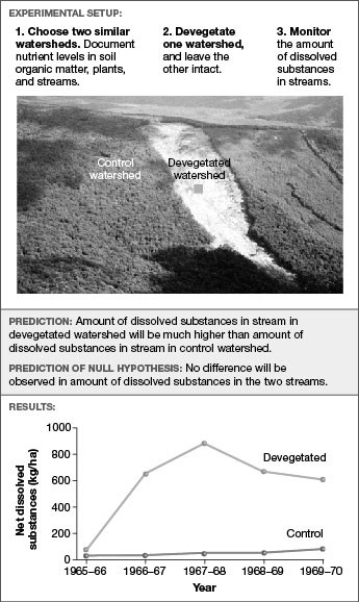 -Based on the experiment in the accompanying figure, which of the following are plausible reasons for the result?
I. No nutrients evaporate now that vegetation is absent.
II. Nutrients dissolve in the water running through the watershed.
III. Nutrients are attached to small particles of sand or clay that leave the watershed.
IV. Plant roots that held soil particles in place are no longer there.
-Based on the experiment in the accompanying figure, which of the following are plausible reasons for the result?
I. No nutrients evaporate now that vegetation is absent.
II. Nutrients dissolve in the water running through the watershed.
III. Nutrients are attached to small particles of sand or clay that leave the watershed.
IV. Plant roots that held soil particles in place are no longer there. (Multiple Choice)
4.9/5  (79)
(79) Use the following diagram of a hypothetical food web to answer the question(s) below. The arrows represent the transfer of energy between the various trophic levels. 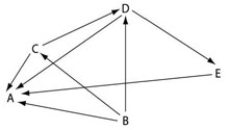 -Which letter represents an organism that could be a producer?
 (Multiple Choice)
4.8/5 (76)
(76) 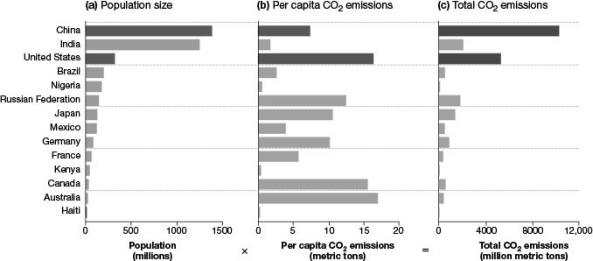 -In the accompanying figure, which of these countries has the highest per capita CO2 emissions?
 (Multiple Choice)
4.8/5 (75)
(75) Which of the following consume other living organisms?
I. primary producers
II. herbivores
III. carnivores
IV. decomposers
(Multiple Choice)
5.0/5 (69)
(69)
-Which of the following have contributed to the increase in the emission of CO2?
I. increases in human population
II. increases in per capita fossil-fuel use
III. land use changes
-Which of the following have contributed to the increase in the emission of CO2?
I. increases in human population
II. increases in per capita fossil-fuel use
III. land use changes (Multiple Choice)
4.8/5 (79)
(79) What factor could potentially increase the length of a food chain?
(Multiple Choice)
4.7/5 (82)
(82) Which of the following are TRUE about the greenhouse effect?
I. High-energy solar radiation enters the atmosphere.
II. Some of the energy is reflected, and some is absorbed by the Earth's surface.
III. Heat is emitted as infrared radiation, and some of it is retained in the atmosphere, decreasing the temperature on Earth.
(Multiple Choice)
4.9/5 (75)
(75) Why is terrestrial productivity higher in equatorial climates?
(Multiple Choice)
4.8/5 (86)
(86) Which of the following are negative biological consequences of climate change?
I. changes in geographic ranges
II. changes in phenology
III. extinctions
(Multiple Choice)
4.9/5 (84)
(84) Which of the following locations are large reservoirs for carbon for the carbon cycle?
I. atmosphere
II. sediments and sedimentary rocks
III. fossilized plant and animal remains (coal, oil, and natural gas)
IV. plant and animal biomass
(Multiple Choice)
5.0/5 (77)
(77) 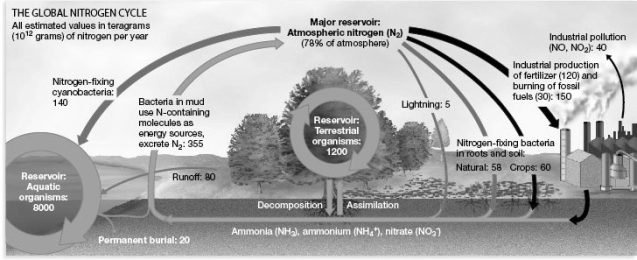 -Which of the following is a source of human-fixed nitrogen?
I. industrially produced fertilizers
II. cultivation of soybeans
III. irrigation agriculture
-Which of the following is a source of human-fixed nitrogen?
I. industrially produced fertilizers
II. cultivation of soybeans
III. irrigation agriculture (Multiple Choice)
4.9/5 (81)
(81) 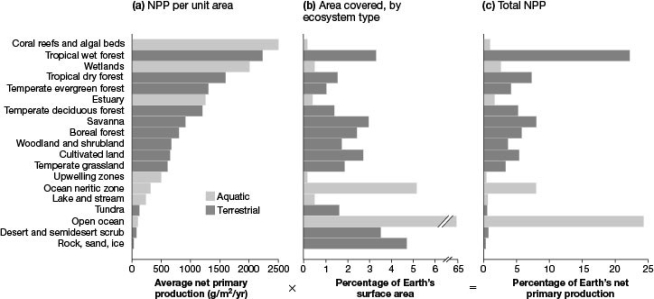 -Which habitat types in the accompanying figure cover the largest area?
 (Multiple Choice)
4.8/5 (86)
(86) Which of the following locations is the main reservoir for nitrogen in the nitrogen cycle?
(Multiple Choice)
4.7/5 (73)
(73) Which statement best describes what ultimately happens to the chemical energy that is NOT converted to new biomass in the process of energy transfer between trophic levels in an ecosystem?
(Multiple Choice)
4.8/5 (95)
(95)
-In the accompanying figure, which of these countries has the highest total CO2 emissions?
-In the accompanying figure, which of these countries has the highest total CO2 emissions? (Multiple Choice)
4.8/5 (84)
(84) In the nitrogen cycle, the bacteria that replenish the atmosphere with nitrogen are ________.
(Multiple Choice)
4.8/5 (81)
(81) Regarding soil and organic matter in humus, which of the following statements is TRUE?
(Multiple Choice)
4.9/5 (80)
(80) 
Filters
- Essay(0)
- Multiple Choice(0)
- Short Answer(0)
- True False(0)
- Matching(0)