



 Chat with AI
Exam 54: Biodiversity and Conservation Biology

Exam 1: Biology and the Tree of Life37 Questions
Exam 2: Water and Carbon: the Chemical Basis of Life59 Questions
Exam 3: Protein Structure and Function59 Questions
Exam 4: Nucleic Acids and the Rna World43 Questions
Exam 5: An Introduction to Carbohydrates44 Questions
Exam 53: Ecosystems and Global Ecology57 Questions
Exam 6: Lipids, Membranes, and the First Cells59 Questions
Exam 7: Inside the Cell60 Questions
Exam 8: Energy and Enzymes: an Introduction to Metabolism60 Questions
Exam 9: Cellular Respiration and Fermentation61 Questions
Exam 10: Photosynthesis58 Questions
Exam 11: Cellcell Interactions52 Questions
Exam 12: The Cell Cycle59 Questions
Exam 13: Meiosis63 Questions
Exam 14: Mendel and the Gene60 Questions
Exam 15: Dna and the Gene: Synthesis and Repair51 Questions
Exam 16: How Genes Work48 Questions
Exam 17: Transcription, Rna Processing, and Translation58 Questions
Exam 18: Control of Gene Expression in Bacteria29 Questions
Exam 19: Control of Gene Expression in Eukaryotes56 Questions
Exam 20: The Molecular Revolution: Biotechnology and Beyond70 Questions
Exam 21: Genes, Development, and Evolution38 Questions
Exam 22: Evolution by Natural Selection38 Questions
Exam 23: Evolutionary Processes37 Questions
Exam 24: Speciation56 Questions
Exam 25: Phylogenies and the History of Life63 Questions
Exam 26: Bacteria and Archaea38 Questions
Exam 27: Protists37 Questions
Exam 28: Green Algae and Land Plants59 Questions
Exam 29: Fungi47 Questions
Exam 30: An Introduction to Animals48 Questions
Exam 31: Protostome Animals54 Questions
Exam 32: Deuterostome Animals60 Questions
Exam 33: Viruses44 Questions
Exam 34: Plant Form and Function46 Questions
Exam 35: Water and Sugar Transport in Plants47 Questions
Exam 36: Plant Nutrition54 Questions
Exam 37: Plant Sensory Systems, Signals, and Responses48 Questions
Exam 38: Plant Reproduction and Development51 Questions
Exam 39: Animal Form and Function53 Questions
Exam 40: Water and Electrolyte Balance in Animals60 Questions
Exam 41: Animal Nutrition94 Questions
Exam 42: Gas Exchange and Circulation93 Questions
Exam 43: Animal Nervous Systems100 Questions
Exam 44: Animal Sensory Systems50 Questions
Exam 45: Animal Movement40 Questions
Exam 46: Chemical Signals in Animals59 Questions
Exam 47: Animal Reproduction and Development104 Questions
Exam 48: The Immune System in Animals77 Questions
Exam 49: An Introduction to Ecology40 Questions
Exam 50: Behavioral Ecology40 Questions
Exam 51: Population Ecology57 Questions
Exam 52: Community Ecology55 Questions
Exam 54: Biodiversity and Conservation Biology43 Questions
Select questions type


Which of the following is a cultural service of ecosystems?
(Multiple Choice)
4.7/5  (77)
(77) A land developer and several ecologists are discussing how a parcel of private land should be developed while saving 20 hectares as natural habitat. The land developer suggests that the 20 hectares be divided into twenty separate 1-hectare areas. The ecologists suggest that it would be better to have one intact parcel of 20 hectares. What is the significance of these different arrangements of the 20 hectares?
(Multiple Choice)
4.9/5 (80)
(80) 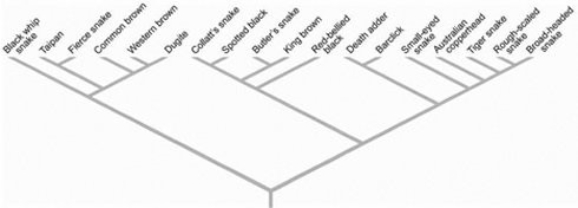 -Based on the accompanying figure, what snake antivenom would you administer to a person bitten by a king brown snake if king brown snake antivenom were not available?
 (Multiple Choice)
4.8/5 (68)
(68) Philippe Bouchet and colleagues conducted a massive survey of marine mollusks on the west coast of New Caledonia. Twenty percent of the species found had only a single specimen collected. What does that suggest about the diversity of mollusks in this area?
(Multiple Choice)
4.8/5 (99)
(99) 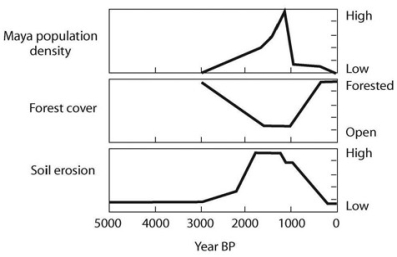 Copyright © 2003 American Institute of Biological Sciences. (Foster, D. R., F. Swanson, J. Aber, D. Tilman, N. Brokaw, I. Burke, and A. Knapp. 2003. The importance of land-use and its legacies to ecology and environmental management. BioScience 53:77-88.)
Based on the accompanying figure, what can you conclude about the history of land use in the southern Yucatán?
Copyright © 2003 American Institute of Biological Sciences. (Foster, D. R., F. Swanson, J. Aber, D. Tilman, N. Brokaw, I. Burke, and A. Knapp. 2003. The importance of land-use and its legacies to ecology and environmental management. BioScience 53:77-88.)
Based on the accompanying figure, what can you conclude about the history of land use in the southern Yucatán? (Multiple Choice)
4.9/5 (84)
(84) Erwin and Scott used an insecticidal fog to knock down insects from the top of a L. seemannii tree. The researchers identified over 900 species of beetles among the individuals that fell. Erwin also projected that this entire tree is host to about 600 arthropod species unique to this tree species. There are approximately 50,000 species of tropical trees. Although it could not be entirely accurate, what would be the best way to estimate the total number of arthropod species?
(Multiple Choice)
4.9/5 (83)
(83) According to most conservation biologists, the single greatest threat to global biodiversity is ________.
(Multiple Choice)
4.8/5 (85)
(85)
-By knowing the interrelatedness of various snake species, the appropriate antivenom can be chosen. Based on the accompanying figure, which snake antivenom would you administer to a person bitten by an Australian copperhead, if antivenom to the Australian copperhead were not available?
-By knowing the interrelatedness of various snake species, the appropriate antivenom can be chosen. Based on the accompanying figure, which snake antivenom would you administer to a person bitten by an Australian copperhead, if antivenom to the Australian copperhead were not available? (Multiple Choice)
4.8/5 (68)
(68) What is TRUE concerning the high consumption of fossil fuels?
(Multiple Choice)
4.8/5 (84)
(84) Which of the following criteria have to be met for a species to qualify as invasive?
(Multiple Choice)
4.9/5 (71)
(71) Which of the following is a regulating service of ecosystems?
(Multiple Choice)
4.8/5 (75)
(75) 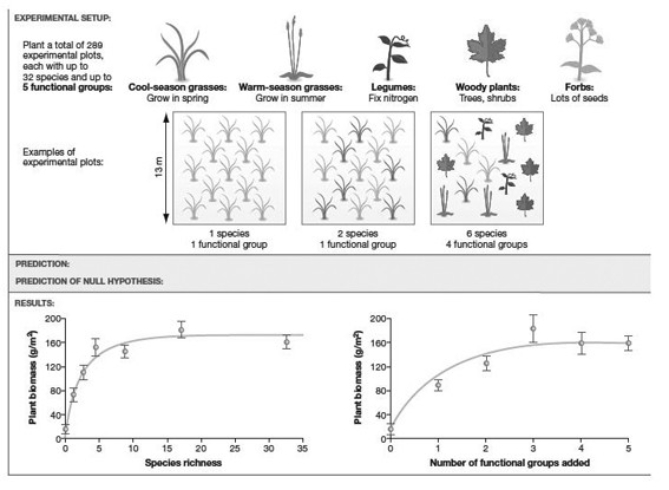 -Use the accompanying figure to answer this question: What two variables were manipulated?
 (Multiple Choice)
4.8/5 (78)
(78) If all individuals in the last remaining population of a particular bird species were all highly related, which type of diversity would be of greatest concern when planning to keep the species from going extinct?
I. genetic diversity
II. species diversity
III. ecosystem diversity
(Multiple Choice)
4.9/5 (80)
(80) The introduction of the Burmese python by pet owners in Florida has resulted in ________.
(Multiple Choice)
4.9/5 (88)
(88) With regard to the destruction of tropical forests, the focus is often on biodiversity and the impact on these ecosystems. What is a direct benefit to humans that helps explain why these forests need to be preserved?
(Multiple Choice)
4.8/5 (84)
(84) Relatively small geographic areas with high concentrations of endemic species and a large number of endangered and threatened species are known as ________.
(Multiple Choice)
4.8/5 (77)
(77) 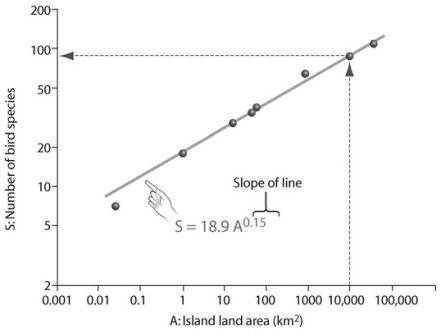 -Based on the species-area plot in the accompanying figure, if habitable area on an island were reduced from 10,000 km2 (square kilometers) to 1000 km2, roughly what percentage of the species would disappear?
 (Multiple Choice)
4.8/5 (83)
(83)
-In looking at the species-area plot in the accompanying figure, what can be concluded?
-In looking at the species-area plot in the accompanying figure, what can be concluded? (Multiple Choice)
4.8/5 (79)
(79) 
Filters
- Essay(0)
- Multiple Choice(0)
- Short Answer(0)
- True False(0)
- Matching(0)