



 Chat with AI
Exam 8: Energy and Enzymes: an Introduction to Metabolism

Exam 1: Biology and the Tree of Life37 Questions
Exam 2: Water and Carbon: the Chemical Basis of Life59 Questions
Exam 3: Protein Structure and Function59 Questions
Exam 4: Nucleic Acids and the Rna World43 Questions
Exam 5: An Introduction to Carbohydrates44 Questions
Exam 53: Ecosystems and Global Ecology57 Questions
Exam 6: Lipids, Membranes, and the First Cells59 Questions
Exam 7: Inside the Cell60 Questions
Exam 8: Energy and Enzymes: an Introduction to Metabolism60 Questions
Exam 9: Cellular Respiration and Fermentation61 Questions
Exam 10: Photosynthesis58 Questions
Exam 11: Cellcell Interactions52 Questions
Exam 12: The Cell Cycle59 Questions
Exam 13: Meiosis63 Questions
Exam 14: Mendel and the Gene60 Questions
Exam 15: Dna and the Gene: Synthesis and Repair51 Questions
Exam 16: How Genes Work48 Questions
Exam 17: Transcription, Rna Processing, and Translation58 Questions
Exam 18: Control of Gene Expression in Bacteria29 Questions
Exam 19: Control of Gene Expression in Eukaryotes56 Questions
Exam 20: The Molecular Revolution: Biotechnology and Beyond70 Questions
Exam 21: Genes, Development, and Evolution38 Questions
Exam 22: Evolution by Natural Selection38 Questions
Exam 23: Evolutionary Processes37 Questions
Exam 24: Speciation56 Questions
Exam 25: Phylogenies and the History of Life63 Questions
Exam 26: Bacteria and Archaea38 Questions
Exam 27: Protists37 Questions
Exam 28: Green Algae and Land Plants59 Questions
Exam 29: Fungi47 Questions
Exam 30: An Introduction to Animals48 Questions
Exam 31: Protostome Animals54 Questions
Exam 32: Deuterostome Animals60 Questions
Exam 33: Viruses44 Questions
Exam 34: Plant Form and Function46 Questions
Exam 35: Water and Sugar Transport in Plants47 Questions
Exam 36: Plant Nutrition54 Questions
Exam 37: Plant Sensory Systems, Signals, and Responses48 Questions
Exam 38: Plant Reproduction and Development51 Questions
Exam 39: Animal Form and Function53 Questions
Exam 40: Water and Electrolyte Balance in Animals60 Questions
Exam 41: Animal Nutrition94 Questions
Exam 42: Gas Exchange and Circulation93 Questions
Exam 43: Animal Nervous Systems100 Questions
Exam 44: Animal Sensory Systems50 Questions
Exam 45: Animal Movement40 Questions
Exam 46: Chemical Signals in Animals59 Questions
Exam 47: Animal Reproduction and Development104 Questions
Exam 48: The Immune System in Animals77 Questions
Exam 49: An Introduction to Ecology40 Questions
Exam 50: Behavioral Ecology40 Questions
Exam 51: Population Ecology57 Questions
Exam 52: Community Ecology55 Questions
Exam 54: Biodiversity and Conservation Biology43 Questions
Select questions type


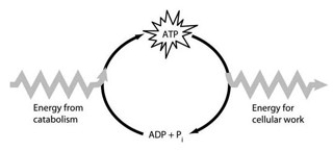 -Which of the following is the most correct interpretation of the accompanying figure?
 (Multiple Choice)
4.7/5  (72)
(72) A noncompetitive inhibitor decreases the rate of an enzyme reaction by ________.
(Multiple Choice)
4.9/5 (86)
(86) How might a change of one amino acid at a site, distant from the active site of an enzyme, alter an enzyme's substrate specificity?
(Multiple Choice)
4.9/5 (86)
(86) When ATP releases some energy, it also releases inorganic phosphate. What happens to the inorganic phosphate in the cell?
(Multiple Choice)
4.8/5 (76)
(76) For living organisms, which of the following is an important consequence of the first law of thermodynamics?
(Multiple Choice)
4.8/5 (89)
(89) Mutations that result in a single amino acid substitution in an enzyme ________.
(Multiple Choice)
5.0/5 (83)
(83) Reactants capable of interacting to form products in a chemical reaction must first overcome a thermodynamic barrier known as the reaction's ________.
(Multiple Choice)
4.8/5 (91)
(91) 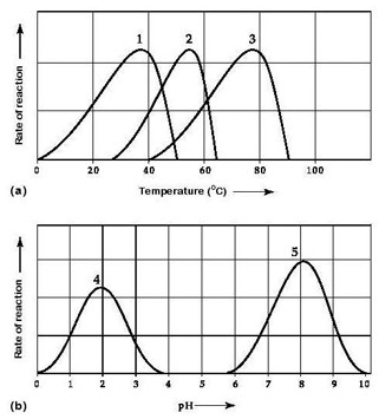 Activity of various enzymes at various temperatures (a) and at various pH (b).
-Which curves on the accompanying graphs may represent the temperature and pH profiles of an enzyme taken from a bacterium that lives in a mildly alkaline hot springs at temperatures of 70°C or higher?
Activity of various enzymes at various temperatures (a) and at various pH (b).
-Which curves on the accompanying graphs may represent the temperature and pH profiles of an enzyme taken from a bacterium that lives in a mildly alkaline hot springs at temperatures of 70°C or higher? (Multiple Choice)
5.0/5 (71)
(71) The following question(s) are based on the reaction A + B ↔ C + D shown in the accompanying figure. 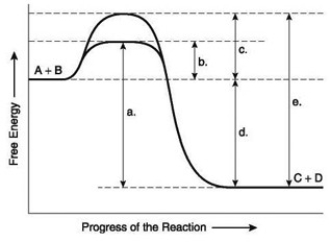 -Which of the following represents the ΔG of the reaction in the figure?
 (Multiple Choice)
4.9/5 (70)
(70) Which of the following is a statement of the first law of thermodynamics?
(Multiple Choice)
4.9/5 (83)
(83) Activity of various enzymes at various temperatures (a) and at various pH (b).
-Which temperature and pH profile curves on the graphs were most likely generated from analysis of an enzyme from a human stomach where conditions are strongly acid?
Activity of various enzymes at various temperatures (a) and at various pH (b).
-Which temperature and pH profile curves on the graphs were most likely generated from analysis of an enzyme from a human stomach where conditions are strongly acid? (Multiple Choice)
5.0/5 (71)
(71) Which of the following statements is representative of the second law of thermodynamics?
(Multiple Choice)
4.8/5 (74)
(74) The lock-and-key analogy for enzymes applies to the specificity of enzymes ________.
(Multiple Choice)
4.9/5 (89)
(89)
-Which of the following is TRUE when comparing an uncatalyzed reaction to the same reaction with a catalyst?
-Which of the following is TRUE when comparing an uncatalyzed reaction to the same reaction with a catalyst? (Multiple Choice)
4.9/5 (82)
(82) Biological evolution of life on Earth, from simple prokaryote-like cells to large, multicellular eukaryotic organisms, ________.
(Multiple Choice)
4.8/5 (76)
(76) 
Filters
- Essay(0)
- Multiple Choice(0)
- Short Answer(0)
- True False(0)
- Matching(0)