



 Chat with AI
Exam 9: Cellular Respiration and Fermentation

Exam 1: Biology and the Tree of Life37 Questions
Exam 2: Water and Carbon: the Chemical Basis of Life59 Questions
Exam 3: Protein Structure and Function59 Questions
Exam 4: Nucleic Acids and the Rna World43 Questions
Exam 5: An Introduction to Carbohydrates44 Questions
Exam 53: Ecosystems and Global Ecology57 Questions
Exam 6: Lipids, Membranes, and the First Cells59 Questions
Exam 7: Inside the Cell60 Questions
Exam 8: Energy and Enzymes: an Introduction to Metabolism60 Questions
Exam 9: Cellular Respiration and Fermentation61 Questions
Exam 10: Photosynthesis58 Questions
Exam 11: Cellcell Interactions52 Questions
Exam 12: The Cell Cycle59 Questions
Exam 13: Meiosis63 Questions
Exam 14: Mendel and the Gene60 Questions
Exam 15: Dna and the Gene: Synthesis and Repair51 Questions
Exam 16: How Genes Work48 Questions
Exam 17: Transcription, Rna Processing, and Translation58 Questions
Exam 18: Control of Gene Expression in Bacteria29 Questions
Exam 19: Control of Gene Expression in Eukaryotes56 Questions
Exam 20: The Molecular Revolution: Biotechnology and Beyond70 Questions
Exam 21: Genes, Development, and Evolution38 Questions
Exam 22: Evolution by Natural Selection38 Questions
Exam 23: Evolutionary Processes37 Questions
Exam 24: Speciation56 Questions
Exam 25: Phylogenies and the History of Life63 Questions
Exam 26: Bacteria and Archaea38 Questions
Exam 27: Protists37 Questions
Exam 28: Green Algae and Land Plants59 Questions
Exam 29: Fungi47 Questions
Exam 30: An Introduction to Animals48 Questions
Exam 31: Protostome Animals54 Questions
Exam 32: Deuterostome Animals60 Questions
Exam 33: Viruses44 Questions
Exam 34: Plant Form and Function46 Questions
Exam 35: Water and Sugar Transport in Plants47 Questions
Exam 36: Plant Nutrition54 Questions
Exam 37: Plant Sensory Systems, Signals, and Responses48 Questions
Exam 38: Plant Reproduction and Development51 Questions
Exam 39: Animal Form and Function53 Questions
Exam 40: Water and Electrolyte Balance in Animals60 Questions
Exam 41: Animal Nutrition94 Questions
Exam 42: Gas Exchange and Circulation93 Questions
Exam 43: Animal Nervous Systems100 Questions
Exam 44: Animal Sensory Systems50 Questions
Exam 45: Animal Movement40 Questions
Exam 46: Chemical Signals in Animals59 Questions
Exam 47: Animal Reproduction and Development104 Questions
Exam 48: The Immune System in Animals77 Questions
Exam 49: An Introduction to Ecology40 Questions
Exam 50: Behavioral Ecology40 Questions
Exam 51: Population Ecology57 Questions
Exam 52: Community Ecology55 Questions
Exam 54: Biodiversity and Conservation Biology43 Questions
Select questions type


Which kind of metabolic poison would most directly interfere with glycolysis?
(Multiple Choice)
4.9/5  (86)
(86) Why is glycolysis considered to be one of the first metabolic pathways to have evolved?
(Multiple Choice)
4.8/5 (76)
(76) Which of the following occurs in the cytosol of a eukaryotic cell?
(Multiple Choice)
5.0/5 (84)
(84) The final electron acceptor of the electron transport chain that functions in aerobic oxidative phosphorylation is ________.
(Multiple Choice)
4.8/5 (86)
(86) What kind of molecules serve as electron acceptors in cellular respiration?
(Multiple Choice)
4.7/5 (76)
(76) The oxygen consumed during cellular respiration is involved directly in which process or event?
(Multiple Choice)
4.9/5 (76)
(76) What is the major adaptive advantage of cellular respiration?
(Multiple Choice)
4.9/5 (75)
(75) Use the accompanying figure to answer the question(s) below. 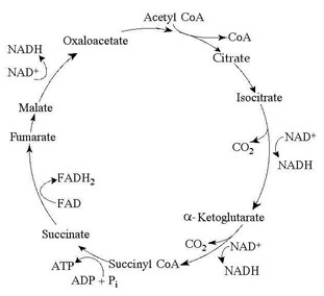 -Starting with citrate, which of the following combinations of products would result from three acetyl-CoA molecules entering the citric acid cycle (see the accompanying figure)?
 (Multiple Choice)
4.7/5 (80)
(80) The primary role of oxygen in cellular respiration is to ________.
(Multiple Choice)
4.8/5 (77)
(77) If you were to add one of the eight citric acid cycle intermediates to the culture medium of yeast growing in the laboratory, what do you think would happen to the rates of ATP and carbon dioxide production?
(Multiple Choice)
4.8/5 (75)
(75) What is the term for metabolic pathways that release stored energy by breaking down complex molecules?
(Multiple Choice)
5.0/5 (71)
(71) Use the following information to answer the question(s) below.
Exposing inner mitochondrial membranes to ultrasonic vibrations will disrupt the membranes. However, the fragments will reseal "inside out." The little vesicles that result can still transfer electrons from NADH to oxygen and synthesize ATP.
-These inside-out membrane vesicles will ________.
(Multiple Choice)
4.9/5 (77)
(77) Canine phosphofructokinase (PFK) deficiency afflicts Springer spaniels, affecting an estimated 10 percent of the breed. Given its critical role in glycolysis, one implication of the genetic defect resulting in PFK deficiency in dogs is ________.
(Multiple Choice)
4.8/5 (86)
(86) C6H12O6 (glucose) + 6 O2 → 6 CO2 + 6 H2O
Where is most of the water in this reaction produced?
(Multiple Choice)
4.9/5 (81)
(81) Carbon dioxide (CO2) is released during which of the following stages of cellular respiration?
(Multiple Choice)
4.9/5 (86)
(86) Phosphofructokinase is an allosteric enzyme that catalyzes the conversion of fructose 6-phosphate to fructose 1,6-bisphosphate, an early step of glycolysis. In the presence of oxygen, an increase in the amount of ATP in a cell would be expected to ________.
(Multiple Choice)
4.8/5 (74)
(74) When a glucose molecule loses a hydrogen atom as the result of an oxidation-reduction reaction, the molecule becomes ________.
(Multiple Choice)
4.9/5 (82)
(82) Chemiosmotic ATP synthesis (oxidative phosphorylation) occurs in ________.
(Multiple Choice)
4.9/5 (74)
(74) The molecule that functions as the reducing agent (electron donor) in a redox or oxidation-reduction reaction ________.
(Multiple Choice)
4.9/5 (80)
(80) 
Filters
- Essay(0)
- Multiple Choice(0)
- Short Answer(0)
- True False(0)
- Matching(0)