



 Chat with AI
Exam 10: Earthquakes and Earth's Interior

Exam 1: An Introduction to Geology and Plate Tectonics198 Questions
Exam 2: Minerals: The Building Blocks of Rocks185 Questions
Exam 3: Igneous Rocks190 Questions
Exam 4: Volcanoes and Volcanic Processes155 Questions
Exam 5: Weathering and Soil157 Questions
Exam 6: Sedimentary Rocks234 Questions
Exam 7: Metamorphism and Metamorphic Rocks143 Questions
Exam 8: Geologic Time143 Questions
Exam 9: Crustal Deformation145 Questions
Exam 10: Earthquakes and Earth's Interior185 Questions
Exam 11: The Ocean Floor172 Questions
Exam 12: Plate Tectonics: The Framework for Modern Geology162 Questions
Exam 13: Mountain Building and Continental Frameworks161 Questions
Exam 14: Mass Wasting: The Work of Gravity131 Questions
Exam 15: Running Water139 Questions
Exam 16: Groundwater159 Questions
Exam 17: Glaciers and Glaciation183 Questions
Exam 18: Deserts and Winds132 Questions
Exam 19: Shorelines153 Questions
Exam 20: Mineral and Energy Resources159 Questions
Select questions type


Just before a major earthquake, locked portions of major faults exhibit a period of fault creep.
(True/False)
4.8/5  (91)
(91) During the 1906 San Francisco earthquake, fire destroyed many buildings that were otherwise undamaged or only slightly damaged by the ground shaking.
(True/False)
4.9/5 (73)
(73) Is the average earthquake intensity along the oceanic ridge system stronger or weaker than along the circum-Pacific belt? Is it because the crust is thinner and warmer or more brittle?
(Short Answer)
4.8/5 (79)
(79) Examine the words and/or phrases for each question below and determine the relationship among the majority of words/phrases.
-Choose the option that does not fit the pattern.
(Multiple Choice)
4.9/5 (85)
(85) Solid, simple, traditional stone or brick and mortar buildings generally withstand earthquake shaking because they are so massive and strong.
(True/False)
4.8/5 (69)
(69) On a typical seismogram, ________ will show the highest amplitudes.
(Multiple Choice)
4.8/5 (91)
(91) ________ first recognized the seismic discontinuity between the inner and outer cores.
(Multiple Choice)
4.9/5 (87)
(87) Why was building damage so extensive in the 1985 Mexico City quake?
(Multiple Choice)
4.9/5 (74)
(74) Approximately how much more energy is released in a 6.5 Richter magnitude earthquake than in one with magnitude 5.5?
(Multiple Choice)
4.9/5 (76)
(76) What acoustic phenomenon causes the shadow zone for P-wave arrivals at epicentral angles between 100° and 140°?
(Multiple Choice)
4.9/5 (68)
(68) How was the Turnagain Heights area of Anchorage, Alaska, damaged during the 1964 earthquake?
(Multiple Choice)
4.7/5 (93)
(93) Which one of the following statements concerning P waves is true?
(Multiple Choice)
4.8/5 (75)
(75) The Milankovitch discontinuity separates Earth's mantle and outer core.
(True/False)
4.7/5 (75)
(75) What amplitude would a ML6.0 earthquake with a 50 sec S-P arrival difference show on a seismogram?
(Multiple Choice)
4.9/5 (88)
(88) As determined by dated sedimentary evidence in west coast marshes, there have been at least 13 great "Megathrust" earthquakes on the Cascadia Subduction Zone during the past 6000 years.
(True/False)
4.8/5 (81)
(81) What is the belt where seismic waves are blocked by the outer core in the diagram below?
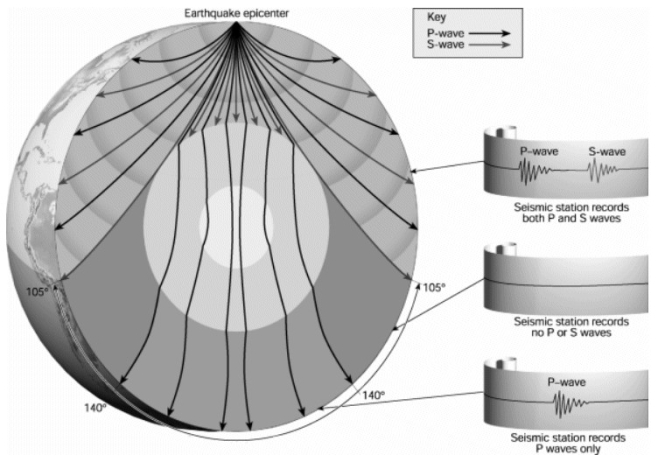
(Short Answer)
4.9/5 (88)
(88) What characterizes P-wave arrivals on the far side of the Earth at epicentral angles beyond 140°?
(Multiple Choice)
4.9/5 (78)
(78) What is the main reason that ray paths of seismic waves are curved like dipping arcs, rather than proceeding along the straightest, shortest path as they pass through the whole earth?
(Multiple Choice)
4.7/5 (86)
(86) 
Filters
- Essay(0)
- Multiple Choice(0)
- Short Answer(0)
- True False(0)
- Matching(0)