



 Chat with AI
Exam 6: Sedimentary Rocks

Exam 1: An Introduction to Geology and Plate Tectonics198 Questions
Exam 2: Minerals: The Building Blocks of Rocks185 Questions
Exam 3: Igneous Rocks190 Questions
Exam 4: Volcanoes and Volcanic Processes155 Questions
Exam 5: Weathering and Soil157 Questions
Exam 6: Sedimentary Rocks234 Questions
Exam 7: Metamorphism and Metamorphic Rocks143 Questions
Exam 8: Geologic Time143 Questions
Exam 9: Crustal Deformation145 Questions
Exam 10: Earthquakes and Earth's Interior185 Questions
Exam 11: The Ocean Floor172 Questions
Exam 12: Plate Tectonics: The Framework for Modern Geology162 Questions
Exam 13: Mountain Building and Continental Frameworks161 Questions
Exam 14: Mass Wasting: The Work of Gravity131 Questions
Exam 15: Running Water139 Questions
Exam 16: Groundwater159 Questions
Exam 17: Glaciers and Glaciation183 Questions
Exam 18: Deserts and Winds132 Questions
Exam 19: Shorelines153 Questions
Exam 20: Mineral and Energy Resources159 Questions
Select questions type


Fill in the missing sediment names on the following table.
Table 7.1 Particle Size Classification for Dentrital Rocks Size Range (millimeters) Particle Name Common Sediment Name Dentrital Rock <256 Boulder 64-256 Cobble Conglomerate 4-64 Pebble or breccia 2-4 Granule 1/16-2 Sand Sandstone 1/256-1/16 Silt Shale, mudstone or <1/256 Clay siltstone
(Short Answer)
4.8/5  (83)
(83) Flint, jasper, and travertine are microcrystalline forms of calcite.
(True/False)
4.8/5 (74)
(74) What are the chemical, physical and biologic changes called, that happen to sediments as they transform into sedimentary rocks ?
(Short Answer)
4.8/5 (53)
(53) Which characteristic is absolutely necessary for a sedimentary rock to have potential as a possible reservoir rock for oil or gas?
(Multiple Choice)
4.9/5 (83)
(83) What two important pieces of geologic information are principally contained in sedimentary rocks?
(Essay)
4.8/5 (89)
(89) A sedimentary deposit of angular rock fragments larger than "pea sized" would be called ________.
(Short Answer)
4.9/5 (71)
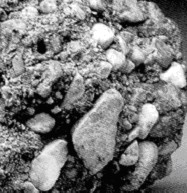
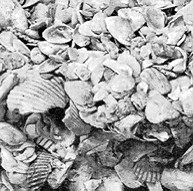
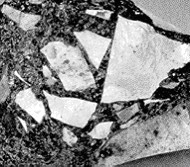
(71) Carefully observe each of the photographs below of sedimentary rocks.To the right of each sample, name the rock and describe its origin (how it formed).
a)______________________________
 b)______________________________
 c)______________________________
b)______________________________
c)______________________________
(Short Answer)
4.8/5 (90)
(90) Examine the words and/or phrases for each question below and determine the relationship among the majority of words/phrases.
-Choose the option that does not fit the pattern.
(Multiple Choice)
4.8/5 (83)
(83) Which of the following organisms would have used pebble- to cobble-sized gastroliths?
(Multiple Choice)
4.8/5 (90)
(90) Examine the words and/or phrases for each question below and determine the relationship among the majority of words/phrases.
-Choose the option that does not fit the pattern.
(Multiple Choice)
4.9/5 (90)
(90) The study of depositional environments in sedimentary rocks is critical to understanding Earth's history.What features or characteristics of sedimentary rocks are unique to particular environments? What features are found in a variety of environments and are therefore less definitive for interpreting paleoenvironments?
(Essay)
4.8/5 (88)
(88) What are the three, most common, cementing agents for sandstones?
(Short Answer)
4.8/5 (85)
(85) What do dense crystalline rocks and shales have in common?
(Multiple Choice)
5.0/5 (86)
(86) How are sedimentary environments categorized or distinguished from each other?
(Short Answer)
4.8/5 (81)
(81) 
Filters
- Essay(0)
- Multiple Choice(0)
- Short Answer(0)
- True False(0)
- Matching(0)