



 Chat with AI
Exam 36: Relativity

Exam 1: Units, Physical Quantities, and Vectors107 Questions
Exam 2: Motion Along a Straight Line59 Questions
Exam 3: Motion in Two or Three Dimensions50 Questions
Exam 4: Newtons Laws of Motion44 Questions
Exam 5: Applying Newtons Laws95 Questions
Exam 6: Work and Kinetic Energy54 Questions
Exam 7: Potential Energy and Energy Conservation55 Questions
Exam 8: Momentum, Impulse, and Collisions50 Questions
Exam 9: Rotation of Rigid Bodies26 Questions
Exam 10: Equilibrium and Elasticity50 Questions
Exam 11: Fluid Mechanics50 Questions
Exam 12: Gravitation50 Questions
Exam 13: Periodic Motion50 Questions
Exam 14: Mechanical Waves44 Questions
Exam 15: Sound and Hearing66 Questions
Exam 16: Temperature and Heat63 Questions
Exam 17: Thermal Properties of Matter58 Questions
Exam 18: The First Law of Thermodynamics52 Questions
Exam 19: The Second Law of Thermodynamics50 Questions
Exam 20: Electric Charge and Electric Field58 Questions
Exam 21: Gausss Law41 Questions
Exam 22: Electric Potential55 Questions
Exam 23: Capacitance and Dielectrics52 Questions
Exam 24: Current, Resistance, and Electromotive Force50 Questions
Exam 25: Direct-Current Circuits53 Questions
Exam 26: Magnetic Field and Magnetic Forces36 Questions
Exam 27: Sources of Magnetic Field51 Questions
Exam 28: Electromagnetic Induction39 Questions
Exam 29: Inductance26 Questions
Exam 30: Alternating Current49 Questions
Exam 31: Electromagnetic Waves47 Questions
Exam 32: The Nature and Propagation of Light28 Questions
Exam 33: Geometric Optics81 Questions
Exam 34: Interference33 Questions
Exam 35: Diffraction49 Questions
Exam 36: Relativity51 Questions
Exam 37: Photons: Light Waves Behaving As Particles38 Questions
Exam 38: Particles Behaving As Waves52 Questions
Exam 39: Quantum Mechanics40 Questions
Exam 40: Atomic Structure41 Questions
Exam 41: Molecules and Condensed Matter31 Questions
Exam 42: Nuclear Physics89 Questions
Exam 43: Particle Physics and Cosmology44 Questions
Select questions type


The captain of spaceship A observes enemy spaceship E escaping with a relative velocity of 0.48c, as shown in the figure. A missile M is fired from ship A, with a velocity of 0.72c relative to ship A. What is the relative velocity of approach of missile M, observed by the crew on ship E? 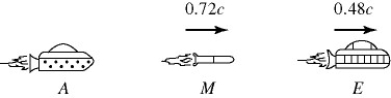
(Multiple Choice)
4.8/5  (89)
(89) An unstable particle is moving at a speed of 2.6 × 10⁸ m/s relative to a laboratory. Its lifetime is measured by a stationary observer in the laboratory to be 4.7 × 10⁻⁶ seconds. What is the lifetime of the particle, measured in the rest frame of the particle? (c = 3.00 × 10⁸ m/s)
(Short Answer)
4.8/5 (78)
(78) Two spaceships are approaching one another, each at a speed of 0.28c relative to a stationary observer on Earth. What speed does an observer on one spaceship record for the other approaching spaceship?
(Short Answer)
4.8/5 (74)
(74) An electron is accelerated from rest through a potential difference of 50.0 kV. What is the speed of the electron? (c = 3.00 × 10⁸ m/s, e = 1.60 × 10⁻¹⁹ C, mel = 9.11 × 10⁻³¹ kg)
(Multiple Choice)
4.9/5 (75)
(75) A rocket is moving at 1/4 the speed of light relative to Earth. At the center of this rocket, a light suddenly flashes. To an observer at rest on Earth
(Multiple Choice)
5.0/5 (65)
(65) A spaceship is moving away from the earth with a constant speed of 0.80c. The spaceship fires a 28-kg missile with a speed of 0.50c relative to the spaceship. What is the speed of the missile measured by observers on the earth if the missile is fired
(a) away from the earth?
(b) toward the earth?
(Short Answer)
4.8/5 (80)
(80) A particle is moving at 0.75c relative to a lab on Earth. By what percentage is the Newtonian expression for its momentum in error? (The percentage error is the difference between the erroneous and correct values, divided by the correct one).
(Multiple Choice)
4.8/5 (70)
(70) Astronaut Mark Uri is space-traveling from planet X to planet Y at a speed of 0.65c relative to the planets, which are at rest relative to each other. When he is precisely halfway between the planets, a distance of 1.0 light-hour from each one as measured in the planet frame, nuclear devices are detonated on both planets. The explosions are simultaneous in Mark's frame. What is the difference in the time of arrival of the flashes from the explosions as observed by Mark?
(Multiple Choice)
4.9/5 (72)
(72) System Sʹ has a velocity u = +0.56c relative to system S, as shown in the figure. The clocks of S and Sʹ are synchronized at t = tʹ = 0 when the origins O and Oʹ coincide. An event is observed in both systems. The event takes place at x = 800 m and at time t = 3.0 μs as measured by an observer in S. What is the time tʹ of the event, measured by an observer in Sʹ? 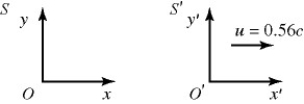
(Multiple Choice)
4.9/5 (82)
(82) Three spaceships A, B, and C are in motion, as shown in the figure. The commander on ship B observes ship C approaching with a relative velocity of 0.78c. The commander also observes ship A, advancing in the rear, with a relative velocity of 0.31c. What is the velocity of ship C, relative to an observer on ship A? 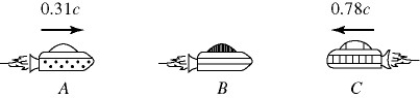
(Multiple Choice)
5.0/5 (68)
(68) You are a passenger on a spaceship. As the speed of the spaceship increases, you would observe that
(Multiple Choice)
4.8/5 (74)
(74) 
Filters
- Essay(0)
- Multiple Choice(0)
- Short Answer(0)
- True False(0)
- Matching(0)