



 Chat with AI
Exam 29: Inductance

Exam 1: Units, Physical Quantities, and Vectors107 Questions
Exam 2: Motion Along a Straight Line59 Questions
Exam 3: Motion in Two or Three Dimensions50 Questions
Exam 4: Newtons Laws of Motion44 Questions
Exam 5: Applying Newtons Laws95 Questions
Exam 6: Work and Kinetic Energy54 Questions
Exam 7: Potential Energy and Energy Conservation55 Questions
Exam 8: Momentum, Impulse, and Collisions50 Questions
Exam 9: Rotation of Rigid Bodies26 Questions
Exam 10: Equilibrium and Elasticity50 Questions
Exam 11: Fluid Mechanics50 Questions
Exam 12: Gravitation50 Questions
Exam 13: Periodic Motion50 Questions
Exam 14: Mechanical Waves44 Questions
Exam 15: Sound and Hearing66 Questions
Exam 16: Temperature and Heat63 Questions
Exam 17: Thermal Properties of Matter58 Questions
Exam 18: The First Law of Thermodynamics52 Questions
Exam 19: The Second Law of Thermodynamics50 Questions
Exam 20: Electric Charge and Electric Field58 Questions
Exam 21: Gausss Law41 Questions
Exam 22: Electric Potential55 Questions
Exam 23: Capacitance and Dielectrics52 Questions
Exam 24: Current, Resistance, and Electromotive Force50 Questions
Exam 25: Direct-Current Circuits53 Questions
Exam 26: Magnetic Field and Magnetic Forces36 Questions
Exam 27: Sources of Magnetic Field51 Questions
Exam 28: Electromagnetic Induction39 Questions
Exam 29: Inductance26 Questions
Exam 30: Alternating Current49 Questions
Exam 31: Electromagnetic Waves47 Questions
Exam 32: The Nature and Propagation of Light28 Questions
Exam 33: Geometric Optics81 Questions
Exam 34: Interference33 Questions
Exam 35: Diffraction49 Questions
Exam 36: Relativity51 Questions
Exam 37: Photons: Light Waves Behaving As Particles38 Questions
Exam 38: Particles Behaving As Waves52 Questions
Exam 39: Quantum Mechanics40 Questions
Exam 40: Atomic Structure41 Questions
Exam 41: Molecules and Condensed Matter31 Questions
Exam 42: Nuclear Physics89 Questions
Exam 43: Particle Physics and Cosmology44 Questions
Select questions type


For the circuit shown in the figure, the inductors have no appreciable resistance and the switch has been open for a very long time. 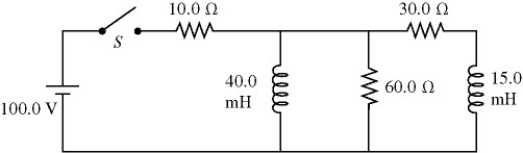 (a) The instant after closing the switch, what is the current through the 60.0-Ω resistor?
(b) The instant after closing the switch, what is the potential difference across the 15.0-mH inductor?
(c) After the switch has been closed and left closed for a very long time, what is the potential drop across the 60.0-Ω resistor?
(a) The instant after closing the switch, what is the current through the 60.0-Ω resistor?
(b) The instant after closing the switch, what is the potential difference across the 15.0-mH inductor?
(c) After the switch has been closed and left closed for a very long time, what is the potential drop across the 60.0-Ω resistor?
Free
(Short Answer)
4.8/5  (88)
(88) Correct Answer: Verified
(a) 1.43 A
(b) 85.7 V
(c) 0.00 V
An ideal solenoid is 18.5 cm long, has a circular cross-section 2.20 cm in diameter, and contains 545 equally spaced thin windings. This solenoid is connected in a series circuit with an open switch, a 15.0-Ω resistor, and a battery of internal resistance 5.00 Ω and open-circuit terminal voltage of 25.0 V. (μ0 = 4π × 10-7 T ∙ m/A)
(a) What is the maximum amount of energy that the solenoid will store after closing the switch?
(b) How long after closing the switch will it take for the stored energy in the solenoid to reach one-half of its maximum value?
Free
(Short Answer)
4.8/5 (67)
(67) Correct Answer:Verified
Verified(a) 0.599 mJ
(b) 47.1 µs
What is the self-inductance of a solenoid 30.0 cm long having 100 turns of wire and a cross-sectional area of 1.00 × 10⁻⁴ m2? (μ0 = 4π × 10-7 T ∙ m/A)
Free
(Multiple Choice)
4.9/5 (67)
(67) Correct Answer:Verified
VerifiedC
The mutual inductance between two coils is 10.0 mH. The current in the first coil changes uniformly from 2.70 A to 5.00 A in 0.160 s. If the second coil has a resistance of 0.600 Ω, what is the magnitude of the induced current in the second coil?
(Short Answer)
4.7/5 (86)
(86) An LR circuit contains an ideal 60-V battery, a 42-H inductor having no resistance, a 24-Ω resistor, and a switch S, all in series. Initially, the switch is open and has been open for a very long time. At time t = 0 s, the switch is suddenly closed. How long after closing the switch will the potential difference across the inductor be 24 V?
(Multiple Choice)
4.7/5 (84)
(84) At a certain instant the current flowing through a 5.0-H inductor is 3.0 A. If the energy in the inductor at this instant is increasing at a rate of 3.0 J/s, how fast is the current changing?
(Multiple Choice)
4.8/5 (76)
(76) An LR circuit contains an ideal 60-V battery, a 51-H inductor having no resistance, a 21-Ω resistor, and a switch S, all in series. Initially, the switch is open and has been open for a very long time. At time t = 0 s, the switch is suddenly closed. When the voltage across the resistor is equal to the voltage across the inductor, what is the current in the circuit?
(Multiple Choice)
4.8/5 (74)
(74) A 45-mH ideal inductor is connected in series with a 60-Ω resistor through an ideal 15-V DC power supply and an open switch. If the switch is closed at time t = 0 s, what is the current 7.0 ms later?
(Multiple Choice)
4.8/5 (92)
(92) At what rate would the current in a 100-mH inductor have to change to induce an emf of 1000 V in the inductor?
(Multiple Choice)
4.8/5 (77)
(77) A solenoid of length 0.700 m having a circular cross-section of radius 5.00 cm stores 6.00 µJ of energy when a 0.400-A current runs through it. What is the winding density of the solenoid? (μ0 = 4π × 10-7 T ∙ m/A)
(Multiple Choice)
4.8/5 (82)
(82) In an LC circuit containing a 40-mH ideal inductor and a 1.2-mF capacitor, the maximum charge on the capacitor is 45 mC during the oscillations. What is the maximum current through the inductor during the oscillations?
(Multiple Choice)
4.8/5 (80)
(80) A 96-mH solenoid inductor is wound on a form 0.80 m in length and 0.10 m in diameter. A coil is tightly wound around the solenoid at its center. The coil's resistance is 9.9 ohms. The mutual inductance of the coil and solenoid is 31 μH. At a given instant, the current in the solenoid is 540 mA, and is decreasing at the rate of 2.5 A/s. At the given instant, what is the magnitude of the induced current in the coil? (μ0 = 4π × 10-7 T ∙ m/A)
(Multiple Choice)
4.8/5 (93)
(93) In the figure, the current in a solenoid having no appreciable resistance is flowing from b to a and is decreasing at a rate of 9.6 A/s. The self-induced emf in the solenoid is found to be 8.4 V.  (a) What is the self-inductance of the solenoid?
(b) Which point, a or b is at higher potential?
(a) What is the self-inductance of the solenoid?
(b) Which point, a or b is at higher potential? (Short Answer)
4.9/5 (69)
(69) What resistance should be added in series with a 3.0-H inductor to complete an LR circuit with a time constant of 4.0 ms?
(Multiple Choice)
4.8/5 (80)
(80) A charged capacitor is connected to an ideal inductor. At time t = 0, the charge on the capacitor is equal to 6.00 μC. At time t = 2.00 ms the charge on the capacitor is zero for the first time. What is the amplitude of the current at that same instant?
(Multiple Choice)
4.7/5 (78)
(78) A charged capacitor is connected to an ideal inductor to form an LC circuit with a frequency of oscillation f = 1.6 Hz. At time t = 0 the capacitor is fully charged. At a given instant later the charge on the capacitor is measured to be 3.0 μC and the current in the circuit is equal to 75 μA. What is the maximum charge of the capacitor?
(Multiple Choice)
4.9/5 (82)
(82) Consider the circuit shown in the figure. The battery has emf ε = 25 volts and negligible internal resistance. The inductance is L = 0.80 H and the resistances are R1 = 12 Ω and R2 = 9.0 Ω. Initially the switch S is open and no currents flow. Then the switch is closed. 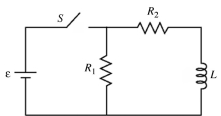 (a) What is the current in the resistor R1 just after the switch is closed?
(b) After leaving the switch closed for a very long time, it is opened again. Just after it is opened, what is the current in R1?
(a) What is the current in the resistor R1 just after the switch is closed?
(b) After leaving the switch closed for a very long time, it is opened again. Just after it is opened, what is the current in R1? (Short Answer)
4.7/5 (78)
(78) A series LR circuit contains an emf source of 14 V having no internal resistance, a resistor, a 34 H inductor having no appreciable resistance, and a switch. If the emf across the inductor is 80% of its maximum value 4.0 s after the switch is closed, what is the resistance of the resistor?
(Multiple Choice)
4.9/5 (73)
(73) An insulated wire of diameter 1.0 mm and negligible resistance is wrapped tightly around a cylindrical core of radius 5.0 cm and length 30 cm to build a solenoid. What is the energy stored in this solenoid when a current I = 0.20 A flows through it? (μ0 = 4π × 10-7 T ∙ m/A)
(Multiple Choice)
4.8/5 (82)
(82) A series LR circuit consists of a 2.0-H inductor with negligible internal resistance, a 100-ohm resistor, an open switch, and a 9.0-V ideal power source. After the switch is closed, what is the maximum power delivered by the power supply?
(Multiple Choice)
4.8/5 (82)
(82) 
Filters
- Essay(0)
- Multiple Choice(0)
- Short Answer(0)
- True False(0)
- Matching(0)