



 Chat with AI
Exam 29: Inductance

Exam 1: Units, Physical Quantities, and Vectors107 Questions
Exam 2: Motion Along a Straight Line59 Questions
Exam 3: Motion in Two or Three Dimensions50 Questions
Exam 4: Newtons Laws of Motion44 Questions
Exam 5: Applying Newtons Laws95 Questions
Exam 6: Work and Kinetic Energy54 Questions
Exam 7: Potential Energy and Energy Conservation55 Questions
Exam 8: Momentum, Impulse, and Collisions50 Questions
Exam 9: Rotation of Rigid Bodies26 Questions
Exam 10: Equilibrium and Elasticity50 Questions
Exam 11: Fluid Mechanics50 Questions
Exam 12: Gravitation50 Questions
Exam 13: Periodic Motion50 Questions
Exam 14: Mechanical Waves44 Questions
Exam 15: Sound and Hearing66 Questions
Exam 16: Temperature and Heat63 Questions
Exam 17: Thermal Properties of Matter58 Questions
Exam 18: The First Law of Thermodynamics52 Questions
Exam 19: The Second Law of Thermodynamics50 Questions
Exam 20: Electric Charge and Electric Field58 Questions
Exam 21: Gausss Law41 Questions
Exam 22: Electric Potential55 Questions
Exam 23: Capacitance and Dielectrics52 Questions
Exam 24: Current, Resistance, and Electromotive Force50 Questions
Exam 25: Direct-Current Circuits53 Questions
Exam 26: Magnetic Field and Magnetic Forces36 Questions
Exam 27: Sources of Magnetic Field51 Questions
Exam 28: Electromagnetic Induction39 Questions
Exam 29: Inductance26 Questions
Exam 30: Alternating Current49 Questions
Exam 31: Electromagnetic Waves47 Questions
Exam 32: The Nature and Propagation of Light28 Questions
Exam 33: Geometric Optics81 Questions
Exam 34: Interference33 Questions
Exam 35: Diffraction49 Questions
Exam 36: Relativity51 Questions
Exam 37: Photons: Light Waves Behaving As Particles38 Questions
Exam 38: Particles Behaving As Waves52 Questions
Exam 39: Quantum Mechanics40 Questions
Exam 40: Atomic Structure41 Questions
Exam 41: Molecules and Condensed Matter31 Questions
Exam 42: Nuclear Physics89 Questions
Exam 43: Particle Physics and Cosmology44 Questions
Select questions type


What is the energy density in the magnetic field 25 cm from a long straight wire carrying a current of 12 A? (μ0 = 4π × 10-7 T ∙ m/A)
(Multiple Choice)
4.7/5  (79)
(79) A series circuit consists of a 0.55-H inductor with internal resistance of 8.0 Ω connected in series with a 4.0-Ω resistor, an open switch, and an ideal 12-V battery.
(a) When the switch is closed, what is the initial current through the 4.0-Ω resistor?
(b) What is the current through the 4.0-Ω resistor a very long time after the switch is closed?
(Short Answer)
4.9/5 (83)
(83) An LC circuit consists of a 3.4-µF capacitor and a coil with a self-inductance 0.080 H and no appreciable resistance. At t = 0 the capacitor has a charge of 5.4 µC and the current in the inductor is zero.
(a) How long after t = 0 will the current in the circuit be maximum?
(b) What will be this maximum current?
(Short Answer)
4.9/5 (81)
(81) How much energy is stored in a room 3.0 m by 4.0 m by 2.4 m due to the earth's magnetic field with a strength of 5.0 × 10⁻⁵ T? (μ0 = 4π × 10-7 T ∙ m/A)
(Multiple Choice)
4.7/5 (68)
(68) For the circuit shown in the figure, the switch has been open for a very long time. 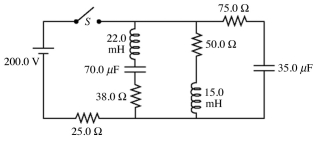 (a) What is the potential drop across the 15.0-mH inductor just after closing the switch?
(b) What is the potential drop across the 70.0-µF capacitor after the switch has been closed for a very long time?
(a) What is the potential drop across the 15.0-mH inductor just after closing the switch?
(b) What is the potential drop across the 70.0-µF capacitor after the switch has been closed for a very long time? (Short Answer)
4.8/5 (90)
(90) Which of the following statements about inductors are correct? There may be more than one correct choice.
(Multiple Choice)
4.8/5 (84)
(84) 
Filters
- Essay(0)
- Multiple Choice(0)
- Short Answer(0)
- True False(0)
- Matching(0)