



 Chat with AI
Exam 36: Relativity

Exam 1: Units, Physical Quantities, and Vectors107 Questions
Exam 2: Motion Along a Straight Line59 Questions
Exam 3: Motion in Two or Three Dimensions50 Questions
Exam 4: Newtons Laws of Motion44 Questions
Exam 5: Applying Newtons Laws95 Questions
Exam 6: Work and Kinetic Energy54 Questions
Exam 7: Potential Energy and Energy Conservation55 Questions
Exam 8: Momentum, Impulse, and Collisions50 Questions
Exam 9: Rotation of Rigid Bodies26 Questions
Exam 10: Equilibrium and Elasticity50 Questions
Exam 11: Fluid Mechanics50 Questions
Exam 12: Gravitation50 Questions
Exam 13: Periodic Motion50 Questions
Exam 14: Mechanical Waves44 Questions
Exam 15: Sound and Hearing66 Questions
Exam 16: Temperature and Heat63 Questions
Exam 17: Thermal Properties of Matter58 Questions
Exam 18: The First Law of Thermodynamics52 Questions
Exam 19: The Second Law of Thermodynamics50 Questions
Exam 20: Electric Charge and Electric Field58 Questions
Exam 21: Gausss Law41 Questions
Exam 22: Electric Potential55 Questions
Exam 23: Capacitance and Dielectrics52 Questions
Exam 24: Current, Resistance, and Electromotive Force50 Questions
Exam 25: Direct-Current Circuits53 Questions
Exam 26: Magnetic Field and Magnetic Forces36 Questions
Exam 27: Sources of Magnetic Field51 Questions
Exam 28: Electromagnetic Induction39 Questions
Exam 29: Inductance26 Questions
Exam 30: Alternating Current49 Questions
Exam 31: Electromagnetic Waves47 Questions
Exam 32: The Nature and Propagation of Light28 Questions
Exam 33: Geometric Optics81 Questions
Exam 34: Interference33 Questions
Exam 35: Diffraction49 Questions
Exam 36: Relativity51 Questions
Exam 37: Photons: Light Waves Behaving As Particles38 Questions
Exam 38: Particles Behaving As Waves52 Questions
Exam 39: Quantum Mechanics40 Questions
Exam 40: Atomic Structure41 Questions
Exam 41: Molecules and Condensed Matter31 Questions
Exam 42: Nuclear Physics89 Questions
Exam 43: Particle Physics and Cosmology44 Questions
Select questions type


Relative to the frame of the observer making the measurement, at what speed parallel to its length is the length of a meterstick 60 cm?
(Multiple Choice)
4.9/5  (70)
(70) A navigational beacon in deep space broadcasts at a radio frequency of 50 MHz. A spaceship approaches the beacon with a relative velocity of 0.40c. What is the frequency of the beacon radio signal that is detected on the ship?
(Multiple Choice)
4.7/5 (74)
(74) The special theory of relativity predicts that there is an upper limit to the speed of a particle. It therefore follows that there is also an upper limit on the following properties of a particle.
(Multiple Choice)
4.7/5 (84)
(84) In the lab, a relativistic proton has a momentum of 1.00 × 10⁻¹⁹ kg ∙ m/s and a rest energy of 0.150 nJ. What is the speed of the proton in the lab? (c = 3.00 × 10⁸ m/s, mproton = 1.67 × 10⁻²⁷ kg)
(Multiple Choice)
5.0/5 (72)
(72) As measured in Earth's rest frame, a spaceship traveling at 0.964c takes 11.2 y to travel between planets. How long does the trip take as measured by someone on the spaceship?
(Multiple Choice)
4.9/5 (84)
(84) An astronaut in an inertial reference frame measures a time interval Δt between her heartbeats. What will observers in all other inertial reference frames measure for the time interval between her heartbeats?
(Multiple Choice)
4.9/5 (63)
(63) A set of twins, Andrea and Courtney, are initially 10 years old. While Courtney remains on Earth, Andrea rides on a spaceship which travels away from Earth at a speed of 0.60c for five years (as measured by Courtney), then immediately turns around and comes back at 0.60c. When Andrea returns, Courtney is 20 years old. How old is Andrea upon her return?
(Multiple Choice)
4.9/5 (63)
(63) A particle in a 453 m-long linear particle accelerator is moving at 0.875c. How long does the particle accelerator appear to the particle?
(Multiple Choice)
4.8/5 (78)
(78) Astronaut Spud Nick is space-traveling from planet X to planet Y at a speed of 0.60c relative to the planets, which are at rest relative to each other. When he is precisely halfway between the planets, a distance of 1.0 light-hour from each one as measured in the planet frame, nuclear devices are detonated on each planet. The explosions are simultaneous in the frame of the planets. What is the difference in the time of arrival of the flashes from the explosions as observed by Spud?
(Multiple Choice)
4.9/5 (66)
(66) Consider three galaxies, Alpha, Beta and Gamma. An observer in Beta sees the other two galaxies each moving away from him in opposite directions at speed 0.70c. At what speed would an observer in Alpha see the galaxy Beta moving?
(Multiple Choice)
4.9/5 (70)
(70) A navigational beacon in deep space broadcasts at a radio frequency of 50 MHz. A spaceship approaches the beacon with a relative velocity of 0.40c. The spaceship passes the beacon and departs from it with a DIFFERENT relative velocity. The beacon signal is now detected at a frequency of 40 MHz. What is the new velocity of the spaceship relative to the beacon?
(Multiple Choice)
4.8/5 (86)
(86) Someone in Earth's rest frame says that a spaceship's trip between two planets took 10.0 y, while an astronaut on the space ship says that the trip took 6.27 y. Find the speed of the spaceship in terms of the speed of light.
(Multiple Choice)
4.9/5 (95)
(95) How much work must be done to accelerate a particle of mass 2.1 × 10⁻¹⁴ kg from a speed of 1.5 × 10⁸ m/s to a speed of 2.5 × 10⁸ m/s? (c = 3.00 × 10⁸ m/s)
(Short Answer)
4.7/5 (80)
(80) A proton in a certain particle accelerator has a kinetic energy that is equal to its rest energy. What is the momentum of the proton as measured by a physicist working with the accelerator? (c = 3.00 × 10⁸ m/s, mproton = 1.67 × 10⁻²⁷ kg)
(Multiple Choice)
4.9/5 (73)
(73) How many joules of energy are required to accelerate a 1.0-kg mass from rest to a speed of 86.6% the speed of light? (c = 3.00 × 10⁸ m/s)
(Multiple Choice)
5.0/5 (82)
(82) In an "atom smasher," two particles collide head on at relativistic speeds. If the velocity of the first particle is 0.741c to the left, and the velocity of the second particle is 0.35c to the right (both of these speeds are measured in Earth's rest frame), how fast are the particles moving with respect to each other?
(Multiple Choice)
4.8/5 (85)
(85) A spacecraft is measured by an observer on the ground to have a length of 53 m as it flies toward the earth with a speed 1.7 × 10⁸ m/s. The spacecraft then lands and its length is again measured by the observer on the ground, this time while the spacecraft is at rest on the launchpad. What result does he now get for the length? (c = 3.00 × 10⁸ m/s)
(Short Answer)
4.8/5 (80)
(80) A rocket is moving at 1/4 the speed of light relative to Earth. At the center of this rocket, a light suddenly flashes. To an observer at rest in the rocket
(Multiple Choice)
4.8/5 (83)
(83) At what speed relative to the lab will a 0.272-kg object have the same momentum as a 1.30-kg object that is moving at 0.515c relative to the lab?
(Multiple Choice)
4.8/5 (88)
(88) System Sʹ has a velocity u = +0.45c relative to system S, as shown in the figure. The clocks of S and Sʹ are synchronized at t = tʹ = 0 when the origins O and Oʹ coincide. An event is observed in both systems. The event takes place at x = 600 m and at time t = 1.9 μs, as measured by an observer in S. What is the xʹ-coordinate of the event, measured by an observer in Sʹ ? 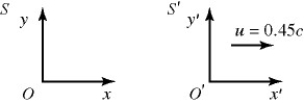
(Multiple Choice)
4.8/5 (89)
(89) 
Filters
- Essay(0)
- Multiple Choice(0)
- Short Answer(0)
- True False(0)
- Matching(0)