



 Chat with AI
Exam 5: Weathering and Soil

Exam 1: An Introduction to Geology and Plate Tectonics198 Questions
Exam 2: Minerals: The Building Blocks of Rocks185 Questions
Exam 3: Igneous Rocks190 Questions
Exam 4: Volcanoes and Volcanic Processes155 Questions
Exam 5: Weathering and Soil157 Questions
Exam 6: Sedimentary Rocks234 Questions
Exam 7: Metamorphism and Metamorphic Rocks143 Questions
Exam 8: Geologic Time143 Questions
Exam 9: Crustal Deformation145 Questions
Exam 10: Earthquakes and Earth's Interior185 Questions
Exam 11: The Ocean Floor172 Questions
Exam 12: Plate Tectonics: The Framework for Modern Geology162 Questions
Exam 13: Mountain Building and Continental Frameworks161 Questions
Exam 14: Mass Wasting: The Work of Gravity131 Questions
Exam 15: Running Water139 Questions
Exam 16: Groundwater159 Questions
Exam 17: Glaciers and Glaciation183 Questions
Exam 18: Deserts and Winds132 Questions
Exam 19: Shorelines153 Questions
Exam 20: Mineral and Energy Resources159 Questions
Select questions type


The soil material hardpan refers to a layer of highly compacted clay in the B soil horizon of some areas.
(True/False)
4.8/5  (70)
(70) Which one of the following statements is the best description of erosion?
(Multiple Choice)
4.8/5 (86)
(86) Mechanical weathering involves rock materials being broken into smaller particles.
(True/False)
4.9/5 (69)
(69) Give one example each for mechanical and chemical weathering directly attributed to biologic activity.
(Essay)
4.8/5 (85)
(85) Weathering generally accentuates the differences in minerals and rocks, serving to sculpt unusual shapes and spectacular landscapes.
(True/False)
4.8/5 (86)
(86) Humus is a concentration of decaying, organic matter in the B horizons of lateritic soils.
(True/False)
4.7/5 (84)
(84) What two chemical constituents cannot form by chemical weathering of the feldspar minerals alone?
(Multiple Choice)
4.9/5 (85)
(85) What mineral particles are the dominant colouring agents in reddish, brownish, and yellowish soils?
(Multiple Choice)
4.9/5 (66)
(66) Word Analysis Questions
Examine the words and/or phrases for each question below and determine the relationship among the majority of words/phrases.
-Choose the option that does not fit the pattern.
(Multiple Choice)
4.9/5 (83)
(83) Decomposition of pyrite is an important factor in generating acidic mine drainage.
(True/False)
4.9/5 (81)
(81) Clay minerals, silica (SiO?), and dissolved potassium bicarbonate in the soil water are products of which process?
(Multiple Choice)
4.9/5 (78)
(78) List the major processes that contribute to chemical weathering.
(Short Answer)
4.8/5 (84)
(84) Pedalfers form more readily than pedocals under conditions of low soil moisture content.
(True/False)
4.8/5 (72)
(72) Which term describes a soil formed by weathering of the underlying bedrock?
(Multiple Choice)
4.9/5 (70)
(70) What is the common soil formed in semi-arid grassland with alkali and salt tolerant plants as in SE Alberta and SW Saskatchewan?
(Multiple Choice)
4.9/5 (81)
(81) What is the term for the selective removal of softer or less stable portions of a rock?
(Short Answer)
4.8/5 (68)
(68) When did land plants first contribute to biologic weathering and soil formation?
(Essay)
4.9/5 (80)
(80) Carefully examine the illustration below and the features labeled A through D.
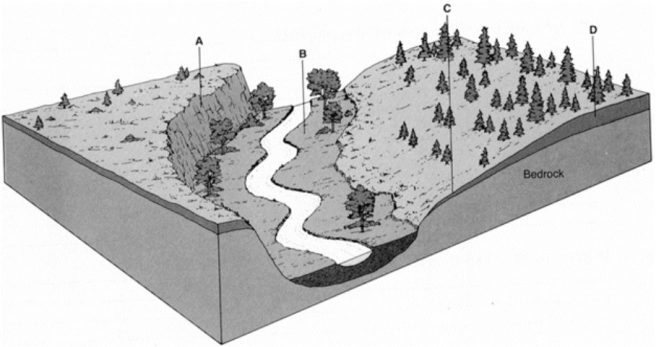 Give a letter (A, B, C, or D)for each answer below.Letters may be used more than once.
a)At which location would the thickest residual soil develop? ________
b)At which location would the greatest amount of frost wedging occur? ________
c)At which location would the thickest transported soil develop? ________
d)At which location would there be the most unconsolidated deposits? ________
Give a letter (A, B, C, or D)for each answer below.Letters may be used more than once.
a)At which location would the thickest residual soil develop? ________
b)At which location would the greatest amount of frost wedging occur? ________
c)At which location would the thickest transported soil develop? ________
d)At which location would there be the most unconsolidated deposits? ________ (Short Answer)
4.8/5 (83)
(83) The addition of a small amount of acidity dramatically increases rates of dissolution and chemical weathering.
(True/False)
5.0/5 (80)
(80) Removal of soluble chemical constituents from a soil is termed leaching.
(True/False)
5.0/5 (85)
(85) 
Filters
- Essay(0)
- Multiple Choice(0)
- Short Answer(0)
- True False(0)
- Matching(0)