



 Chat with AI
Exam 33: Geometric Optics

Exam 1: Units, Physical Quantities, and Vectors107 Questions
Exam 2: Motion Along a Straight Line59 Questions
Exam 3: Motion in Two or Three Dimensions50 Questions
Exam 4: Newtons Laws of Motion44 Questions
Exam 5: Applying Newtons Laws95 Questions
Exam 6: Work and Kinetic Energy54 Questions
Exam 7: Potential Energy and Energy Conservation55 Questions
Exam 8: Momentum, Impulse, and Collisions50 Questions
Exam 9: Rotation of Rigid Bodies26 Questions
Exam 10: Equilibrium and Elasticity50 Questions
Exam 11: Fluid Mechanics50 Questions
Exam 12: Gravitation50 Questions
Exam 13: Periodic Motion50 Questions
Exam 14: Mechanical Waves44 Questions
Exam 15: Sound and Hearing66 Questions
Exam 16: Temperature and Heat63 Questions
Exam 17: Thermal Properties of Matter58 Questions
Exam 18: The First Law of Thermodynamics52 Questions
Exam 19: The Second Law of Thermodynamics50 Questions
Exam 20: Electric Charge and Electric Field58 Questions
Exam 21: Gausss Law41 Questions
Exam 22: Electric Potential55 Questions
Exam 23: Capacitance and Dielectrics52 Questions
Exam 24: Current, Resistance, and Electromotive Force50 Questions
Exam 25: Direct-Current Circuits53 Questions
Exam 26: Magnetic Field and Magnetic Forces36 Questions
Exam 27: Sources of Magnetic Field51 Questions
Exam 28: Electromagnetic Induction39 Questions
Exam 29: Inductance26 Questions
Exam 30: Alternating Current49 Questions
Exam 31: Electromagnetic Waves47 Questions
Exam 32: The Nature and Propagation of Light28 Questions
Exam 33: Geometric Optics81 Questions
Exam 34: Interference33 Questions
Exam 35: Diffraction49 Questions
Exam 36: Relativity51 Questions
Exam 37: Photons: Light Waves Behaving As Particles38 Questions
Exam 38: Particles Behaving As Waves52 Questions
Exam 39: Quantum Mechanics40 Questions
Exam 40: Atomic Structure41 Questions
Exam 41: Molecules and Condensed Matter31 Questions
Exam 42: Nuclear Physics89 Questions
Exam 43: Particle Physics and Cosmology44 Questions
Select questions type


A person's eye lens is 2.7 cm away from the retina. This lens has a near point of 25 cm and a far point at infinity.
(a) What must the focal length of this lens be in order for an object placed at the near point of the eye to focus on the retina?
(b) What must the focal length of this lens be in order for an object placed at the far point of the eye to focus on the retina?
(Short Answer)
4.7/5  (83)
(83) A fisherman in a stream 39 cm deep looks downward into the water and sees a rock on the stream bed. How deep does the stream appear to the fisherman? The index of refraction of the water is 1.33.
(Multiple Choice)
4.9/5 (89)
(89) A magnifying glass uses a converging lens with a refractive power of 20 diopters. What is the magnification if the image is to be viewed by a relaxed eye (image at the far point) having a near point of 25 cm and a far point at infinity?
(Multiple Choice)
4.9/5 (82)
(82) The spherical side mirror on a car is convex and has a radius of curvature of 25 cm. Another car is following, 20 m behind the mirror. If the height of the car is 1.6 m, how tall is its image?
(Multiple Choice)
4.8/5 (81)
(81) The near point of a person's uncorrected eyes is 125.0 cm and the far point is at infinity. What is the focal length of a contact lens that will move the near point to 25.0 cm from this person's eyes?
(Multiple Choice)
5.0/5 (81)
(81) An optical system comprises in turn, from left to right: an observer, a lens of focal length +30 cm, an erect object 20 mm high, and a convex mirror of radius 80 cm. The object is between the lens and the mirror, 20 cm from the lens and 50 cm from the mirror. The observer views the image that is formed first by reflection and then by refraction. What is the position of the final image, measured from the mirror? 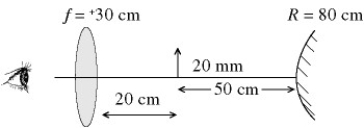
(Multiple Choice)
4.7/5 (77)
(77) The focal length of a thin lens is 40 mm and its aperture diameter is 10 mm. What is the f-number of this lens?
(Multiple Choice)
4.8/5 (69)
(69) A thin double convex lens is to focus the image of an object onto a screen so that the image is life-sized. The lens surfaces have equal radii of curvature of 112 cm, and the refractive index of the lens material is 1.500.
(a) How far from the lens should the screen be placed?
(b) How far is the screen from the object?
(Short Answer)
4.8/5 (81)
(81) A convex lens has a focal length f. An object is placed at a distance between f and 2f on a line perpendicular to the center of the lens. The image formed is located at what distance from the lens?
(Multiple Choice)
4.9/5 (86)
(86) Suppose you place your face in front of a concave mirror. Which one of the following statements is correct?
(Multiple Choice)
4.9/5 (78)
(78) An object is placed 10 cm from a convex lens of focal length 20 cm. What is the lateral magnification of the object?
(Multiple Choice)
4.9/5 (81)
(81) The eyepiece of a compound microscope has a focal length of 2.50 cm and the objective has a focal length of 1.60 cm. The two lenses are separated by 15.0 cm. The microscope is used by a person with normal eyes (near point at 25 cm). What is the angular magnification of the microscope?
(Multiple Choice)
5.0/5 (75)
(75) An object 4.0 cm in height is placed 8.0 cm in front of a concave spherical mirror with a focal length of 10.0 cm. What is the position of its image in relation to the mirror, and what are the characteristics of the image?
(Multiple Choice)
4.8/5 (89)
(89) An object is placed in front of a lens which forms an image of the object.
(Multiple Choice)
4.9/5 (79)
(79) The distance between the object and the eyepiece of a compound microscope is 25.0 cm. The focal length of its objective lens is 0.200 cm and the eyepiece has a focal length of 2.60 cm. A person with a near point of 25.0 cm and a far point at infinity is using the microscope.
(a) What is the angular magnification obtainable using the eyepiece alone as a magnifying lens if the final image is at the person's far point?
(b) What is the total magnification of the microscope when used by the person of normal eyesight?
(Short Answer)
4.9/5 (80)
(80) What is the focal length of the corrective contact lens needed by a nearsighted person whose far point is 60 cm?
(Multiple Choice)
4.8/5 (78)
(78) The left-hand end of a glass rod is ground to a spherical surface. The glass has index of refraction 1.50. A small object 4.00 mm tall is placed on the axis of the rod, 37.0 cm to the left of the vertex of the spherical surface. The image is formed in the rod, 50.0 cm to the right of the vertex.
(a) What is the magnitude of the radius of curvature of the spherical surface at the end of the rod?
(b) What is the height of the image?
(Short Answer)
4.8/5 (76)
(76) A concave spherical mirror with a radius of 20 cm creates a real image 30 cm from the mirror. How far is the object from the mirror?
(Multiple Choice)
4.9/5 (89)
(89) A convex lens has a focal length f. An object is placed between infinity and 2f from the lens along a line perpendicular to the center of the lens. The image is located at what distance from the lens?
(Multiple Choice)
4.7/5 (76)
(76) When an object 1.15 cm tall is placed 12 cm from a lens, the lens produces an upright image of the object that is 5.75 cm tall. What is the focal length of the lens?
(Multiple Choice)
4.9/5 (76)
(76) 
Filters
- Essay(0)
- Multiple Choice(0)
- Short Answer(0)
- True False(0)
- Matching(0)